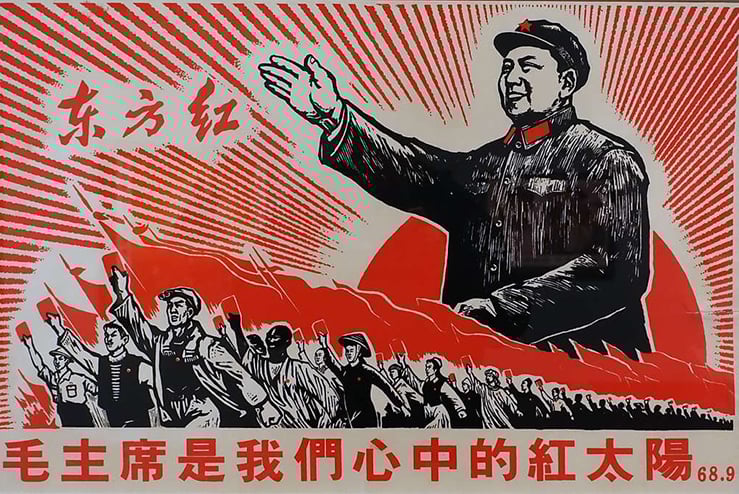
At the tail end of Mao’s Cultural Revolution (1966-1976), my father was teaching at a university in Xi’an, China. Viewed as a relic of bourgeois oppression of the proletarian class, the college entrance exam was canceled. Instead, candidates were evaluated by their level of class consciousness. Only the economically underprivileged could score high enough. Consequently, though the overwhelming majority of my father’s students had only an elementary to middle school education, their proletarian family backgrounds qualified them to study in college.
No one questioned this practice. When common sense was replaced by political correctness, critical thinking was not permitted. All one could do was to flow with the political tide.
Intellectuals like my father who had bourgeois backgrounds were labeled “stinking ninth ranks,” a low caste in society. Typically, they dressed themselves in plain and sloppy clothes as a self-imposed effort to eradicate the bourgeois influence in them, demonstrating their repentance. Some even wore clothes with patches, virtue signaling their solidarity with the proletariat.
I never saw my father complain—nor did I detect a desire for change in him. Like most people, he simply accepted his lot in life and tried to make the best of it.
Books were confiscated and burned. Even though I grew up in an intellectual environment, I recall seeing only a few books that were not written by Karl Marx, Fredrick Engels, Vladimir Lenin, or Mao. Pursuing knowledge apart from Marxism was deemed a bourgeois pastime. The only path to improving one’s social status was through achieving a higher level of class consciousness. For people like my father, that path never really existed. Nevertheless my parents nurtured aspirations that their daughter might achieve some upward mobility. I overheard my mother conversing with a friend once expressing her desire that one day I might become a factory worker, something she regarded as a significant social advancement for a daughter of a stinking ninth rank.
At a young age, I was able to discern people’s family background by observing their behavior. A swagger with a rude attitude was a proud display of one’s proletarian origins. Those like my father dared not show any self-assertiveness. As a daughter of a “stinking ninth rank,” I could sense my disadvantaged position in society. It never occurred to me that life could be otherwise. I thought I had a normal life, regretting only that luck had not visited our family as it had others.
Then overnight, an earthshaking event took place—the Cultural Revolution abruptly ended in October 1976. Soon after, the Chinese Communist Party (CCP) under the leadership of Deng Xiaoping reinstated the annual college entrance exam in 1977. It was a paradigm shift, symbolizing the end of an era centered around the concept of class struggle and class consciousness. For the first time since the CCP came to power in 1949, one’s economic status ceased to be the determining factor in one’s advancement. It was replaced by a merit-based system that put young people’s destinies mostly back into their own hands.
Even from a child’s perspective, the change was drastic. Formerly, I had never seen a queue of people standing outside the bookstore—not far from our apartment—waiting to purchase books. But many books were now available for the first time in 10 years. A family friend, walking out of the store and holding a copy of a poorly printed algebra book, shouted with excitement as if he had won some extraordinary prize. Within my own family, the changes were also palpable. My father began to hold his head high and walk with broad strides. His students, now admitted through a vigorous college entrance exam, began frequenting our apartment, asking questions, and seeking advice from the professor who had been despised and shunned just a few years before. Those with a proletarian background, who formerly had thrown their weight around, also began making swift adjustments, ceasing to be so arrogant and domineering.
These experiences during and after the Cultural Revolution left a deep impression on my young mind, as if my life was carried away in sequence by two tides going in different directions.
The startling differences in people’s thoughts and behaviors during and after the Cultural Revolution might reflexively be attributed to the high-handed totalitarian regime that used power to bend the people’s will. Upon reflection, however, I would argue, the contrary. It was the culture—a mighty tide—that exerted the ultimate influence. Mao shrewdly understood that culture was more potent than military force. Long before the Cultural Revolution, Mao and the CCP had strategically and systematically made moves to eradicate traditional Chinese culture and replace it with a Marxist socialist ideology.
Soon after taking power in 1949, the Party launched the nationwide political campaign called Thought Reform. Through the state-controlled media, Mao promoted novel political terms and expressions he coined, such as, “class struggle,” “thought struggle,” “thought reform” and “ideological remolding of the liberated.” This brainwashing movement successfully paved the road for the subsequent political campaigns—Suppressing Counterrevolutionaries, Three-Anti/Five-Anti, Anti-Rightist, Anti-Right Deviation, Socialist Education and so forth.
All of Mao’s movements relied on Marxist central doctrine, the class struggle between the oppressor and the oppressed, pitting one group against another. This practice had proven enormously effective. In the new environment, an individual could be found guilty by virtue of belonging to the condemned group. By creating the new culture, Mao was able to manipulate people to think and act within the Marxist cultural framework. This is how he was able to get intellectuals like my father to sincerely loathe their bourgeois upbringing and seek out opportunities to demonstrate repentance.
In traditional Chinese culture, filial piety is viewed as the peak virtue. Yet, Mao, knew that once the Marxist socialist culture took root, even a practice that formerly had been considered appalling could become a new norm. So by the early 1960s, he was able to persuade young students to publicly denounce their parents, an act that violated the most sacred precept in Chinese culture.
Without firing a single shot, Mao thus fundamentally transformed the thoughts and behavior of every Chinese—a feat no military force could have accomplished. Although technically the Cultural Revolution was from 1966 to 1976, in reality, it started immediately after the CCP seized power in 1949. The formal Cultural Revolution was just Mao’s mass campaign attempting to consolidate and secure his power within the CCP. In this effort he mobilized young students to wage class struggle by spreading violence and chaos throughout society.
The Cultural Revolution resulted in 2 million deaths, a poverty-stricken economy, the disintegration of families and termination of education and became the darkest period in Chinese history. Yet, without the more than decade-long methodical endeavor to eliminate Chinese culture and piecemeal transformation of China into a Marxist socialist culture, Mao could not have achieved what he did. Mao understood the potency of culture and took full advantage of it.
A decade later in 1976, for the survival of the CCP, Deng was forced to partially restore the traditional Chinese culture. When the political tide flowed in a different direction, every Chinese had no choice but to flow with it. Culture as a mighty force once again manifested its strength, carrying everyone in the direction it traveled.
After immigrating to the U.S., I occasionally remembered my life during the Cultural Revolution but I never dwelled on it. Tragic events like the Cultural Revolution can only occur in a totalitarian society, I used to think. Why obsess over the atrocious past when living in the freest country in human history? The checks and balances created by our Constitution have largely prevented the formation of a centralized power and we also have the Bill of Rights to safeguard our liberties. I thought Marxism and its evolved forms could never lay roots in American soil. My assumption, however, was shattered after George Floyd’s death at the end of May in 2020.
The death of George Floyd precipitated a chain reaction in our society. Cities like Portland, Seattle, Kenosha, and Chicago were set on fire all summer long. Violence and riots broke out in multiple states. Statues representing our national history were marred, destroyed, or removed.
What shocked me most, however, was not the social upheaval itself but the lack of proper response to the societal chaos in front of us. Under normal circumstances, most Americans—citizens who value law and order—would stand up to condemn lawless behaviors. In 2020, however, there was a sense of hopelessness and apathy in the air, as if a mighty tidal wave was crossing over society, carrying everyone with it. When I saw some conservatives in the faith community jump on the BLM wagon, I knew it was not an isolated incident but a reflection of the reality that our society was rapidly becoming Marxist. The déjà vu, was too strong to deny.
It dawned on me that American Marxists—or those we call the progressive left—like their Chinese counterparts, understood the importance of culture. They did not seize power first as Mao had done, because our constitutional system had made it difficult to achieve that end. Instead, over the past 50 years, American Marxists, in a stealthy manner, have deliberately and methodically infiltrated different areas of our society, especially the educational system, to indoctrinate our youth with the intention of dismantling the foundations of the American culture centered on freedom, faith, family, virtue, and patriotism. Further, they knew that in America they couldn’t explicitly promote the Marxist doctrine of class struggle because the vast American middle class wouldn’t believe it. Thus, they settled on the issue of race instead, pitting blacks against whites under the pretense of social justice.
Wokeism is but another form of Mao’s revolutionary consciousness. The emergence of woke whites who are eager to identify themselves with blacks is reminiscent of the behavior of the Chinese intellectuals during the Cultural Revolution. Like Mao, the American progressive left recognized the significance of controlling language. They invented politically charged nomenclatures, CRT (critical race theory), DEI (diversity equity and inclusion), hate speech, racist, misogynist, homophobia, xenophobia, bigot, fascist, Nazis and so forth, using them to control public discourse.
In recent years, the ideas advocated by the progressive left have increasingly taken on the form of derangement. For instance, a decade ago, the notion that a child could choose to alter his or her gender seemed shocking and wrong to just about everyone. But during the Biden administration, nearly everyone on the progressive left from the top of the administration down to local school boards openly promoted transgenderism. Mao knew that for people to accept the most bizarre Marxist ideas, the culture had to be changed first. The boldness of the Biden administration indicated— that our society has been on its way to becoming a Marxist culture for a long time.
Given President Trump’s decisive win last November we are in a better place than we were a year ago. Nevertheless, the road to victory is still full of challenges.
Even within conservative circles, American churches have failed to uphold Christian culture. Lacking understanding of the potency of culture, American churches for a long time have declined to engage in politics as a way to resist and defeat the progressive’s attempt to remake our culture. Most pastors engage with the culture only in the most superficial ways, equating cultural engagement with things like getting a cool haircut, wearing Hawaiian shirts and jeans, singing contemporary songs, or having a coffee shop in the church lobby.
Broadly speaking, this failure of the American Church to engage the culture has helped American Marxists accelerate the cultural war. Moreover, while left-leaning pastors have engaged cultural issues, most conservative pastors run away from them. Marxist leaning pastors seek out every opportunity inside the church to promote their ideology explicitly or implicitly. Having a better grasp of the significance of culture, they, like their Chinese counterparts, have demonstrated a greater degree of shrewdness, boldness, tenacity and ferocity than their opponents.
Consequently, among those who attend church on a weekly basis, only about 54 percent hold a conservative worldview. If we admit that this nation was created and shaped by Christian traditions, the percentage of self-professed Christians supporting progressive ideology should be chilling—roughly 42 percent. We have nobody but ourselves to blame.
There are, however, positive signs in the wake of Charlie Kirk’s passing. On the Sunday following his assassination, I attended a church service with a left-leaning acquaintance. The senior pastor had persistently maintained an position of political neutrality. He didn’t provide a basic voter’s guide before the crucial presidential election last November. Nor did he spend a minute from his pulpit to encourage his flock to vote. His congregation, like most American churches, consists of a mixture of people holding two opposing ideologies. Not wanting to infuriate half of his flock, he chose not to broach controversial subjects. On that Sunday, however, he stood up and publicly expressed his conservative worldview.
To my great astonishment, my left-leaning acquaintance afterwards began to talk as if she was a conservative, which was telling. Perhaps most conservative pastors underestimate their persuasive power in forming a conservative culture within their congregations. My acquaintance’s change in demeanor suggests that there may be at least some part of most congregations that would be open to conservative ideas, if conservative pastors became more vocal about their positions and how they are rooted in Christianity.
Culture is a decisive factor, not just in Mao’s China but here in America, in determining how people will align politically. Whoever controls the culture has the final say. In the ongoing battle to preserve America’s conservative and Christian culture and to defeat Marxism, the American Church, the sleeping giant, must do more to engage the with it. Conservative pastors should overcome their reluctance to discuss politics. It is their task preserve our Christian roots and traditions.
Leave a Reply