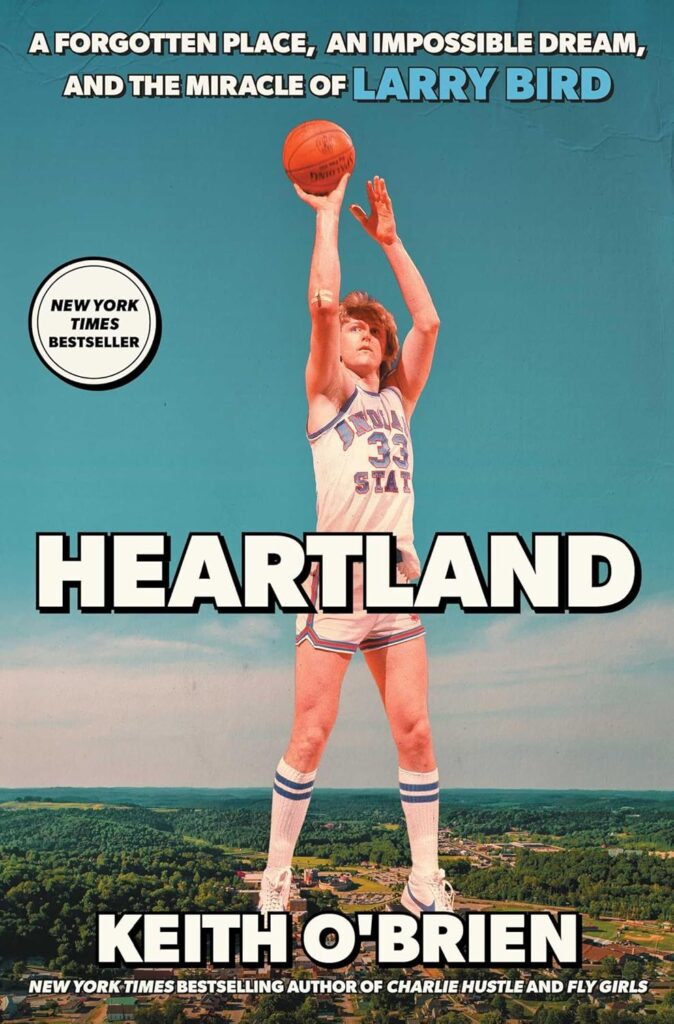
Heartland: A Forgotten Place, an Impossible Dream, and the Miracle of Larry Bird
by Keith O’Brien
Atria Books
384 pp., $27.96
“For fifty years we told this story one way,” best-selling sportswriter Keith O’Brien says. “We weaved the stories of Larry Bird and Magic Johnson together. I understand why we do that. They are inextricably linked. But when you tell the story that way, there is something that you lose—the incredible underdog story of Larry Bird.”
O’Brien is the author of the recently released book Heartland: A Forgotten Place, an Impossible Dream, and the Miracle of Larry Bird. I had a chance to speak with him at the Gaithersburg Book Festival, an annual event in Maryland that attracts thousands of readers, publishers, and authors.
O’Brien’s skill as a storyteller and doggedness as a reporter contribute to making Heartland one of this year’s most compelling reads. Basketball legend Bird did not talk to O’Brien in preparing the book, but no matter. O’Brien logged weeks in French Lick, Indiana, Bird’s hometown, talking to Bird’s friends, teachers, coaches, opponents, and employers. Too many journalists these days are lazy, which O’Brien is not.
He also took a novel approach in chronicling Bird’s life. Before Larry Bird became a legendary NBA player with the Boston Celtics or was linked to his opponent and eventual friend Ervin “Magic” Johnson in the 1980s, Bird was a player for the unknown Indiana State Sycamores in the late 1970s. A garbage collector and son of an alcoholic father who committed suicide in 1975, Bird loved basketball but had trouble finding direction. He got into Indiana University in 1974 with the chance to play for legendary coach Bobby Knight, but, facing financial problems and intimidated by the huge campus, he hitchhiked home after just three weeks.
“There is this alternate reality where he never leaves French Lick and never becomes a star,” O’Brien tells me. “What I wanted to do here is tilt the camera a little differently and zoom in on that story. Magic Johnson will, of course, come into the story where he comes in. But this is a story of a player of a team and a time and a place and a moment that is so big it picks them all up.”
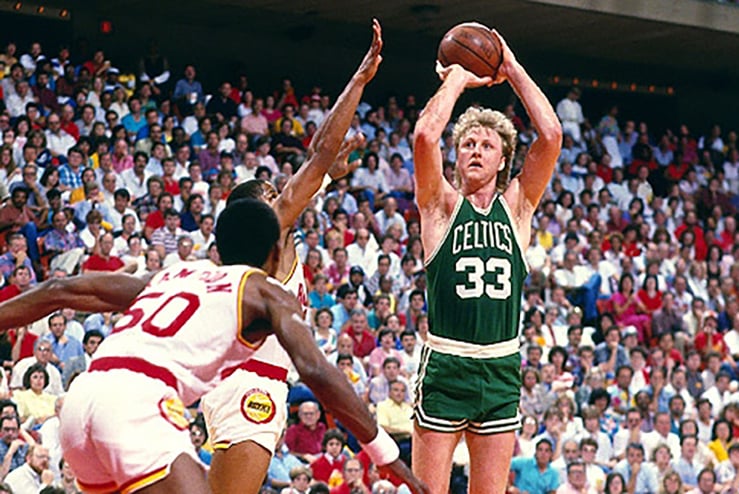
Heartland ends where most storytellers would begin—with the spectacular 1978-79 college basketball season. Bird was playing for Indiana State and first-year coach Bill Hodges. To the astonishment of the nation, the Sycamores went undefeated in the regular season and advanced to the championship game, where they lost to the Magic Johnson-led Michigan State Spartans. Bird had gone from working on a trash truck to the cover of Sports Illustrated. He and Johnson, who would become the star of the Los Angeles Lakers, would go on to ignite the NBA.
What is so refreshing about Heartland is the curiosity and respect O’Brien shows for the people of the town that made Bird—French Lick. During his talk at the book festival, O’Brien recounted how in researching the book, he left messages for people who had known Bird in French Lick. None of them ever called him back. Rather than giving up, O’Brien then reserved a room at the Best Western on the edge of town for a week and began knocking on doors and letting people know he was in town. The vibe shifted. He had come to them and had shown that he wasn’t just some coastal elitist pumping them for information.
O’Brien writes about Bird’s father, Joe, with compassion. He interviews former teammates like Carl Nicks and Bob Helton, as well as the two cheerleaders who shared the Sports Illustrated cover with Bird in 1977. That cover describes Bird, the former Hancock Construction star standing behind two Indiana State cheerleaders, as “College Basketball’s Secret Weapon.”
Bird is portrayed in Heartland as what he is—elusive, self-deprecating, obsessed with basketball, wary of the press, and reluctant to talk about himself or his past—as one writer called him, “a Bob Dylan in sneakers.” O’Brien told me he heard that Bird likes the book.
I asked O’Brien about Bird’s dedication to the craft of basketball—the repetitive, hard work it takes to make an athlete great. In this way, Bird is similar to Pete Rose, the baseball great and the subject of another of O’Brien’s books, Charlie Hustle: The Rise and Fall of Pete Rose, and the Last Glory Days of Baseball.
“Rose and Bird are different in lots of ways,” O’Brien says,
Pete Rose sabotaged himself again and again with his choices off the field. Bird has lived a clean and straight-and-narrow life. But these are two guys who both came from hardscrabble working-class backgrounds, who had to work for everything they got, who overcame adversity. They loved the game for the game. The craft for craft. Rose lived in the batting cage, even after he was a megastar. Bird loved shooting for the act of shooting. He worked on shots for the craft of it. Not only in the 1970s in school and college, but when he was a superstar with the Celtics.
Heartland offers readers a glimpse at a college sports world that no longer exists. As O’Bien writes:
It’s a narrative that’s almost impossible to imagine today in an era when college basketball players jump from school to school, leave through the transfer portal in the middle of March, play for the highest bidder, chase lucrative deals funded with name, image, and likeness money, live on campus as millionaires, cash in, check out, and rarely stay in one place long enough to leave any legacy at all. In the spring of 2025 alone, more than a thousand college basketball players entered the portal after the NCAA tournament—enough players to create rosters that would fill an entire 68-team bracket and then some. The games were over, but the real madness had just begun. Young athletes were on the move. Coaches were scrambling to sign them, and booster clubs in charge of doling out the cash stood at the ready, their checkbooks open.
Leave a Reply