The late Dilbert cartoonist and social critic, Scott Adams, had a genius for spotting corruption in complex systems. While he acknowledged that no court ever found widespread cheating in the 2020 election, he offered this frame of reference for considering it: Although it is true that in America, individuals should be presumed innocent until proven guilty, governments, which have the obligation to be transparent, should have to prove their innocence through transparency.
It is with this framework in mind that we should examine the June 2026 California primary election, which has again raised suspicions of fraud and cheating. Now that it appears certain that the Republican candidate for Los Angeles mayor, Spencer Pratt, will be excluded from the general election due to a post-election-night surge in mail-in votes for candidate Nithya Raman, election skeptics have begun voicing concerns. Here are four obvious reasons to be skeptical of the results of California’s elections:
1. AI systems and social media still push propaganda and censorship.
Inez Stepman of the Federalist recently retweeted this chart, which appears to show a sudden break in the vote totals shortly after polls closed.
For those old enough to remember, the chart evokes a graphic that emerged after the surprise surge in Biden votes in Michigan during the 2020 presidential election. That chart has now been all but scrubbed from the internet, and all of the AI services I tried, including Gemini, Grok, Perplexity, and Claude, steadfastly insisted it is no longer available. Below, I believe, is the post Trump re-truthed on election night 2020, which has since been censored by X.
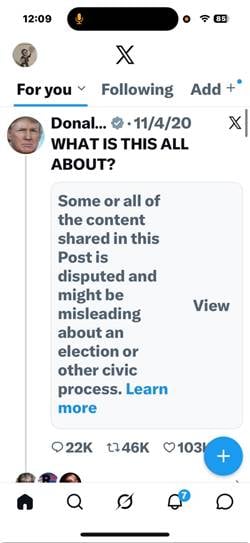
Anyone who tried to research information that might corroborate his suspicions about the Los Angeles mayoral election using any AI system was forced to run the gauntlet of unsolicited spin and “context” reassuring the user that everything about the L.A. election was normal. Even though the votes are still being counted and nothing has yet been investigated, the AI services were all pre-positioned to push back on any questions about it. The fact that all AI competitors seem to have coalesced around protecting the L.A. election’s official narrative calls into question whether there might be some lingering 2020-style governmental interference in election-related speech.
2. California has failed in its stated goal of improving voter turnout.
California has a universal mail-in ballot system. The stated goal of this system is to maximize voter participation. Thus, proponents reason, if a little election security must be sacrificed for the greater good of widespread public participation in elections, it’s worth it. In support of this approach, Caltech published this study arguing that “universal voting-by-mail increases voter turnout.” In addition, the League of Women Voters tells us that voter security laws cause voter suppression.
Not only are voter photo ID laws ineffective as [a] means of combating voter fraud, but their main impact is that they promote voter suppression.
The use of restrictive voting laws to disenfranchise minority voters can be traced back to the Jim Crow era, when many states employed various tactics—including literacy tests, poll taxes, and extralegal measures such as violence and intimidation—to prevent Black Americans from voting.
But what do actual numbers show?
Florida has one of the most restrictive voter ID laws, requiring a photo ID to vote. We should therefore expect its voter turnout to be lower than California’s, particularly among minorities who, according to the League of Women Voters, cannot obtain IDs. Yet in the 2024 election, the voter participation in Florida was higher than in California (67.4 percent in Florida vs. 62.26 percent in California). As noted in a report by the “Center for Inclusive Democracy,” California’s voter participation in 2024 declined by 4.8 percent compared with the 2020 election. This loss of participation in California was highest among minority voters (black and Latino). Thus, whatever California is doing, it’s not improving minority participation in elections.
3. California does not have basic chain of custody security measures.
If one were inclined to commit voter fraud in California, the mail-in ballot system has several exploitable vulnerabilities. First, the mere fact that every registered voter receives a ballot, whether requested or not, puts millions of ballots in mailboxes that can easily be pilfered. Is this a problem in California? It’s a big enough problem that California has an established system for requesting a replacement ballot. However, California does not appear to publish statistics on the number of replacement ballots requested. This is a clear obfuscation of public data that could alert the public to widespread ballot theft from mailboxes.
Additionally, the system permits acceptance of mail-in ballots received after election day so long as the envelopes bear a postmark from on or before election day. Unfortunately, California does not have a process for authenticating postmarks. A Los Angeles-area woman recently pleaded guilty to forging $150 million worth of postage to ship tens of millions of parcels, fooling trained eyes at the U.S. Post Office. Thus, while “postage” and “postmarks” are different things, the case clearly illustrates that the Post Office’s official markings can be convincingly forged at scale. Additionally, there’s no apparent requirement that postal workers present credentials when dropping off mail-in ballots, nor are the logs of mail-in ballot receipts made public.
To ensure that ballots match registered voters, California has a signature-matching process. However, as was reported in a 2020 piece at the Los Angeles Times, this process is totally unreliable.
When performed by professionals in criminal cases or legal proceedings, signature verification can take hours. But election employees in many states must do the job in as little as five seconds…People tasked with verifying signatures often receive little or no instruction. According to one study, those without formal training are more likely to flag a genuine signature as a fake rather than identify false signatures as real.
The Times meant to advocate for further relaxation of the sparse election security measures California retains. But the sword cuts both ways. If the overzealous election official might invalidate a lawful signature, isn’t it just as likely that the lazy worker will speed through ballots and miss fraudulent ones? Which approach gets the worker home at a reasonable hour? Nevertheless, California has a rejection rate of approximately 0.9 percent. Among the rejected ballots, most are due to a signature mismatch. The California Voter Foundation noted in their reporting about this issue that,
An analysis of mail ballot rejections during the 2024 election by USC’s Center for Inclusive Democracy found that 59% had a non-matching voter signature, 27% were mailed or arrived after the deadline, and 11% had no signature. The other 3% were dismissed for other unspecified reasons.
We don’t know how many of the signature mismatches were due to fraud. Nor do we know whether any fraudulent signatures slipped through the cracks with inattentive inspectors. What we do know is that it is yet another vulnerability through which fraud might be manifesting. We just don’t know the extent of it.
4. Late vote counting consistently benefits the party in power.
California and other blue states stand out among Western democracies for their elongated counting processes. This, by itself, does not indicate fraud. But looks bad when the post-election mail-in ballots consistently swing close elections towards the party in power. In 2024, for example, late votes changed the lead in CA-13 and CA-45. On Nov. 6, 2024, Republican John Duarte led Democrat Adam Gray by a respectable 2.89 percent. Duarte continued to lead until the late ballots erased his margin, resulting in a narrow loss by 187 votes. In the CA-45 race, the Republican Michelle Steel held an 11,363-vote lead, or 3.5 percent, on Nov. 6, 2024. Her lead persisted through Nov. 15, but shrank to just 58 votes. The next day, Nov. 16, Derek Tran took a 36-vote lead, which he expanded to 653 votes when the counting finally stopped on Dec. 5. In theory, no ballot is valid if received more than seven days after the election. So the public naturally has questions when the total votes cast column continues to expand in December, well after the election. Both Republicans and Democrats have noticed that post-election vote counting always seems to benefit Democrats. But, according to the Los Angeles Times and any Democrat you ask, fraud is not one of the reasons for this phenomenon.
Do these vulnerabilities signal fraud? Or are they simply features of the slow, creaky machinery of an inefficient and opaque system that’s otherwise trustworthy?
The U.S. Attorney’s office in Los Angeles has opened an investigation into voter fraud in California’s most recent election. If I had to make a prediction, he won’t find much. This isn’t necessarily because there’s no fraud, but because the vulnerabilities in the system make fraud hard to detect. The rumors you hear about unmarked vans delivering pristine ballots in the middle of the night generally cannot be verified. There’s almost never a “Kraken,” and the rumors divert public attention from the important vulnerabilities we can verify. But why do Democrats defend their lax system even though it has the actual effect of reducing voter participation of the minorities they claim to be helping?
Leave a Reply