The deeper we get into the digital age, the more people seem to lose their sense of play. As a new book points out, play is essential to human happiness and flourishing, and the digital age—with its inevitable politicization of everything—explains much of why it seems to be missing today. The loss of play is also why our journalism is so bad. There once was a time when journalists, believe it or not, were recruited from the athlete class. They were not the chip-on-their-shoulders loners, looking to settle high school grudges. And this was one of the reasons they were able to find so many great stories. They had a sense of adventure and toughness, and they knew where to look.
In her book The Playful Way: Creativity, Connection, and Joy Through Everyday Moments of Play, Piera Gelardi argues for the spiritual, psychological, and physical benefits of play. “Research reveals that playful adults excel at problem-solving and stress management and consistently report higher life satisfaction,” Gelardi writes. “They’re keen observers who spot fresh perspectives where others see only obstacles. They develop healthier coping mechanisms and bounce back faster from setbacks, too. As Dr. Stuart Brown from the National Institute for Play puts it, ‘The opposite of play is not work. It’s depression.’”
Gelardi further notes that:
playfulness is an underestimated trait that’s more Swiss Army knife than cheap toy—it’s an incredibly handy tool for handling life’s complexities. It’s got corkscrews for opening up possibilities, scissors for cutting through perfectionism, a magnifying glass for finding solutions, and tweezers for extracting joy from the teensy-tiniest of spaces. Beyond the mental, playfulness also benefits our bodies.
Earlier generations never lost their sense of play. In 1978, when I was 14, my father and a friend of his, both approaching 50, decided to put on a dance. They called it “The Very Senior Prom” and roped in the Glenn Miller Orchestra to play big band music. It was not always an easy undertaking for them, but the actual event was a huge success—so big that they continued the tradition and sponsored it four more times. I still remember hearing my parents come home late at night, or rather early in the morning following the dance, their laughter and love filling the house. They had been out to play.
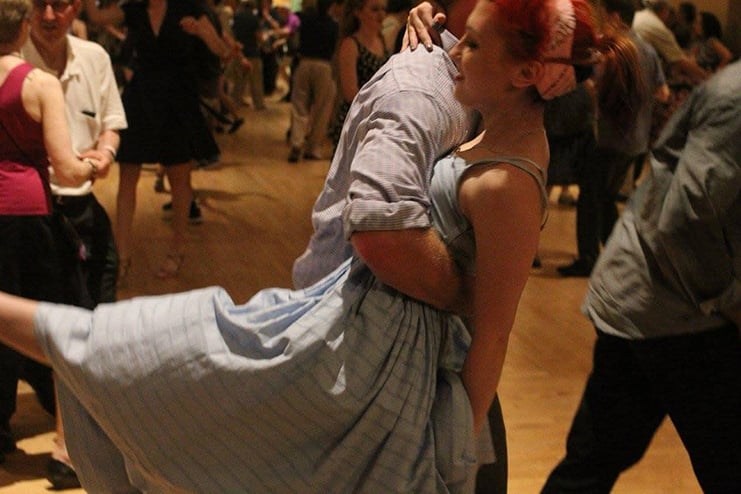
In the early 1990s, I set out to learn to swing dancing, an activity almost entirely immune to political diktats. One of my instructors was a man who used a distinctive count-in when leading his students. Instead of “one, two, three-and-four” he chimed “one, two, be-the-man.”
It was a signal to the dance leaders—be the man. Lead her. Of course, anyone who has been swing dancing for a while knows that after enough time, the woman lets you know, even if only non-verbally, exactly where she wants to be led. And that is part of the play.
The inability to see play as a story afflicts elements of both the left and the right. A few years ago, a conservative New York newspaper sent me to the Eastern Shore to do a story about President Biden and his summer vacation spot in Delaware. I did the Biden story, but I also came across a fascinating man who is a DUI lawyer and surfer who helps his clients get sober after they are pinched. I wanted to write that story, too.
The conservative editor of the paper couldn’t understand why I was interested in the DUI attorney who surfed between court dates—a real American and a genuinely interesting character. Too many journalists are chained to the news cycle. They can’t think outside of the box to find things that might illuminate our understanding of the world or help us understand our common humanity—what ought to be important to us.
”Whatever form it takes,” Gilardi says in The Playful Way,
playfulness means approaching the situation with curious creativity—treating it as raw material for possibility not just an obstacle to endure … watch any child transform a cardboard box into a spaceship or a pile of sticks into a fairy house, and—beyond the cute façade—you are witnessing them exercising some of humanity’s most valuable capacities: imagination, adaptation, and ingenuity. Somewhere along the way to adulthood, many of us tucked these qualities into storage.
Somewhere along the way, we conceded too much of the playground to the buzzkill do-gooders—the very serious people who can think of nothing but how to tell other people what to do. I’ve often written about my love of skateboarding, for example, but it is notable that whenever I get scolded for riding in the city or on a wealthy neighborhood street, the killjoy is almost always a liberal Karen who’s got some bureaucratic job in D.C. She hates to see play in others because she has forgotten how to do it. She can’t find any joy in the life she has chosen.
The laborers, the electricians, the lawn maintenance guys, and the plumbers—the people who stay active during the day and are not hunched up in a dingy office—all these people see my joy and cheer me on. They’ll sometimes stop to talk to me about their riding history and my board specs. One time, a worker in a white van called after me as I did a cutback in front of him. He asked if my board was running on a battery. I said no and headed downhill, hearing him shout behind me: “Old school, man! Old school!”
The social historian Christopher Lasch once wrote:
The uselessness of games makes them offensive to social reformers, improvers of public morals, or functionalist critics of society, who saw in the futility of upper-class sports anachronistic survivals of militarism and prowess. Yet the ‘futility’ of play, and nothing else, explains its appeal—its artificiality, the arbitrary obstacles it sets up for no other purpose than to challenge the players to surmount them, the absence of any utilitarian or uplifting object. Games quickly lose their charm when forced into the service of education, character development, or social improvement.
Yet if left to its own devices, play can and does result in education, character development, and social improvement. These virtues are nurtured because play and sports are among the last vestiges of an America that can engage conservative virtues. These are the activities that encourage young people to develop perseverance and excellence based on ability, fairness to competitors, and the capacity to enter what people call “the zone”—that inexplicable feeling of free-flowing focus where you feel something like the touch of God.
It’s also a place where you can find great stories.
Leave a Reply