Sean McMeekin has written the best history of communism since Edmund Wilson.
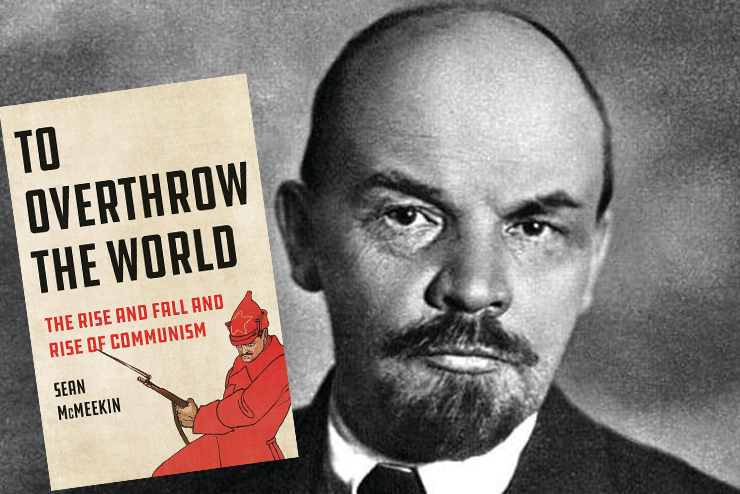
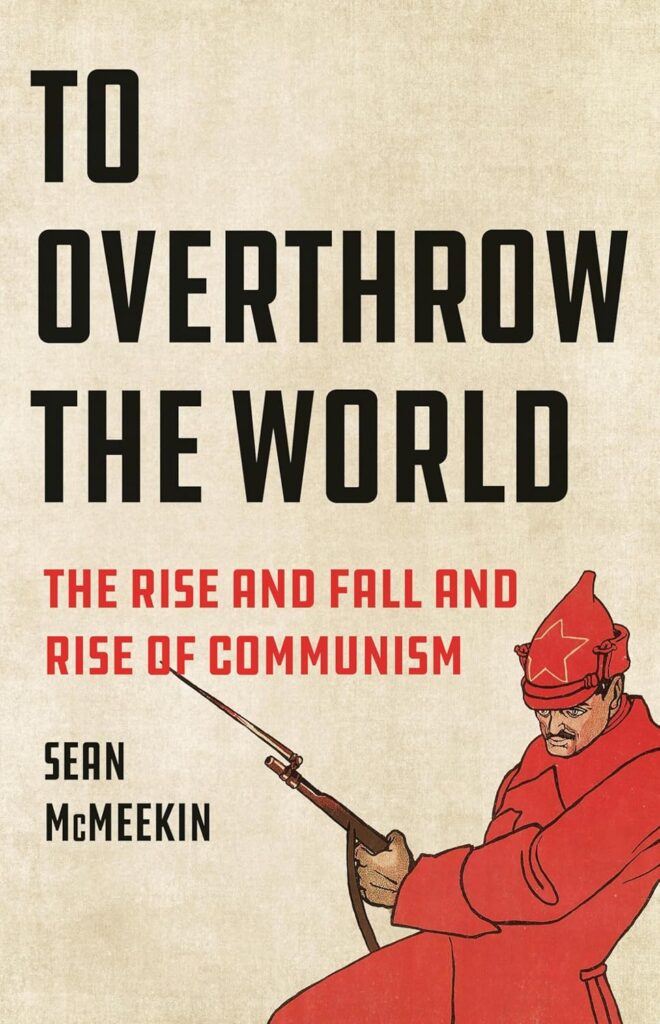
To Overthrow the World: The Rise and Fall and Rise of Communism
by Sean McMeekin
Basic Books
544 pp., $35.00
In 1940, the American writer Edmund Wilson published To the Finland Station, a history of communism in theory and practice, from its origins in the writings of Enlightenment philosophers, through its intellectual and practical coalescence under Marx and Engels, to the arrival of Lenin in St. Petersburg in 1917 during the Russian Revolution. Wilson was the very model of a modernist fellow traveler—a wealthy, well-connected literary critic living in New York who counted F. Scott Fitzgerald among his Princeton friends and Mary McCarthy among his wives. His book reflected the attitudes of his milieu, appearing at a time when it was still very fashionable (if not accurate) to see the Soviet Union as representing a bright human future, and communism’s intellectual development as a success story.
Unfortunately for Wilson’s Depression-era optimism, he lived long enough to see the results of communism in practice, results he had initially chosen to ignore. In an honest and rueful introduction to the 1971 edition, published a year before his death, Wilson began by noting “it is all too easy to idealize a social upheaval which takes place in some other country than one’s own.” He then chided his generation for being “naïve” about its hopes for the Russian Revolution.
“I had no premonition that the Soviet Union was to become one of the most hideous tyrannies that the world had ever known,” Wilson wrote, “and Stalin the most cruel and unscrupulous of the merciless Russian tsars.”
Although he did not fundamentally rewrite the overall text, Wilson’s introductory mea culpa recast the story as the tragedy that it was, as humanity rushed to embrace an ideology that promised utopia and instead brought horror and death.
Since To the Finland Station, there have been few subsequent attempts to trace the entire history of communism as both idea and governing policy, with the notable exception of the collected essays of varying quality that comprise The Black Book of Communism. Now, however, Sean McMeekin, one of the most prolific historians of this generation, has applied his considerable knowledge and literary skill to the challenge.
Wilson had been a literary critic and intellectual historian, so his work focused heavily on the ideas of communism, such as they were. McMeekin is a scholar of modern Russia and the Ottoman Empire, with a special focus on the world wars and their consequences. As a result, even though he discusses intellectual currents in his opening chapters, his work ultimately focuses on the practical consequences of communism in action. McMeekin shines a harsh light on the realities of communism rather than its intentions, which he regards as more or less fig leaves covering the pursuit of power. He strives to show what communism has been rather than what some may have hoped it would be. “The history of communism may not always be edifying or reassuring,” he writes, “but it is worth reexamining dispassionately, without either prejudice or wishful thinking.”
McMeekin also starts his story at the beginning, with a discussion of the persistent problem going back to the ancients of relating freedom and equality. He also goes well beyond the events of Finland Station, taking the story of communism from its success in wartime St. Petersburg to its collapse in Europe in the age of Gorbachev, also tracing its uneven spread through the rest of the world and its spectral existence in regimes as disparate as Cuba, North Korea, and the People’s Republic of China. Throughout, McMeekin focuses on the violent ruthlessness of Communist leaders and the fecklessness of their opposition. It is a story with few heroes but many villains, and at least as many dupes and frauds.
McMeekin’s biggest advantage over Edmund Wilson is that he clearly never had any illusions to lose and focuses his analyses squarely on the baleful consequences of communism. The story will be familiar to many readers of this magazine, or anyone who has paid any attention to the history of Communist regimes. Their ghastly records of death through direct murder, revolutionary terror, and famine (caused directly or indirectly by government policy) should surprise no one. But this story still needs to be told.
The book has already garnered many plaudits, especially from organizations that, unsurprisingly, feel vindicated in their anticommunism. It certainly deserves praise for its ambition and scope across both time and space.
Like communism itself, however, the book’s readers may experience diminishing returns. McMeekin is on more sure ground in his familiar specialties of Russia and Europe, where he draws upon a lifetime of research and publication in selecting appropriate anecdotes and details. As he races through the 1970s and 1980s, and in his discussion of communism in Asia and Africa, he relies more extensively on a few secondary sources.
He also ends the book on an idiosyncratic note. First, he denounces the willingness of Westerners to help the economic development of the People’s Republic of China. But instead of developing upon the obvious role played by large corporations and shareholders in shoring up a dictatorship to increase their profits (actions that Marx himself would have predicted), he chooses to identify by name the husband of Dianne Feinstein, to score a partisan political point. Then he ends the book by claiming to see communism as the driving idea behind the Western response to COVID, as he warns of the totalitarian ambitions of Western elites and suggests the need for a populist resistance to them.
That latter point highlights a fascinating paradox of To Overthrow the World. McMeekin spends hundreds of pages showing that Communist leaders duped and coerced people into their control by pretending to defend the people against elites, whom they defined to serve their purposes, then ends the book with spurious attacks against an ill-defined Western elite. The persistent problem, apparent even to someone who shares McMeekin’s distaste for Communist regimes and the Western intellectuals who promote them, is that there have indeed been small elites through history who have oppressed people, and that revolution has sometimes been the appropriate response to that oppression.
This is where McMeekin’s general focus on events rather than ideas lets him down, as he struggles to explain why communism had any appeal at all. Although he notes at the outset that “as long as people dream of brotherhood between men, of equal rights for women or for racial or ethnic minorities… some form of Communism will retain broad popular appeal,” and begins with a prologue discussing the ideal of social equality, within the book he does not have much to say about efforts to satisfy those dreams in any other way. It’s not enough to blame the violent determination of communist fanatics, or to refer cynically to the public’s general lack of historical or even contemporary political awareness. Plenty of revolutionary movements fail despite these advantages, after all.
Even as he pivots in his conclusion to attacking Western elites, McMeekin’s analysis generally misses how the hubris of pre-Communist ruling elites provoked the revolutions that displaced them. One thinks of French aristocrats, who spent centuries defending their privileges by resisting modest reforms to the taxation system, mounting the scaffold in the Place de la Concorde. Communist regimes are responsible for millions of deaths, but anyone who wants to argue that excessive violence is solely the work of Marxist-inspired revolutionaries might want to glance at the history of 16th-century Central Europe, or the fate of the residents of Ludlow, Colorado, killed by capitalist mercenaries, or those protestors killed in the Peterloo Massacre in Manchester in 1819. Even the Chinese were quite capable of killing millions in various civil wars long before Mao Zedong and his compatriots began Leaping Forward Greatly. As Mark Twain wrote in A Connecticut Yankee in King Arthur’s Court, reflecting on the centuries-long oppression of medieval European peasants in relationship to the French Revolution: “There were two ‘Reigns of Terror’ … the one wrought murder in hot passion, the other in heartless cold blood; the one lasted mere months; the other had lasted a thousand years.” Twain went so far as to assert “a city cemetery could contain the coffins filled by that brief Terror which we have all been so diligently taught to shiver at and mourn over; but all France could hardly contain the coffins filled by that older and real Terror.”
McMeekin has done important work to remind us that the cemeteries for communism’s victims would cover many cities. Nevertheless, Twain’s observation and Wilson’s change of heart should still haunt thoughtful readers. And Marx’s descriptions of the depredations of uncontrolled free trade (“All that is solid melts into air, all that is holy is profaned”) were more accurate than his predictions about the inevitable post-revolutionary future. But they have lost none of their descriptive power, even as they are now more likely to appear in jeremiads about the deindustrialization of the American heartland.
Marx promised to liberate the proletarians from their chains, only to have his intellectual heirs forge those chains into instruments of torture and death. Any honest history must face those facts squarely. If we hope to learn from the tragedy of communism, however, we will need to grapple more honestly not only with the what but also the why. Knowing that communism has been terrible does not absolve us from the challenge to understand its continued appeal. Nor does pointing at communism’s horrors let any of us off the hook for developing political systems responsive to the will of the people and which struggle, however imperfectly, to respect the freedom and dignity of our fellow citizens. Facing that challenge will take work. Anti-communists of the world, unite!
Leave a Reply