“This is what democracy looks like!” a plethora of online social media posts proclaimed in the hours following last weekend’s fleeting No Kings protest. No Kings, which itself has no leadership, no program, no platform, no scheduled future events, no logical argument for its own existence in a land that already has no monarchs, and no ideology beyond a shared disdain for a democratically elected and reelected president, fizzled into nothingness after its preplanned two-hour rally on Saturday.
Already forgotten amid the flurry of good foreign policy news and strong economic data this week, anyone who still cares about No Kings is hard put to answer some basic questions about this public tantrum: How did it “look like” democracy going into a tantrum against a duly elected president? How was it “peaceful” despite all the signs calling for the deaths of President Trump and his supporters? And how it was “patriotic” despite its objections to the democratically expressed will of the American people, its brazen calls for the extralegal removal of our leaders, and its wide-ranging support from Democrats, some two-thirds of whom, according to recent surveys, do not consider themselves to be patriotic.
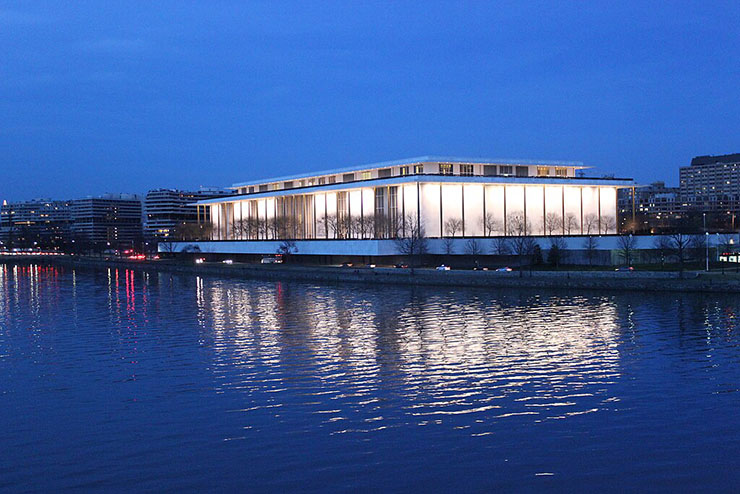
Washington, D.C. was the site of one of the larger demonstrations, but fortunately the nation’s capital, newly sparkling thanks to President Trump’s supplemental law enforcement and other measures, has truly patriotic elements that are palpable and will be with us for a long time. Even as the No Kings protestors gathered for their exercise in rage, the John F. Kennedy Center for the Performing Arts is offering programming any true patriot would readily enjoy.
President Trump has made reforming the “KenCen,” as locals call it, a centerpiece of his cultural policy. Shortly after his inauguration, he removed the center’s leadership, appointed close supporters to its board, took over as chairman, and appointed former ambassador and special presidential envoy Ric Grenell as interim president and executive director. What had been a tired, woke, and, it appears, nearly bankrupt institution less than a year ago has blossomed into a temple of American pride. On the eve of No Kings, a sold-out performance by the Glenn Miller Orchestra—a 14-piece ensemble keeping alive the spirit of the legendary big band founded in 1938—played an exceptional concert in the Kennedy Center’s rooftop Terrace Theatre.
The rooftop space is now itself enlivened by a speakeasy-style bar that takes over the center’s restaurant, which used to close at the grimly early hour of 8 p.m., and is now open through the nearly unheard of (in Washington) hour of 11 p.m.
The music had the crowd—which, unlike No Kings spanned all age groups—walking on air in a program sandwiched between opening and closing performances of “Moonlight Serenade.” Halfway through, just before the band played “American Patrol,” the houselights went up with a request for all veterans and active-duty military servicemen in the audience to rise for recognition and a round of applause. This moving and supremely tasteful moment was a far cry from the vulgar drag shows and boring, DEI-infused “Social Impact” programs that blighted the arts complex for so long under its previous president Deborah Rutter, who was at one time paid nearly $1.4 million per year despite some highly dubious artistic choices.
Just hours after the No Kings crowd dispersed into oblivion, a substantial audience assembled downstairs in the Concert Hall for the National Symphony, which hosted the brilliant young Austrian-Armenian conductor Emmanuel Tjeknavorian leading an inspiring Beethoven program. Its highlights included an enthusiastic performance of Beethoven’s Egmont Overture, music which the composer wrote to accompany a play by Johann Wolfgang von Goethe celebrating a rebel who led an uprising against—guess what—an actual king!
After a moving interlude of Beethoven’s Violin Concerto, with the solo part played with exceptional grace by the German violinist Isabelle Faust, the concert concluded with the composer’s Seventh Symphony. Described by Richard Wagner as “the Apotheosis of Dance,” the program notes remind us that this work was yet another artistic reaction to tyranny—its premiere in 1813 was a benefit for Austrian soldiers who had returned from fighting Napoleon, who had tried to conquer all of Europe.
Last month, the National Symphony Orchestra was itself the beneficiary of a grand gala held to open the Kennedy Center’s new season—its first under Trump’s and Grenell’s leadership. It raised a record $3.5 million, setting the tone for a new, patriotic culture while the opposition can do little more than hold up crude signs in the expectation of change before just going away. And best of all, from now on the National Symphony will open every concert this season with the national anthem. It doesn’t get more patriotic than that!
Leave a Reply