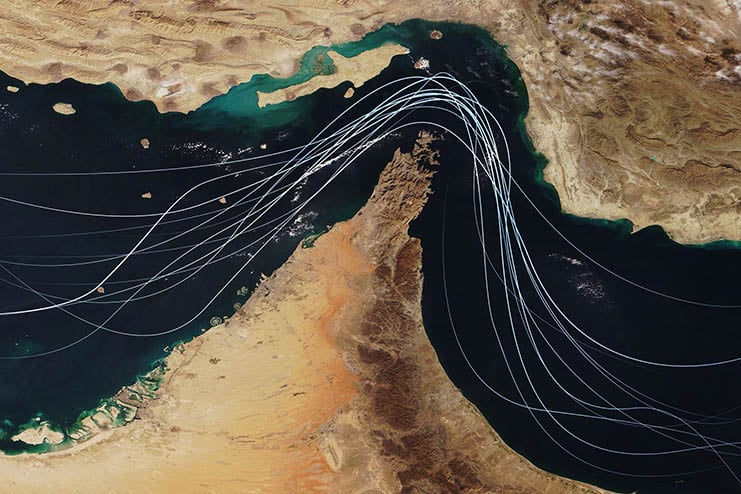
Like many disaffected establishment Republicans, Senator Bill Cassidy of Louisiana, who recently placed third in the primary for his Senate seat, is critical of the Trump administration’s handling of the Iran conflict:
“This is the worst foreign policy blunder in decades,” the senator wrote on X, adding,
Reagan is rolling over in his grave. Iran’s nuclear ambitions were not curbed, and they have learned that threatening the Strait of Hormuz works and will undoubtedly leverage it in the future. Now, Iran gets to build brand-new infrastructure under this deal.
Those who, like Cassidy, demand a harder line from the administration in bringing the Iran conflict to a close have a poor understanding of our current geopolitical reality—perhaps because they have played a role in creating it. Negotiating without sufficient leverage is called begging. Now that we’ve paid the steep tuition charged at the School of Hard Knocks, we should carefully examine the events that brought us to our current position.
True, the deal is not ideal, but we do not live in an ideal world. As things transpired, the president was left with two choices: escalate to a ground war or seek an expensive peace with the Iranians. Those unhappy with the expensive peace should be asking themselves the following questions:
Where was the armed uprising of the Iranian people promised by so many who encouraged this operation? Why couldn’t the most powerful and expensive navy in history control a strip of water so narrow you can swim across it? And why can the United States be brought to its knees by a one-point increase in inflation?
The president’s negotiating position is an extension of the United States’ strategic position. Getting angry and blaming the president doesn’t change that central fact. Fixing the problems that put us in this position is the only useful approach going forward. America must address three strategic vulnerabilities.
1. The Debt Problem
The closure of the Strait of Hormuz caused a massive spike in energy prices that pushed inflation higher. Naturally, the cost of the government’s debt followed. This month, the U.S. Government Accountability Office (GAO) sounded yet another alarm regarding our debt. Bond yields on the 30-year Treasury spiked above 5 percent. The government’s debt is so high, in other words, that even a tiny change in the interest rate results in huge fiscal impacts. Had the war continued, it almost certainly would have caused massive economic hardship.
The United States is not in a position to weather a disruption in the flow of oil for more than a few weeks. Had the president been able to keep the strait open and oil flowing, he might have had more leverage at the negotiating table but importantly, this does not change the fact that the U.S. must get control of its deficit spending. The failure to do so is leaving us vulnerable to real dangers.
2. The Intelligence Failure
In the weeks leading up to the war, the Iranian people bravely rose up to confront the regime. The regime blamed U.S. intelligence for inspiring the uprising. Of course, there’s probably some truth to the claim. Why wouldn’t we expect our intelligence services to lend assistance to citizens seeking an end to an oppressive regime that also happens to be an open and aggressive enemy of the United States?
But, according to reports, the CIA bungled a transfer of weapons to the Iranian people. Apparently, the CIA gave weapons to Kurdish groups in Iran, and the Kurds, instead of making them available to the Iranians, kept them to protect themselves from the government. Some estimate the Iranian government murdered more than 36,000 unarmed protesters, often using foreign mercenaries to machine gun crowds of protestors.
There’s plenty of room for finger pointing, but one clue as to why the CIA misdirected its resources comes with the recent arrest and charging of David Rush, a senior CIA executive in the CIA’s Directorate of Science and Technology, who is now charged with embezzling over $40 million in gold from the agency.
The public details are sparse. But an educated guess would suggest that the embezzled gold and the misdirected weapons are both symptoms of the same dysfunction: The CIA, like many government agencies, measures its success in terms of spending, not results. One can imagine that Rush may have been pressured to get the gold bars “placed,” or spent, to make room for the next year’s budget. That pressure, combined with a system that doesn’t measure or reward positive outcomes, may have led to Rush deciding to take the gold for himself rather than suffer punishment for failing to “execute” his budget.
When the CIA fails, its funding goes up. This is the organizational lesson from every CIA failure from the Bay of Pigs to September 11. This happens even when every leader and employee does his or her best. Complex organizations evolve to perpetuate themselves in spite of the best intentions of their employees and leaders. Seasoned observers can expect the CIA to point to the failure in Iran to justify more money in its next budget request.
What should happen instead, is that the CIA should be broken up into multiple smaller agencies that receive project funding controlled by the president. The funding should follow success, not failure.
3. The Navy Problem
Eighty-six years ago, the mighty Royal Navy kept its battleships, cruisers, and aircraft carriers behind the defenses of Scapa Flow, Scotland, as the evacuation of its 338,000 troops was carried out by destroyers and small wooden private ships. What good was it for Britain to have the world’s mightiest and most expensive fleet when relatively inexpensive Luftwaffe and submarines rendered the big ships helpless? What good is the world’s most expensive fleet today—America’s—if a few inexpensive drones and missiles can prevent it from keeping the world’s most important strait open?
The lesson from the Ukraine and Iran wars appears to be that future wars will be won with mosquitoes, not elephants. The Russians have lost numerous prestige, high-value assets to Ukrainian drone attacks including strategic bombers, expensive anti-aircraft systems, radar installations, and expensive naval vessels. The drones have made it impossible for tanks and most wheeled vehicles to conduct offensive operations and the Russians have resorted to using small infiltration teams to sneak across battle lines.
Similarly, the U.S. Navy appears to have kept its assets at a safe distance from the Iranian drone and missile capabilities. This isn’t the result of cowardice or unjustified caution. It’s the strategic position we’re in. Without a foolproof anti-missile and anti-drone defense, the Navy can’t afford to risk its high value assets by placing them within the strait itself.
The solution to this situation is similar to the one proposed above for the CIA. Instead of the military bureaucracy distributing its funds top-down, the president should be able to fund wars with project funds that he can direct to major commands or perhaps a new “Drone Force” branch of the military. Again, the president should be able to redirect money towards elements that succeed and away from those that don’t. And we need more mosquitoes and fewer elephants that are too expensive to be risked in real conflict.
While it is good to avoid partisan sugarcoating of our situation, Senator Cassidy’s out-of-context (and personal, given his recent ouster in the primaries) outrage isn’t enough. The strategic problems the United States is facing have been a long time coming, and many critics, including Cassidy, have had a hand in creating them. Now that they have been laid bare to the world, including our enemies and adversaries, we can see that the problems all have a common theme: We’re misspending money when it comes to our strategic priorities.
Changing how we fund the government so that money follows success and starves failure, will go a long way toward better positioning the United States the next time a president needs to confront an enemy. This time, we paid a price in diplomatic prestige and money. Next time, the price could be paid in blood. The good news is that we might still have time to fix the problems before the next tuition bill comes from the School of Hard Knocks.
Leave a Reply