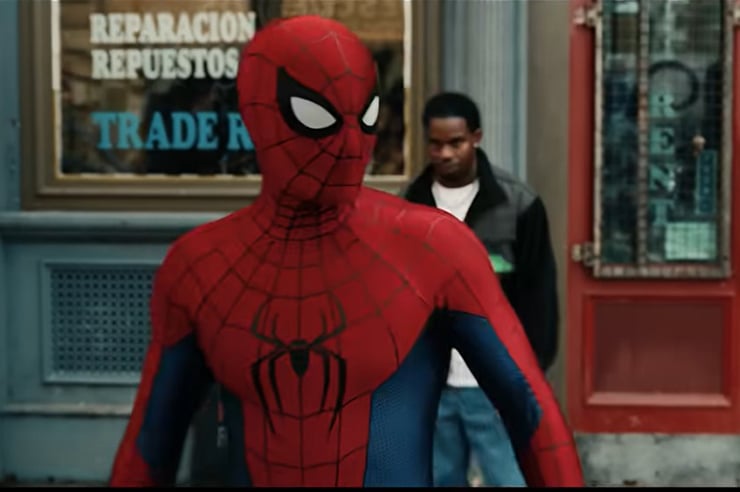
There is a scene early on in Spider-Man: Brand New Day, that is breathtaking and an indication of the film could have been. It’s not a fight scene, nor a romantic kiss between Spidey and his girlfriend, Mary Jane. It’s Peter Parker swinging through New York City in the rain. To protect his friends and family, Spidey had the sorcerer Doctor Strange erase everyone’s memories. Peter Parker has found himself in a world where he sees familiar faces, but no one knows who he is.
For the first 20 minutes of Spider-Man: Brand New Day, this works beautifully. Star Tom Holland acts with genuine hurt on his face and yet is also understated. He is grieving for his old friends and family. He goes to a party, passing himself off as a friendly neighbor. He sees his best friend Ned Leeds (Jacob Batalon) and his best girl MJ (played by Holland’s real-life wife, Zendaya). Then he sees MJ being kissed by another man—her new boyfriend.
Wracked by grief, Peter Parker swings home in the rain. Director Destin Daniel Cretton creates a luminescent, otherworldly backdrop and mystic flow as the web-slinger floats through the city. He is, like all of us, both reaching for heaven and earthbound. He rises to an apex, the camera looking down on him like bird, then lets go, allowing himself to gently drop into the rain and the emptiness below. Then he spins another web, glides along the caverns of Manhattan, and heads for home. Suddenly, we are no longer in a superhero movie, but in a Terrence Malick film.
It is the high point —both literally and figuratively—of what had been, up to that point, about 20 minutes of flawless filmmaking.
Then, of course, Spider-Man: Brand New Day begins to pile on the subplots, fight scenes, and CGI. Parker is having frightening symptoms before learning that his powers are “leveling” up to make him even more powerful and more like a spider than ever before. The Punisher (a funny and endearing Jon Bernthal) appears and blows a lot of stuff up. A corporation called Damage Control turns out to be villainous, trying to destroy a telepathic X-Man (X-Person?) named Jean Grey. They are trying to harness her power after killing her younger sister.
The run time of the original Iron Man, still Marvel’s best superhero movie, is 126 minutes. The run time of Brand New Day is 145. There are also a lot more feelings and therapy in Brand New Day, as opposed to Iron Man’s Tony Stark (Robert Downey Jr.) beating up terrorists and explaining to liberal co-eds the benefits of military spending.
Not that there’s anything wrong with the emotional tone of Brand New Day. Peter Parker is a young man, after all, a college student, and the death of his Aunt May and the loss of his friends is traumatic. Yet the filmmakers abandon the elegiac tone and introduce Peter’s body dysmorphia as his body changes more and more into spider, then add the Punisher, and the evil corporation, and fight scene after fight scene after climax after climax. It’s too much.
This is a shame, because Spider-Man: Brand New Day could have delivered a touching, entertaining and mature film. This is what Marvel Comics have long been known for. The transformation to comic books from corny one-dimensional superhero stories to heroes with more “adult” themes was due to writers who had been affected by the cultural changes of the 1960s and 1970s and national traumas like Vietnam and Watergate.
In his book Supergods: What Masked Vigilantes, Miraculous Mutants, and a Sun God from Smallville Can Teach Us About Being Human, comic book writer Grant Morrison nails it:
These older comic-book hobbyists—often collectors of back issues, compilers of price lists, and publishers of DIY fanzines—favored work that was edgy and defensibly mature …. Anxious to escape the mocking echoes of the Batman TV show and the disrepute it had brought upon the “serious” business of collecting comics, and learning to appreciate the nuances of their artistry, these adolescent advocates were ready to embrace any development that validated their growing interest in politics, poetry, sex, and expressions of emotional pain.
One comic book writer who handled the maturation of the form well was Stan Lee, the Marvel genius behind Spider-Man, The X-Men, the Hulk, and other iconic figures. In the late ’60s, Lee began introducing contemporary social issues into The Amazing Spider-Man. After all, in 1968 Peter Parker was a college student, so it would have been unusual for him to not have been aware of the social upheaval that was going on around him.
Still, Stan Lee was approaching 50 in 1968. He wasn’t a member of the Students for a Democratic Society or the Weather Underground—rather, he was a World War II vet (Lee served stateside as a writer) and the father of two teenagers. When young characters in his comics would give speeches about “the man,” Lee often had a rational adult—someone like Robbie Robertson, an editor at the Daily Bugle newspaper where Peter Parker worked—argue against reactionary politics. Lee was not conservative, but rather more of a pre-1960s liberal. He and his characters argued against racism and Birchers, but also warned against the drugs that were destroying young American lives.
One of Lee’s most impressive works was The Amazing Spider-Man #100, “The Spider or the Man?” It is one of the most honest comics Lee ever wrote, dealing with idea of what happens when a super-hero decides to grow up. After Spidey stops a bank robbery, he admits that he just doesn’t “get the same kick” out of fighting crime as he used to. In fact, Peter Parker is deeply in love with Gwen Stacy, and has decided to dedicate his life to her. After defeating Kingpin, Doc Ock, the Lizard and other villains, Spider-Man is about to confront the challenge of domestic life and marriage. Stan Lee seemed to be wrestling with his fatigue with Spider-Man, whom he had been scripting for more than seven years. He wanted to let Peter Parker become a man.
But, of course, by then the money was just too good and the character too popular. So, Peter is told in a dream by Gwen Stacy’s father that being Spider-Man is his destiny, a “blessing and curse.”
Pacing can make or break a film. In the case of Spider-Man: Brand New Day, as with almost every other superhero movie released today, it comes close to breaking it. This is a continual frustration with comic book movies. They all start beautifully, with even pacing and smart editing, then, but then—like a city after an alien invasion—they completely fall apart.
The Incredible Hulk, X-Men: The First Class, The Dark Knight: these are all films that are strong from the opening credits to about the first hour, but then lose focus. This petering out is more frustrating than a film that is simply bad. It’s like watching a professional golfer who has led for 16 holes suddenly lose it in the last three. The great exception is Iron Man—the first one—which kept things tight and did not overdo the final battle scene.
The problem is that Hollywood blockbusters these days demand not just one dramatic ending, but several. It’s not enough that the hero escapes death; he must do so multiple times. The editing must be increasingly frantic (and confusing) to heighten the suspense. Thus, in The Amazing Spider-Man (2012), it’s not enough to have a battle between Spidey and the Lizard—you have to have at least three fights, one of which absurdly takes place in a high school. As a result, most superhero movies are not bad movies, or brilliant movies. They are half-great movies.
Still, Brand New Day’s opening scene, showing the forlorn Peter Parker floating through the space of Manhattan like a ghost—is cinema worth seeing.
Leave a Reply