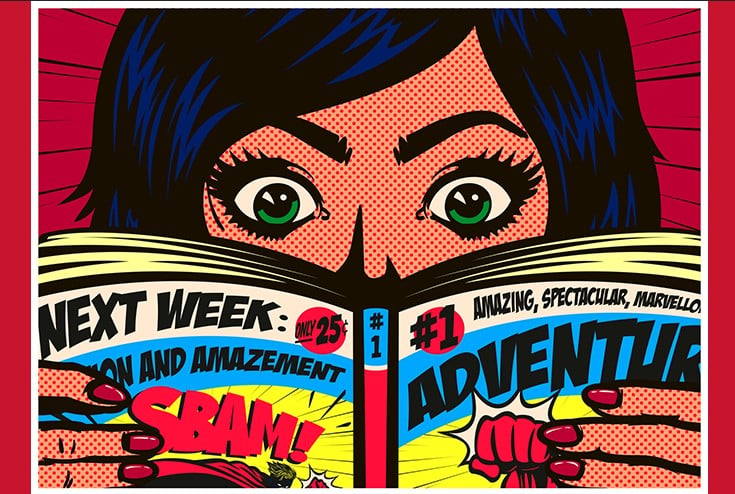
Frank Miller is now sorry about his graphic novel Holy Terror, which was published in 2011. Miller is known as a comic book genius, the man who revolutionized Daredevil, created 300 and Sin City, which became great movies, and gave the world The Dark Knight Returns, a classic 1986 Batman story. Miller has just published an autobiography, Push the Wall: My Life, Writing, Drawing, and the Art of Storytelling.
Miller has often produced comics that offend liberals, and in Push the Wall he apologizes for one of his most realistic and brutal works. Holy Terror depicts a vigilante named “The Fixer” who goes around Empire City—i.e. New York—beating down Islamic terrorists. Here’s Miller’s explanation:
This doesn’t mean that what I dream up is always hatched in joy, fully conceived, and/or well-received. Remember: some things land, others don’t. Later in my career, I created something that sparked a fire of criticism, some of it warranted. When I created Holy Terror, I was in a rage—a crazy-ass blood rage. Sure I was—I had just moved back to Manhattan, my one true home, when nineteen terrorists hijacked four fully fueled commercial jets full of passengers, crashing one into the Pentagon, one into a field in Pennsylvania, and two into the Twin Towers in lower Manhattan. 2,977 people died on September 11, 2001, and 2,753 of those perished in Manhattan. Like so many other New Yorkers, I wasn’t far from the scene of this horrendous atrocity. The stench of it—the burning metal and plastic, the burning human meat—these are things that I will never forget. It lingered for weeks, a sickening, sensory stew, a daily reminder of mass murder, of lives lost, of the open wound to my city, to my country. The comic features The Fixer, a vigilante who takes on Islamic terrorists after an attack on New York, thinly disguised as Empire City. It was my ferocious gut-level reaction to 9/11 and the ongoing jihad activity that followed. Holy Terror was done is a state of unbroken trauma.
Though perhaps an over-the-top apology, his emotions at the time of writing the book, in fact, sound reasonable.
This year also marks the 40th anniversary of The Dark Knight Returns, the graphic novel written and illustrated by Miller, Klaus Janson, and Lynn Varley. Although justly regarded as a classic, The Dark Knight Returns was not universally praised when it was published in 1986. Art Spiegelman, who won a Pulitzer Prize in 1987 for Maus, his own brilliant graphic novel about the Holocaust, called Miller’s Batman “a rather fascistic Reagan-era hero.” Miller had brought a law-and-order edge and an unprecedented level of realism to the violence of the post-1960s American city. Batman was a moralist, and if his obsession with crime seemed nearly psychotic, it reflected the frustrations of many Americans over the explosion of crime during the previous 30 years.
This year, as part to the publisher’s 50th anniversary, Fantagraphics is reissuing the first issue of Peter Bagge’s “alternative” comic book Hate!,which first appeared in 1990. Bagge’s Hate! was not about racial supremacy or political violence, as the title might suggest to today’s audience, but the life of one Buddy Bradley, a twenty-something living in Seattle. Bradley was no Republican—at least not yet—but he had no patience for the budding wokesters then prevalent on the grunge scene. In one strip, his girlfriend, Lisa, tries to call him out when he complains about a girl who has armpit hair. Lisa demands to know why he feels that way. His reply: “Because I don’t want to have sex with someone who looks like me!”
Bagge has long been known to skew libertarian, contributing strips to Reason magazine and he even wrote a graphic novel about Rose Wilder Lane, the mother of American libertarianism.
Bagge’s willingness to work for non-leftist (if not conservative) outlets is part of what makes Hate! so fascinating—in any event, it’s anything but conventional. Even now, it is interesting to consider how Buddy ends up becoming part of the hipster scene in Seattle while, at the same time, also being so contemptuous of it.
Also published this year was R. Crumb’s comic Tales of Paranoia. Crumb has never been politically correct, but Tales sometimes—albeit with great humor—explores the issue of whether one ought to trust what he hears from the government. “The comic is essentially an explanation of, and advocation for, Crumb’s anti-vax stance,” one Redditor observed. “There is an attempt to elevate this position into a broader throughline on the concept of paranoia, but it reads like a comic adaptation of your Grandpa’s Facebook posts, down to the exhaustive walls of text and random personal anecdotes.”
In fact, comics are one of the last platforms of genuinely free expression. The Small Press Expo, the annual convention of independent comic book publisher that meets in September outside of Washington, D.C., is one of the greatest concentrations of creative and free-thinking minds you’ll find in one ballroom. The stunning array of comics of all shapes, sizes, colors, and topics gives you hope that the world isn’t becoming one big iPad.
There are books and comics on elves, cops, drunks, wizards, Revolutionary War-era aliens, drag queens, penguins—even one guy who has made superheroes out of the stars from the 1970s blacksploitation era of cinema. Peanuts and Mickey Mouse are also represented. It’s just a big, buzzing hive of true outré comic nerddom.
While it’s often thought that the people who want to censor and control comic books are right-wingers, more often than not the oppressors have been on the left. In the 1950s, a psychiatrist named Fredric Wertham wrote a book called Seduction of the Innocent that warned of the bad effects that supposedly come from reading comics books—even Batman and Robin, which Wertham called “a homosexual fantasy.” Wertham, it turns out, was no man of the right. He was actually a leftist who had been inspired by Marx and others from the Frankfurt School. He certainly would not have been inspired by The Dark Knight.
Leave a Reply