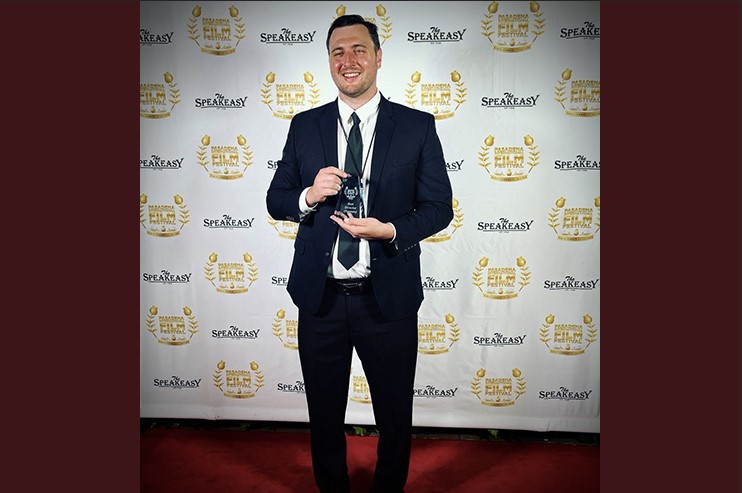
I first met filmmaker Paul Roland in 2023, when I came across his film Exemplum. Made for $10,000 and shot in black and white, Exemplum tells the story of a priest who goes bad and explores the repercussions of his actions. Roland wrote, directed, and even starred in the film. The story is brilliantly written and received great acclaim, including from many conservatives who liked how Roland’s script dealt with the seductive power of evil. It’s a thriller that effectively utilizes insights from Aleksandr Solzhenitsyn.
After producing and directing a hilarious and spot-on parody of Christopher Nolan’s imaginary version of A Christmas Carol, Roland’s new project is a radical departure from his previous work. Punch the Line is a dramatic podcast that explores the lives of kids participating in a high school improv team. Such things existed in California when Roland, 36, was still a kid in the 2000s. It stars Nick Searcy, Allegra Edwards, Francis Cronin, and Austin Kane. The cast and crew just wrapped up recording and after post-production is aiming for a fall release.
I recently spoke with Roland about his new project.
Mark Judge: Paul, you and I met after the release of your 2023 movie Exemplum. That movie got great reviews and depicted a priest who breaks bad. Your new project, Punch the Line is totally different. Tell me about it.
Paul Roland: Fans of my work will be shocked to know just how radically Punch the Line departs from Exemplum—a gritty, tech-noir thriller with meditations on Catholic ideas of grace, redemption, and pride. Punch the Line is neither a thriller nor a spiritual examination but a coming-of-age teen dramedy about a competitive high school improv team done in the spirit of John Hughes and Cameron Crowe.
Think of the poignancy of The Breakfast Club, the carefree joy of Ferris Bueller’s Day Off, the angsty romance of Say Anything, and the high-stakes competition of The Karate Kid with a touch of the comical zaniness of Whose Line Is It Anyway?, all rolled into one magnum opus. As I like to say, it plays like a symphony of the greatest teen movies ever made while setting the stage for its own legacy.
As to how I pivoted from a movie like Exemplum to a story like Punch the Line, that requires a bit of context and some helpful framing. Loosely inspired by my high school experience, Punch the Line has been a labor of love since the summer of 2023 when I first wrote the screenplay, which I then later decided to turn into a fictional podcast after learning more about the art form and how it made the perfect fit for this type of story and my desired autonomy as an independent creative. While I did not perform competitive improv during my time at Trabuco Hills High School, I was quite close to many of my classmates who did, and my experiences with them took place during some of the most profoundly influential years of my life, without which I would not be who I am today.
Inspiration for Punch the Line first came to me in 2004, as I remember sitting in the crowd during one Comedy Sportz match and thinking that it would make for a great teen dramedy in the spirit of a John Hughes film. I thought nothing of it until 16 years later, when I released my debut feature film, Exemplum, and I honored my high school film teacher, Todd Sautner, during the premiere.
Upon reflection, I then suddenly found myself remembering those past experiences—the friends I made, the lessons I learned, and how wonderful it would be to turn it all into a classic coming-of-age story worthy of the master himself: John Hughes.
I immediately fired up the creative engines and contacted my past high school friends to interview them about their experiences performing competitive improv as teens. Their contributions to the story were so immeasurable that I loosely modeled the main characters on their personae.
MJ: Theater kids get a lot of mocking these days, but as the brother of an award-winning actor, I love theater kids. Were you a theater kid? Tell me about your experience in high school in Orange County, California.
PR: I think all of us who deal in the dramatic arts have a theater kid inside them—someone willing to be vulnerable and expose his soul in an act of self-expression. In fact, I would say that most of us who work in the dramatic arts got our start in theater, either in middle school or high school. For me, that was in seventh grade at St. Phillip’s in Pasadena, when I played Jesus in Godspell. One year after that, I played Fagin in Oliver.
Now, it’s interesting how Orange County ties into this. After graduating eighth grade, I spent one semester at Don Bosco Tech (back then, an all-boys Catholic school) before my dad finally decided to move us down to South Orange County, particularly, Rancho Santa Margarita. My parents had just finalized a nasty divorce that had been raging for three years, which led to some horrible events that forced me to cut off contact with my mother and her side of the family. My dad felt we needed a change, and he chose South Orange County for our fresh start.
At the time, I had the option of attending one of several different high schools in the area—Tesoro High School, El Toro High School, and, of course, Trabuco Hills High School. My dad insisted on Trabuco Hills due to its highly-rated drama program, then headed by Todd Sautner and Paul Beidler. Now, being that I was a scared teenager desperate to fit in, I begged my dad to keep me out of drama under the entirely false impression that only geeks did drama while cool kids played football. For context, I was 14.
Of course, my dad won the argument, and I reluctantly took drama. It was my first class on my first day of school, and I will never forget meeting the man who would eventually change the trajectory of my life forever: Todd Sautner. You conjure a thousand images in your head of what a high school drama teacher might look like; Todd Sautner was none of them. He was exceptionally young (a Gen-Xer in his very early 30s in 2003) and had as much a love for surfing and athleticism as he did for the arts. Most of all, he had this charisma about him that drew students from various parts of the high school social scene under his umbrella. In some ways, the high school hierarchy almost disappeared in his class, and we all felt like we were part of a special experience.
Despite joining mid-year, I excelled in his class and found a place where I truly belonged. After two years of drama, we then had the option of moving on to Advanced Theater, taught by Paul Beidler (a gentleman who taught me wonderful lessons in acting), or moving on to Film Production, taught by Todd Sautner. I chose Film Production, and my love for the cinema was born. It was in Sautner’s class I wrote my first screenplays, directed my first short film, and learned the works of timeless directors like Fritz Lang, Akira Kurosawa, Ingmar Bergman, and so many others.
So, to drive this point home, I began as a theater kid until eventually growing into a film kid. Without having moved to Orange County during such a vulnerable and influential time, I do not know if I would be on the path I am now.
MJ: Punch the Line is inspired by teen movies of the 1980s. Why that choice?
PR: One thing about the 1980s teen movies that has always fascinated me is how they came across as real, serious, genuine movies that happened to center on teenagers. In other words, they were the works of genuine filmmakers who saw teenage life as a vehicle to explore unique, untapped themes about the human condition. As time went on and commercialism supplanted artistry, the teen movie just became a marketing tool, jettisoning the tone, styles, and depth of its predecessors, but the spirit never died. I think that’s why the cinema of John Hughes and Cameron Crowe is so revered decades later.
Though they have never risen to the artistic heights of Ingmar Bergman or Fritz Lang or Akira Kurosawa or even Steven Spielberg, the American Teen Movie genre has always held a special place in my heart, as I consider it a great and noble blessing that we live in an era of such abundance that we can explore the inner workings of the teenage mind—one caught between a childhood-long past and an interminable adulthood just beginning.
To that, I say thank God for the teen movie. Thank God for the movies that remind us of our innocence. Thank God for the movies that champion sincere love. Thank God for the movies that dare us to hope. Thank God for the movies that see the dignity in those too young to think for themselves and too old to be told what to think. Thank God for the movies that say the teenager has infinite value and should not be ignored.
MJ: What do you hope for Punch the Line?
PR: Create the best fictional podcast in existence and use that momentum to create the feature film I always intended it to be. With talents like Nick Searcy, Allegra Edwards, Francis Cronin, and Austin Kane among our wonderful cast, I have no doubt audiences will love what we’ve created.
Leave a Reply