America “has enemies” and should “start acting like it” when it comes to higher education, Florida Senator Rick Scott told Fox News Digital last week. Along with New York Republican Representative Elise Stefanik and New Jersey Democrat Josh Gottheimer, Scott has sponsored new congressional legislation that will bar all federal funds from American colleges and universities that operate branch campuses in nations identified in the bill as “adversarial.”
The bill includes in the “adversarial” category nations such as Iran, North Korea, and China, but Qatar is also on the list. An Arab Gulf monarchy that sometimes cooperates with the U.S. and hosts a major American military base, Qatar has at the same time been the chosen place of residence for Hamas’s political leadership, including its late top leader Ismail Haniyeh. It has also long promoted scholars and interests that Stefanik has described as anti-Semitic and “pro-terror.”
Qatar is a small nation of about 3.4 million people, but its role in American higher education is enormous. According to the U.S. Department of Education, its government and state-supported institutions, particularly the Qatar Foundation for Education, Science, and Community Development, have flooded U.S. universities with an estimated $8.8 billion in reported grants and contracts, the single largest sum of any country.
Much of that funding was either lightly detected or undetected until recently, when the first Trump administration ramped up enforcement of the Higher Education Act of 1965. This act requires U.S. colleges and universities to report to the Department of Education all foreign gifts and contracts exceeding $250,000 and requires the department to make those reports available for public inspection.
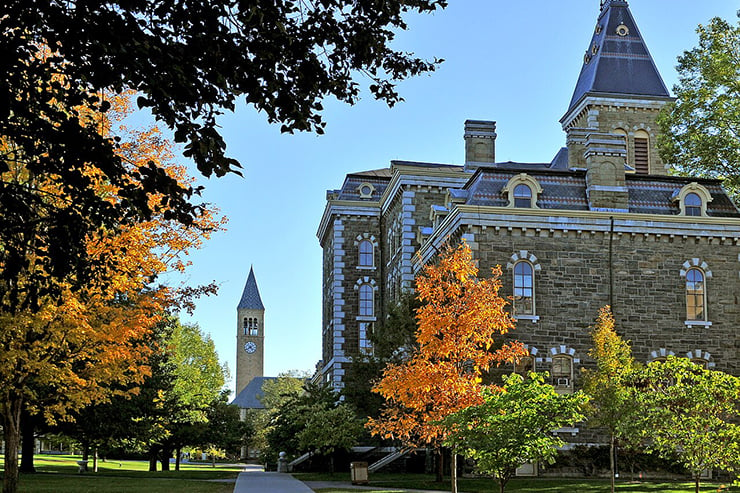
According to an Education Department report issued in 2020, many institutions simply failed to comply, while others accepted funds for institutes, study centers, and individual faculty members who were deemed, rightly or wrongly, to be outside of the statutory reporting requirement. Still other foreign funds have been processed through U.S.-based institutions to mask their foreign provenance. The Education Department’s investigation identified billions in previously undisclosed foreign funds, including $760 million in gifts from Qatar to a university identified by the Wall Street Journal as Cornell, which operates a branch campus in that country. Under the new legislation, that branch campus’s continuing existence would presumably disqualify Cornell from receiving federal funds.
This would certainly be a sore point in Ithaca, where last year Trump’s second administration froze nearly $2 billion in U.S. federal funds pending an investigation into Cornell’s observance of civil rights laws amid violent anti-Semitic protests, but Cornell is far from alone in its vulnerability.
Georgetown, Northwestern, Virginia Commonwealth, Carnegie Mellon, and Texas A&M Universities also maintain campuses in Qatar, which receive substantial local support in addition to largesse directed to their home campuses in the United States. As a critic for the Jerusalem Post points out, Georgetown now includes a member of the Qatari royal family on its university-wide board of directors and has hosted a number of controversial scholars with pro-Islamist views in its School of Foreign Service, a leading conduit for future U.S. diplomats. Notably, this fall Georgetown’s law school will welcome as its new dean disgraced former University of Pennsylvania president M. Elizabeth Magill, one of the three elite university presidents who, in December 2023, told Stefanik in a congressional hearing that “context” would determine whether calling for the genocide of Jews on campus violated university conduct codes.
Stefanik’s bestselling new book, Poisoned Ivies: The Inside Account of the Academic and Moral Rot at America’s Elite Universities, documents the extent of Qatari largesse to American institutions and raises significant concerns. Northwestern’s Qatar campus, she claims, for example, is “a viciously antisemitic environment” and an “influence operation” for “channeling Qatar’s money and Qatar’s worldview into elite American institutions.”
Stefanik is not alone in this view. The National Association of Scholars has found that Qatari “influence led to compromises on freedom of expression” on U.S. campuses. The Institute for the Study of Global Antisemitism & Policy has found that “foreign donations from Qatar, especially, have had a substantial impact on fomenting growing levels of antisemitic discourse and campus politics.” The Network Contagion Research Institute found that foreign donations, particularly from Islamic countries like Qatar, correlated with “higher levels of antisemitic acts than on campuses that did not receive such funding.” The Heritage Foundation found that universities deficient in civil rights enforcement were especially unwilling to sanction foreign students who violated campus civil rights policies. Just this week, Cornell’s new president, Michael E. Kotlikoff, who has been more aggressive about disciplining students for violent campus behavior, was mobbed by pro-Palestinian protestors after a discussion of the war in Gaza.
Momentum is on the new bill’s side. As Inside Higher Ed reported, even before Trump’s reelection, in February 2024, Texas A&M’s board voted to phase out its Qatar campus by 2028, following reports that its nuclear engineering, AI, and cybersecurity programs may have been compromised by Qatari ownership rights. Open the Books, a nonprofit that tracks government spending, reports $890 million in gifts to that university from Qatar.
Shortly after Trump returned to office, he issued an executive order to strengthen enforcement of existing regulations and increase transparency over foreign donations. In March 2025, the House of Representatives, as documented by Higher Ed Dive, passed a bill to lower the general reporting threshold for foreign funds to amounts exceeding $50,000 and to $0 for countries of concern, like Qatar. Currently coursing through the Senate, the bill also extends government oversight over foreign funds. Last December, the House passed two similar bills, one that would deny federal funds to primary and secondary schools that accept any amount of Chinese government money and another that requires schools at those levels to inform parents of their right to request information about foreign influence in them.
Stefanik, who in her book advocates an absolute ban on all foreign funds in U.S. institutions and a 15 percent cap on foreign students, is currently shepherding other legislation to close loopholes that allow foreign funds granted to institutes, study centers, or individuals to be included in reporting requirements. Encouragingly, these bills have enjoyed at least some bipartisan support, with about 30 Democratic members of Congress consistently voting for each of them.
With bans on all suspect foreign funds about to be codified in law, patriotic Americans of all backgrounds should remain vigilant to the dangers of Qatar’s malign influence over education and support further efforts to eliminate it.
Leave a Reply