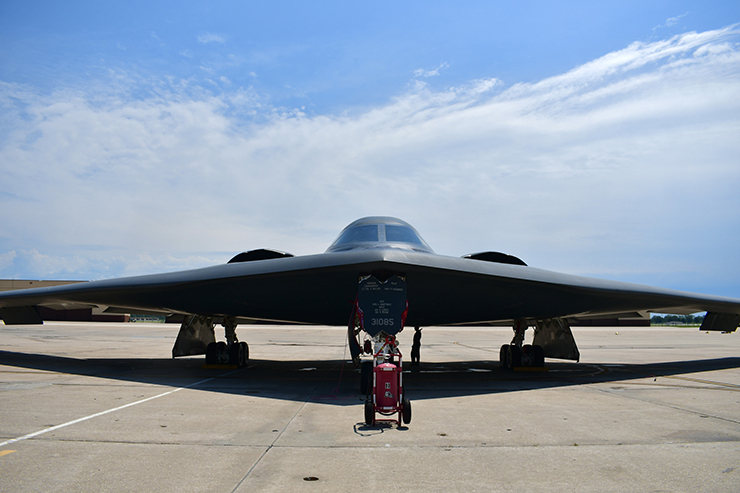
Last month, seven B-2 stealth bombers semi-circumnavigated the earth to conduct the largest B-2 mission in more than two decades. With minimal radio communications along the 18-hour flight to the targets, the B-2s covertly synchronized with over 125 other U.S. aircraft, including refueling tankers, fighters, and intelligence planes. The surprise attack on Iran’s nuclear facilities was nothing short of a virtuoso performance by our pilots and air planners.
But imagine if instead of 14 B-2 pilots flying for 37 hours into and out of enemy airspace, we used drones—and instead of a human behind the stick of the fighter escorts, AI was in control. Could the U.S. claim a moral victory if machines did the dirty work for us? Would our hearts still swell with awe and pride in our military if we didn’t have any skin in the game? I believe the answer is largely “no.”
Culturally, as evidenced by the depiction of aviation in popular films and books, we remain attached to the notion of humans in the cockpit, and the fighter pilot maintains a special place in the American popular consciousness. But this sentiment is eroding, and it will have a profound effect on future warfare.
Last spring, DARPA revealed that its AI-driven X-62 VISTA (a modified F-16) went head-to-head in a dogfight with a human-flown F-16. While the winner of the fight was (wisely) never revealed, the aerial demonstration was deemed a success. And recently, Elon Musk, who knows a thing or two about autonomous vehicles, blithely proclaimed in an X post that “manned fighter jets are obsolete in the age of drones anyway. Will just get pilots killed.”
These developments indicate that the character of air warfare is on the cusp of a radical change: In the not-too-distant future, our military will be able to achieve air superiority without its men (and a few women) possessing “the right stuff.” A soldier once told me that it takes a lot more guts to confront the enemy at close range than to push a little button to drop a bomb from the sky. His point rings true to a degree, but I contend that doing anything at over 500 miles an hour, 30,000 feet above the earth, while vulnerable to missiles, mechanical failures, collisions, and ultimately the laws of physics, requires not only unflappable competence, but tremendous courage.
Thus, the pilot, particularly the fighter pilot, is revered for being the leading edge of the Air Force’s combat capability (even as his accompanying bravado often breeds resentment). Like the chivalrous knight and the rugged cowboy, the fighter pilot stands in the pantheon of solitary heroes. Throughout the 20th century, the arts have played a significant role in placing him there. Early works, particularly the silent film Wings and Antoine Saint-Exupéry’s 1939 memoir, Wind, Sand, and Stars, immerse audiences and readers in the romance, terror, and tragedy of the early days of flight. Moreover, these masterpieces imbued the profession with moral weight, for in hovering in the liminal space between heaven and earth, on the edge of life and death, the pilot is afforded a more expansive view of life, human nature, and truth.
As we entered the jet-age, the pilot shed his courtly persona to adopt a brasher, more roguish identity as depicted in Tom Wolfe’s The Right Stuff. Men like Chuck Yeager, motivated equally by patriotic duty and an unquenchable desire to “push the envelope,” rollicked across the skies, through the sound barrier, and all the way to the moon. From this generation emerged the current fighter pilot archetype, which has been distilled into one particular modern hero: Maverick.
The Top Gun franchise is arguably one of the chief cultural reasons young men have been drawn to aviation since 1986. Based on some highly unscientific polling that I did as a student at the Air Force Academy, I found that the majority of my male counterparts identified Top Gun as among their favorite movies, which was remarkable because the film was already about 20 years old at that point. Over a decade later, while sitting in my Pentagon cubicle, I overheard a retired pilot recounting his days in flight training to some younger officers. Marveling at the aerial maneuvers they were learning to perform, he recalled his feeling that “I am [expletive] Maverick!”
As life seeks to imitate art, so too will people continue to become pilots for the foreseeable future, in part because of Top Gun sequel, Top Gun: Maverick. The latter film reshapes Maverick as a pilot and reimagines what he represents. In keeping with the nature of current air warfare, the Maverick of 2022 is focused less on air-to-air combat or “dogfighting” with enemy pilots, and more on evading surface-to-air missiles that protect his target from an air strike.
More significantly, Maverick becomes a latter-day John Henry, who refuses to cede his trade to the unrelenting march of technological progress—in this case, drone warfare. (Interestingly, Operation Midnight Hammer mirrored Maverick as well, in its mission to destroy the adversary’s deeply hidden and well-guarded uranium enrichment facility.) Little did Tom Cruise realize that while he was saving movie theaters with Maverick, he was actually saving the profession of aviation—for a while, at least.
Because pilots aren’t willing to give up the stick to AI quite yet, they are entering into an uneasy alliance with the robots. Known as “human-machine teaming,” pilot and drone will theoretically collaborate. This is the purported objective of the X-62 VISTA project, as well as the F-47, the Air Force’s sixth-generation warplane, which is designed to be accompanied by drone wingmen. “We’re not trying to replace pilots; we’re trying to augment them, give them an extra tool,” said M. Christopher Cotting, director of research at the USAF Test Pilot School.
This distinction is important, so long as it holds. Antoine de Saint-Exupéry wrote,
To be a man is, precisely, to be responsible. It is to feel shame at the sight of what seems to be unmerited misery. It is to take pride in a victory won by one’s comrades. It is to feel, when setting one’s stone, that one is contributing to the building of the world.
Nearly 90 years later, the truth of his words is being borne out as pilots resist ceding their responsibility.
Most pilots meet reassignment from flying F-16s to Reaper drones with dismay. Obviously, they are disappointed to be forced from the air and into a trailer from which they remotely fly aircraft and conduct airstrikes over distant continents.
The moral and psychological truths of combat aviation minus the pilot, and the resistance of pilots to it, was prefigured in the arts, too. The film Eye in the Sky and the odd opera Grounded (which probably does as much to call into question the suitability of women for combat) are just two examples. As reflected in these works, there is a sense of injustice—or shame, in Saint-Exupéry’s words—in inflicting violence on an adversary from a position of safety thousands of miles away. In taking life without taking risks, drone warfare shirks much of the responsibility of the profession of arms.
In eliminating danger (at least for our armed forces) from conflict, we lower the threshold for foreign adventurism. At the same time, we intuit that imposing our will with impunity is at odds with our identity as a free and just constitutional republic. Whether our citizenry realizes it or not, Operation Midnight Hammer would have had a vastly different complexion if an ICBM or drone had taken out Fordow. Whatever one thinks of the operation, it is significant that humans took the risk and bore the responsibility for the strike.
War is an ugly thing (though not the ugliest of things) and we cannot enter it without serious deliberation. It is redeemed only through acts of heroism, self-sacrifice, duty, and the justice of the cause. The pain of war serves as a corrective, lest it become too easy to kill. But there is little virtue in war waged by machines, and the truth of the soldier’s observation about proximity to danger is all the more evident in this context.
In some ways, we cannot avoid the path that we are on. A harbinger of wars to come, the Ukraine conflict, has been profoundly shaped by AI and drone warfare. If an adversary like China increasingly relies on autonomous machines to wage war, it would be akin to “The Charge of the Light Brigade” to send our servicemembers to their noble demise rather than responding in kind. But what is the point of a machine-vs.-machine battle? Mothers do not weep for drone crashes; monuments will not be erected for robot victories. No one will care about the outcome of human-less combat—until it causes human suffering. Thus, it will be civilians who pay the price for future wars.
Of course, civilians have never been fully spared from the destructive effects of war. But the soldier, the sailor, and the pilot traditionally have absorbed the majority of the moral and physical hardship of combat so that the rest of us don’t have to. War by AI and drone turn this arrangement of human affairs on its head.
To be sure, drones have been a facet of warfare for decades now, and AI is already playing a role in current conflicts and military decision-making. There is no going back. But it is hubristic to think reliance on AI and autonomous weapons will spare human beings the chaos and pain of battle; it will only strip war of its moral facets while shifting risks to civilian populations.
We must guard the human role in conflict zealously and encourage our potential adversaries to do the same. Arms treaties limiting the use of autonomous weapons or requiring human combatants are possibilities. Our attachment to the fighter pilot is not merely a sentimental one; it is a moral one. Maverick is the canary in the coal mine: as he goes, so goes the future of warfare.
Leave a Reply