
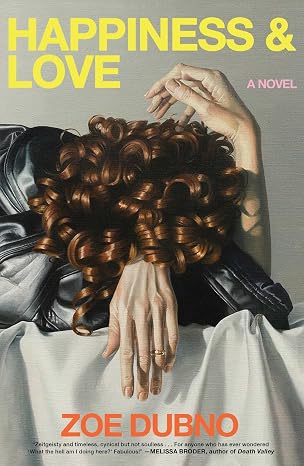
by Zoe Dubno
Scribner
224 pps./$13.43
Happiness & Love, the bracing and barbed debut novel from Zoe Dubno about the pretentious New York art scene and the wretched people who populate it, is a must-read for audiences ready for a thoughtful examination of the elite/populist divide. If you’re a conservative looking for a beach book that will grab and entertain you but is also several literary notches above the usual “reunion-at-the-cape” summer reads, this is for you.
Dubno lives in New York and has a degree from Oberlin and an MFA from Rutgers. Happiness & Love is her pungent kiss-off to the world that bred her.
The unnamed narrator of the novel is a writer who lives between New York and London. Over the course of a single evening in Brooklyn, she attends a dinner party hosted by two of her old art-world friends, artist Eugene and curator Nicole. It’s the night following the funeral of Rebecca, an actress who killed herself after falling into addiction when her career faltered.
Here is an excerpt:
She really made me sick, the magazine editor with the child’s name, the comrade who was so happy to be spotted in the VIP section of the left-wing rally in Queens. I could see her thinking, these people are frivolous, they are the frivolous friends of a frivolous person who died because her life had become unbearably frivolous, whereas in her mind, the magazine editor’s life could never be truly frivolous because she knew that she had given up dialectical materialism for straight materialism. She was impenetrable because she believed that she was studying the machinations of capitalism from its very center—however ridiculous she became she was able to tell herself, what a wonderful service I am doing to the intellectual community, however low she became, however embroiled in the world of consumerism and cultural decay, she felt like she was a secret agent, an emissary from the world of ideas into the depths of the discount underwear bin, and that was why in that moment I realized maybe she bothered me even more than Eugene and Nicole, who had so brazenly used culture to their own ends in order to surround themselves with people they thought were important, to launder their money and their reputations through the cultural arts. Eugene and Nicole knew inside that they were frauds, I thought as I sat in the corner seat of the sofa, they knew that they were completely ridiculous people.
Tom Wolfe lives!
The narrator serves as a kind of safari guide to the wildlife populating the New York arts world. Eugene is obnoxious and creepy, a coke-fueled sexual predator living off the glory of his famous father’s art. Even worse is his wife Nicole, who is cold, cruel and overly immersed in the mediocre art she presents at her shows. Yet Dubno is too good a novelist to reduce these characters to cartoon sketches. They are nasty and cruel, but also sad and pathetic. When Eugene is described in an oversized blue blazer and yellow beret, you kind of feel sorry for him. Nicole is arrogant, but there is a weakness at her core that always seems about to crack. Even the narrator has a turn under her own microscope and is pronounced “weak” and “a coward” for getting dragged into a party she had a chance to avoid. She sees what it is, but at the same time she wants to be part of the scene—–or, at least, she thought she did.
Happiness & Love is literary fiction, but it might better be described as a modern horror novel. The narrator is like a woman trapped in a haunted house—the nightmare world of the liberal elite. This is a world, as one reviewer put it “of art-world operators, where curiosity is instrumentalized, taste is status, and intimacy is degraded to social leverage. Happiness & Love is a novel about people who know how to talk about art, but have given up on really caring about it.”
These people are living off of the greatness of the past and posturing as if they are the ones who created it—as if what they contribute to their world is something unique and special. But it’s all a ruse. Moreover, it is one that the late-arriving guest of honor, a young actress visiting from Los Angeles, sees through. It turns out that the actress is actually a well-educated populist who understands what the people around her are doing. In a verbal war with an academic named Alexander, she almost comes across as MAGA:
Look, man, I went to college, I was an English major! I read some pretty dense things. And even if I didn’t, I don’t see why you have such a low opinion of your audience. Part of the reason I wanted to be an actress was because I loved stories, showing people stories. And I’ve tried to show people that the things I make are for everybody. Shakespearean drama is for the masses, and the things that intimidate people really shouldn’t intimidate them at all, because all that they are, all that any art is, is something that another human being came up with. A human being who took baths, and ate spaghetti, and wrapped presents for their friends and family. That’s what we should really understand about art. Because the extremely high art begs you to remember exactly that. High art reminds us of our humanity, not only of the intellectual prowess of its author. The thing that bothers me even more than people thinking reading is dead, that theater is dead and that Hollywood films killed it and therefore all Hollywood films are useless capitalist trash, because there is a bit of truth to that, what bothers me even more than that are the people that act like being intellectual is the most difficult thing of all, and that by reading and thinking and writing they are some kind of partisan force that exists outside of the general public. In addition to her novels and, like, inventing second-wave feminism or whatever, Simone de Beauvoir wrote about how she and Sartre had so much fun going dancing! The difference with these people is that they had real contributions to make to intellectual life and so they weren’t worried about seeming frivolous, they knew that they didn’t have to turn the mundane practicalities like hanging out with their friends into some kind of mythic performance of their intellects because nothing about their intellect was being called into question.
Like I said, Tom Wolfe lives.
Leave a Reply