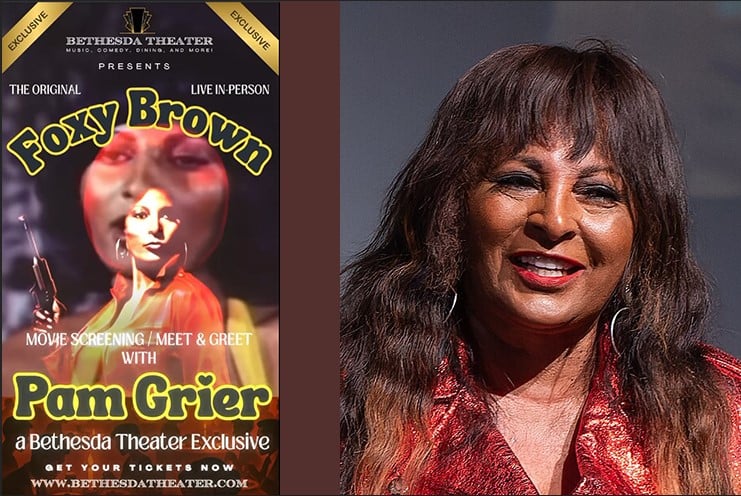
In a recent appearance where she introduced her classic 1974 movie Foxy Brown, Pam Grier said something beautiful. Grier was talking about how the so-called “battle of the sexes” and rising feminist sentiment during the 1970s, and her role in those old struggles, were meant to bring couples closer together, not to spark a competition.
“We set it up for men to be comfortable,” Grier said.
Women are not taking your job away from you, just being a partner. Because some days you don’t want to get up. You came back from war. You’re impaired. You can’t keep up in front of your family. The women said that’s OK, we’ll take care of you. That’s the greatest feeling of love and honor in your relationship that you can have.
Rather than portraying the social upheavals of the 1960s and ’70s as a battle, then, she couched them in sympathy for the struggles of men—while simultaneously praising the strength and love of women.
Grier came to fame while starring in a number of low-budget “blaxploitation” action films in the early-1970s—like 1973’s Coffy and 1974’s Foxy Brown, as well as her fantastic star turn in Quentin Tarantino’s 1997 film Jackie Brown. Her recent appearance at the Bethesda Theater in Maryland, which I attended, proved Grier is much more than a ’70s soul woman or a 1990s movie icon. She’s a woman of real insight and humor, as well as keen intelligence. Grier often defies the categories that reporters and fans try to put her in.
Take the recent answer she gave to the Hollywood Reporter about the blaxploitation films of the 1970s.
It wasn’t called “exploitation” until I walked in a man’s shoes. I used martial arts and I held guns. I come from a country environment, went hunting with a .30-06 [rifle]. I understand rifles and guns and hunting and throwing people over my shoulder. So maybe they meant it was “exploiting” the woman, the little woman who’s not supposed to fight for herself, supposed to let the man come in and save her. Well, sometimes they’re not there and you have to be a little bit exploitative to save your ass, OK?
That answer could have been given by Ann Coulter. In fact, my formative memories about Pam Grier don’t involve the ’70s or even Tarantino, but recall her films of the 1980s. It was in that decade that I worked in the Bethesda Theater, the very place I found myself sitting as I watched Grier speak.
Back then, it was called the Bethesda Cinema ’n’ Drafthouse. It was a beautiful, converted Art Deco-style theater that had been transformedinto a theater with round tables, a bar, and a full kitchen, long before the Alamo Drafthouse franchise popularized that style. It was while bartending there that I saw Grier in the 1980s films Above the Law and The Allnighter. Even before that, I knew her from the 1983 adaptation of Ray Bradbury’s Something Wicked This Way Comes, in which she plays the Dust Witch.
In my brief conversation with Miss Grier before she took the stage, the first thing I mentioned was that Jackie Brown has not only held up in the intervening years, but is considered by many to be Quentin Tarantino’s best film.
“Well, it was made creatively by Quentin Tarantino,” Grier said, “and I got to play in his sandbox of creativity with Samuel Jackson, Michael Keaton, Robert De Niro, Robert Forster, Bridget Fonda, and, of course, Elmore Leonard.” (The film is based on Leonard’s novel Rum Punch.)
It was interesting, and it still is … Jackie Brown is about the color of manipulation and power and how you look at gender issues and political issues. So, it’s complex. The entire film is a master class of discovery and cinema and politics and so many things. Every time I see it, it’s something interestingly new. So, it’s going to translate many years into the future, whether we like it or not. It’s got its own legs, if you will. I’m enjoying it, and I will always, because I’m a learner.
I also wanted to ask Grier about religion. In her autobiography, she talks about growing up with Catholic and Methodist. What is she now?
I was raised in a Catholic environment for my family, and my dad was a Methodist, so I went to Methodist churches. And then there were family who were Baptists, I went to Baptist churches for the music. And I realized, you know, even as a little girl, religion, spirituality is gender-based, and even more so today as we recognize independent thinking, independent praying, and all the different types of gods, male and female. So it’s a little bit more complex, and I’m out of the forest. But basically, I found my own spirituality with all the religions and gods and goddesses that are around.
I was feeling nostalgic as I returned to the space once occupied by the old Cinema ’n’ Drafthouse, and at one point I bumped into the proprietor, Earl, as I was looking for the old stairs that lead up to the projection booth. We chatted for a few minutes and I took my seat. Then Grier took the stage and offered her lovely words of healing for men and women. She even encouraged the audience to “play footsies” during the movie—it’s a sexy picture after all—and then she reminded us of something important: If you want to be a survivor like Foxy, an international spy whose life is faced with constant danger, “you have to be crazier than the people targeting you.” That resonated in a way that caused everybody to cheer as the lights went down and the flicker of the screen captured us.
Leave a Reply