Charlie Brown is 75. The media celebrations of the Peanuts’ anniversary all note that, seven-plus decades on, the strip still resonates. It is funny while, at the same time, making poignant observations about the irony, joy, and frustrations of life.
What’s been missing from the coverage is what I’ve always found most interesting about Charlie, Lucy, Linus, and the gang—the spiritual angle. There has always been a mystical, philosophical and contemplative tone to Peanuts. The characters seem bemused and accepting of the disappointments of life, yet also are rewarded with friendship, loyalty, and humor. There has to be a theology behind it, I have always thought, and I’ve long been curious about what accounts for it.
In his 1968 book, The Parables of Peanuts, Robert Short sees Christian theology at work in the strip. Charles Schulz once asked, “If we are all members of the priesthood, why cannot a cartoonist preach in the same manner as a minister, or anyone else?” Short claims that Schulz’s cartoon strips, like Jesus’ parables, combine “the proclamation of God’s love for the world, and [a depiction of] the world as it really is.” Short’s book contains references to theologians such as Karl Barth, Dietrich Bonhoeffer, and Soren Kierkegaard.
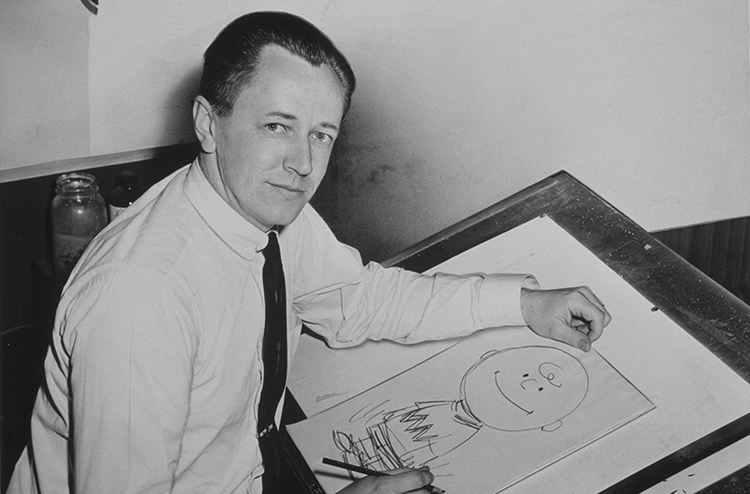
The real story, however, is that Charles Schulz, the creator of Peanuts who died in 2000, was never really comfortable talking openly about religion. As the new book What Cartooning Really Is: The Main Interviews with Charles M. Schulz reveals, the cartoonist would often try to divert questioners who asked him about God.
This is odd considering Schulz was the man who insisted, against the wishes of network executives, that in his Christmas special the character Linus would recite Luke 2: 8-14:
And there were in the same country shepherds abiding in the field, keeping watch over their flock by night. And, lo, the angel of the Lord came upon them, and the glory of the Lord shone round about them: and they were sore afraid. And the angel said unto them, Fear not: for, behold, I bring you good tidings of great joy, which shall be to all people. For unto you is born this day in the city of David a Savior, which is Christ the Lord. And this [shall be] a sign unto you; Ye shall find the babe wrapped in swaddling clothes, lying in a manger. And suddenly there was with the angel a multitude of the heavenly host praising God, and saying, Glory to God in the highest, and on earth peace, good will toward men.
When journalists would remind Schulz of the Christmas special, or remark upon the fact that he had taught Bible study for many years, or note that the Christmas special is explicitly Christian, the creator of Lucy and Linus would demure. “No, I’m not the one to question for anything,” he told historians Rick Marschall and Gary Groth in one interview, “and I don’t know anything, frankly. I think it’s all a total mystery. Have no idea why we’re here, and I have no idea what happens after we die.”
When pressed further, however, Schulz opened up about the focus of his spirituality: gratitude. “My religious thing must have been a matter of gratitude,” he said.
Schulz was the son of a Lutheran minister. When he was just turning 20, his mother Dena began to suffer from cancer. “She suffered terribly,” Schulz said. “I used to wake up at night and hear her down the hall crying in pain. It was a terrible time.”
Soon after, Schulz was drafted by the Army and served in Europe during World War II. Before he left, Schulz’s mother said to him, “Well, goodbye, Sparky, we’ll probably never see each other again.” She died soon after.
In What Cartooning Really Is, Schulz describes the gratitude he felt for surviving both the devastation of the loss of his mother and the war. “I started going to church just out of a feeling of gratitude that I survived all of that,” he said.
I felt that God protected me and gave me the strength to survive because I could have gone off in all sorts of wrong directions. I always felt the I was helped to live through those three years and come home, because I never got shot or anything.
In a wonderfully insightful 2023 New York Times essay, Jewish writer James Poniewozik expressed his love of A Charlie Brown Christmas. “I never felt excluded from Christmas, or—as a reader of Schulz’s Peanuts collections—from A Charlie Brown Christmas,” he observed.
For all of the Snoopy high jinks and slapstick, A Charlie Brown Christmas is as close to poetry as television gets. If Irving Berlin and other great Jewish musicians could compose some of America’s favorite Christmas songs, surely I can look past a few New Testament verses.
Then Poniewozik adds this:
But honestly, I appreciate the Peanuts special more for how it deals directly with Christianity. It is sincere and radically earnest, without any interest in converting anyone. This is just what Christmas is, a ubiquitous celebration based in a faith that I do not share but that I can appreciate, the way I can appreciate the art of plenty of other cultures.
In his unassuming, unpretentious way, Charles Schulz may have been one of the great evangelists of the 20th century.
Leave a Reply