
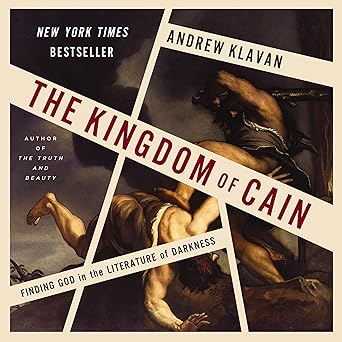
The Kingdom of Cain: Finding God in the Literature of Darkness
by Andrew Klavan
Zondervan
272 pps., $16.15
Definitions matter. When a text treating a particular subject fails to provide sufficient definitions for its terms, it can become convoluted, incomprehensible, and even ugly.
Such is the case with the recent book The Kingdom of Cain: Finding God in the Literature of Darkness by award-winning novelist, screen writer, conservative podcaster, and literary critic Andrew Klavan. While it often succeeds in showcasing Klavan’s wit and insights, ultimately it fails to come together as a satisfying whole. What begins as an exploration of the reality of evil gradually spirals into tangled web of autobiography, philosophy, theology, art criticism, and social commentary.
Klavan clearly has high ambitions, wanting nothing less than a program to restore seriousness and depth to Christian art, restore Western culture, and thereby bring souls to Christ. Unfortunately, his attempt at prescription is more like an offering of amusing food for thought, which is enough to make the book engaging but it nevertheless leaves the reader underwhelmed.
To his credit, Klavan picks an excellent topic to explore, at least in his opener: “My premise is simply: murder is evil. As such, it exposes a path of thought or feeling that the human heart or mind has taken.” He is correct that this simple claim flies in the face of today’s postmodern philosophy that denigrates morality as an arbitrary construct. Klavan begins by taking what he knows best and using the archetypes of a thriller to show that evil is real and that it becomes ever more prevalent as people stray from Christianity.
Thus, Klavan starts with Fyodor Dostoevsky’s Crime and Punishment, which features the young idealist Rodion Raskolnikov who murders two old ladies to prove that he has transcended Christian morality. The German philosopher Friedrich Nietzsche is likewise intrigued with this idea, positing his own theory of the ubermensch, a man with a will strong enough to break the bonds of morality and metaphysics.
Nietzsche, in turn, then inspires two Americans, Nathan Leopold and Richard Loeb, to commit murder, which then becomes the basis for Alfred Hitchcock’s film Rope. Despite the supposedly enlightened arguments given to justify these crimes, they all end up reaffirming the harsh reality of evil.
Klavan not only shows the pattern that emerges when immorality is mistaken for empowerment, he also comes to see the unshakeable moral truth established by the Christian God. Ironically, it’s the existence of evil that leads Klavan to believe in the existence of God.
After this, Klavan examines how lust twists people’s consciences and, in some cases, causes them to commit acts of murder. Under the Christian ethic, lust was understood to be a natural drive that was bridled by divine grace and self-discipline. Outside of Christianity, lust is presented as something society’s luminaries must liberate themselves from—eliminating self-imposed guilt and sexual suppression.
This ideal of sexual liberation figures into the psychopaths of popular horror films like Psycho, Halloween, and Silence of the Lambs. In this view, the evil committed by these monsters is a psychological distortion requiring the expertise of the therapist. Since this is just a kind of false materialism, it is ultimately inadequate both as diagnosis and remedy.
While Klavan’s argument up to this point is gripping and relatively coherent, it jumps off the track in the following chapters. What begins as a focus on the nature of evil soon becomes a commentary on well-regarded thrillers and then drifts into an exegesis of Genesis. In Klavan’s mind, the story of Caine and Abel encapsulates all the major elements of murder. Like his previous chapters, all of this is interesting but it doesn’t rise above the speculative.
Once he moves into the second part of the book, Klavan seems mostly indifferent to the objections of his critics, and instead discusses his faith journey from a depressed young Jewish man to a relatively joyful Christian. He notes that his conversion revolved around the meaning of his original Jewish name L’chaim, which was life: “Life’s the thing. The thing is: Life! L’chaim.”
As nice as these reflections are, they don’t explain how objective morality ended up persuading him to accept God’s existence. Nor do they exactly explain how he became addicted to online smut, which happened after conducting “research” for a book. Mercifully, he can report that he has overcome his addiction and renounced it for good, but it is not clear why he brings this up in the first place.
One chapter that has more structure and focus includes Klavan’s recounting the time he learned about the death of a psychiatrist who had once saved his life when he was a young man. In itself, the story is a moving defense of what psychological therapy can do for a person who is lost. But the power of this reminiscence is lost when Klavan carelessly weaves in details about his ideas for books and stories, his thoughts on the properly Christian view of sex and the body, his eventual conversion.
In his final chapter, “A Certain Splendor: Art as the Key to Theodicy,” Klavan goes on his last tangent, reflecting on the theology of art and beauty. He dismisses the rational “proofs of God” since they are “human things based in the logic of materiality,” and instead surveys the artistic masterpieces of the West in accordance with his notion that “beauty must be the expression of God’s very nature.” What follows is a lush description of many master paintings, beginning from the Hellenic period of Ancient Greece and spanning to the modernist creations of the last century.
Altogether, reading The Kingdom of Cain is a mixed experience. On the one hand, Klavan addresses important questions about the role of art in Christianity and society with a fresh perspective, but it is also clear he lacks the discipline to follow through on finding satisfying answers. Although he is perfectly positioned to deliver a penetrating analysis of fiction and morality, he instead spoils this with his constant changing of purposes.
Perhaps he can make a better effort in a follow-up work that finishes the intellectual journey he has begun. Klavan could still showcase his particular brand of cynicism and grim humor, but now these could work in the service of something clear and distinct. And maybe he could call this much-needed sequel the Kingdom of Christ: God Is Found in the Literature of Darkness. For my part, I would love to see how this story ends.
Leave a Reply