by James Ellroy
Alfred A. Knopf Publishers
544 pps./$32.00
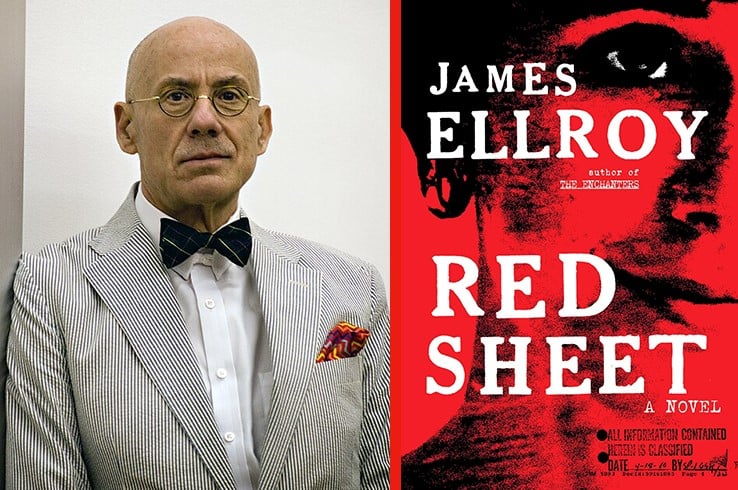
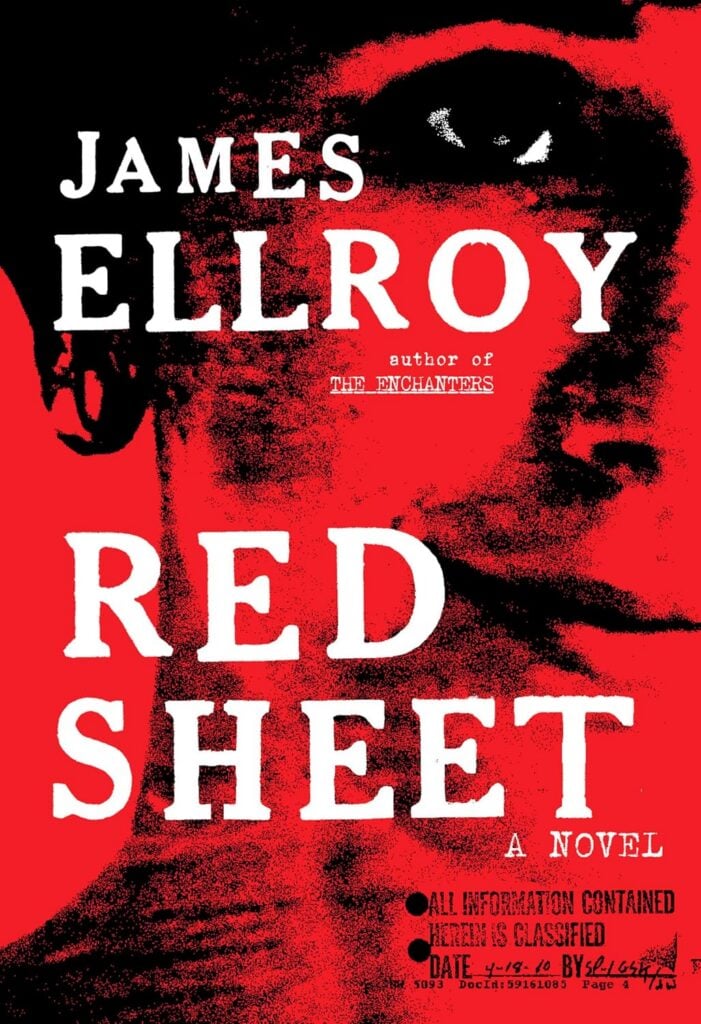
Where were you in ’62? Regardless of your answer to that question, author James Ellroy offers a more exciting alternative in his latest novel, Red Sheet. Red Sheet invites readers to accompany real-life private investigator Fred Otash on a fictional investigation into communist fifth columnists operating in Southern California in the wake of the Cuban Missile Crisis.
Otash, who died in 1992, has experienced a whole new life as an antihero in Ellroy’s recent novels. In Red Sheet, Otash has traded in P.I. work for a job as an investigator in the Los Angeles County District Attorney’s Office. From there, Otash finds himself quarterbacking the aforementioned red hunt alongside a fictionalized version of future Los Angeles police chief Daryl Gates. If that were not enough, Otash accepts a collateral assignment from the staff of gubernatorial candidate Richard Nixon to protect the future president from his own reckless naiveté.
And all of that occurs in the first few chapters. From there, the byzantine plot winds and unwinds through a macabre miasma of historical events, encompassing the anticlerical regime of leftist Mexican president Plutarco Calles, the Lindbergh baby kidnapping, the Spanish Civil War, and the Hiss-Chambers Case. The latter deserves special recognition.
Red Sheet is prefaced by a quote from Whittaker Chambers, and the dramatis personae appended to the novel identifies Chambers as its “spiritual father.” The prepublication press release from publisher Alfred A. Knopf made it clear that Red Sheet would take a favorable view of the congressional witnesses, like Chambers, who endured great personal and professional sacrifice to reveal the extent of communist subversion in America. This is espoused by Otash himself at several points in the novel, where he stresses the necessity of informants willing to break with the omertà demanded by the Communist Party and risk retribution from their former comrades. Here Otash echoes remarks made by Rep. F. Edward Hébert (D-LA) as a member of the House Un-American Activities Committee (HUAC) while questioning Alger Hiss, “You show me a good police force, and I will show you the stool pigeon [the cops relied on].”
You will not find criticism of Red Sheet’s pro-informant stance from me, as I once wrote a column about the need to “bring back HUAC.” Despite the historical nature of Ellroy’s novel, its thesis is timely given the nature of the new cold war with China. Recently, the mayor of a California city was revealed to be a ChiCom agent. The need to expose communist subversion in America is perhaps more critical now, given that the U.S no longer enjoys many of the advantages it had vis-à-vis the U.S.S.R. The U.S.S.R. was only a military power. It was never the economic competitor that China is today.
But in the noirish world of Ellroy, things are never black and white. One of Red Sheet’s most stygian, fully fictional characters appears to be inspired by Elizabeth Bentley, one of the more famous former communists to testify before HUAC, with perhaps a little of Ian Fleming’s Rosa Klebb and Richard Condon’s Eleanor Iselin thrown in for good measure. And of course, Ellroy’s fictionalized version of his protagonist Otash is anything but an exemplar of moral rectitude.
This leads into Red Sheet’s second, more esoteric, but perhaps even more pertinent thesis. In the novel, communism does not come off well. But neither does the far right. Red Sheet is a study of the similarities shared by communism and fascism. Just about every fascist character in Red Sheet was once a communist. The novel even features a left-right criminal combine. Here, the novel is echoing Chambers’ observation that communism is a variety of fascism. We are reminded of this every time the far left and the far right unite, from the Molotov-Ribbentrop Pact to the depraved mind of Graham Platner, the Democratic Party’s U.S. Senate candidate in Maine.
Red Sheet is a good novel. It is reminiscent of the ideologically tinged historical novels of John Dos Passos. The best characters are the purely fictional ones, such as Otash’s three henchmen, who are the literary heirs of Saul Panzer, Fred Durkin, and Orrie Cather, the trio of P.I.s relied on by detective Nero Wolfe in the novels by Rex Stout. Red Sheet requires some work on the part of the reader to keep the plot straight, but it is not as exhausting as Ellroy’s earlier opus, American Tabloid (1995). In Red Sheet, Otash observes that he excels at “condensing seemingly unrelated facts to form a conclusive and accurate thesis.” The same could be said for Ellroy.
Leave a Reply