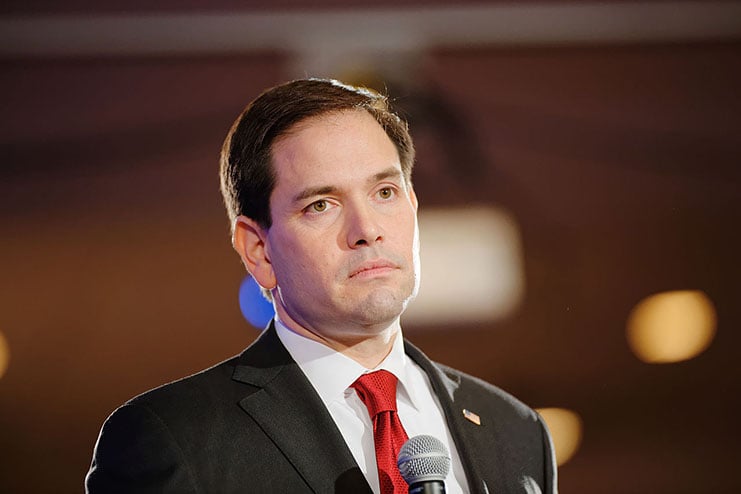
In his address to the Munich Security Conference on Feb. 14, Secretary of State Marco Rubio said that after the end of the Cold War, the West had embarked upon a “dangerous delusion,” thereby weakening its economic, cultural, and political foundations. He also spoke of the “shared Christian faith,” and called the U.S. “a child of Europe.”
During the Cold War the West knew what it was fighting for, and against. After 1989, Rubio said, faith in the flawed notion that trade and international rules could replace national interests began to predominate. This led to the deindustrialization of Western nations, to the benefit of other countries.
Rubio was particularly outspoken on migration. Opposition to the opening of Western borders to waves of mass migration is not a fringe issue, but a transformative crisis that jeopardizes the survival of Western culture and the future of our peoples. Under President Donald Trump, he said, the U.S. is prepared, if necessary, to pursue renewal on its own. Washington wants to take this path together with Europe, however, because we belong to a shared Western civilization, bound by history, culture, and Christian heritage.
National security, Rubio said, is not only a matter of defense spending, but more importantly of what is defended. Armed forces protect nations and a way of life. The West should reaffirm its commitment to its cultural heritage to secure its political and economic future.
In closing, Rubio called on Europe to fundamentally change course. The West is, once again, at a historic turning point. Our decline is not inevitable, but a political choice.
In tone, Rubio’s speech was notably less confrontational, but it was not very different in substance from JD Vance’s now-famous address to that same forum a year ago. More emphatically than Vance, Rubio expressed hope that a common cultural and civilizational heritage of “the West” can be saved if America and the EU work together. Unfortunately, that hope is likely futile.
Less than 24 hours before Rubio’s speech, the European Parliament (EP) voted in favor of a resolution calling for a feminist and transgender-oriented EU foreign policy. MEPs approved a text urging the EU Council to defend the recognition of self-perceived gender identity as an international priority. This was, perhaps unwittingly, as clear an answer to Rubio’s appeal as could be expected.
The resolution was adopted with 340 votes in favor and 141 against. EP called on the European Commission and the Council to pursue a “feminist foreign, security, and development policy” that includes a “gender-transformative vision.” Women’s rights and gender equality are described as “fundamental prerequisites for democracy, social justice, and sustainable development.”
At the same time, the resolution calls for special consideration of the protection of “marginalized groups, including transgender people,” in EU foreign policy. A key passage demands the “full recognition of trans women as women.” This recognition is to be explicitly part of women’s and equality policies and advocated for at the international level, particularly within the bodies of the United Nations.
It is striking the text does not treat trans women as a separate group alongside women, but rather integrates them into the broader category of women’s rights. In other words, the resolution does not make a conceptual distinction between biological sex and gender identity.
Furthermore, the resolution calls for the application of gender mainstreaming in all policy areas and an increase in the proportion of women (trans women now naturally included) in leadership positions, specifically in diplomacy and peacekeeping missions. The EU Commission is also instructed to develop instruments for monitoring “democratic regression” and setbacks in women’s rights thus redefined.
So much for the EU reaffirming its commitment to our common Western cultural heritage and joining the U.S. in preventing civilizational decline.
On the geopolitical front, the underlying gap between America and Europe is just as wide.
In her bellicose speech on Feb. 14, EU Commission President Ursula von der Leyen included a highly significant line regarding the recent €90 billion (US$105 billion) EU loan to the Volodomyr Zelensky government: “Ukraine only has to pay back, if Russia pays reparations.”
This implies that the EU is committed to Russia’s outright military defeat, or else the citizens of its economically declining member states will have to foot the bill. It is unimaginable that, short of being utterly beaten on the battlefield, Russia will ever pay any reparations to anyone.
“Reparations” are a weighty word, reminiscent of the 1919 Versailles Treaty, when the burden of punitive reparations—recklessly imposed on Germany—contributed to the outbreak of another war a generation later.
Von der Leyen—and her fellow immigration-welcoming, gender-affirming, climate fanatical, online-censorship enthusiastic Eurocrats—can hope for that kind of outcome only if the United States is drawn into a war against Russia, on their terms and at their beckon.
This must not happen. If Trump stays true to his 2025 National Security Strategy, which was unveiled two months ago, it will not happen.
Von der Leyen’s “Europe” has morphed, over the past three decades, into the enemy of America as well as Europe, of liberty, of sanity and decency. Hoping that her Brussels nomenklatura can or will “reaffirm its commitment to its cultural heritage” is like hoping that the Democratic Party USA can become a sane, legitimate political entity.
Leave a Reply