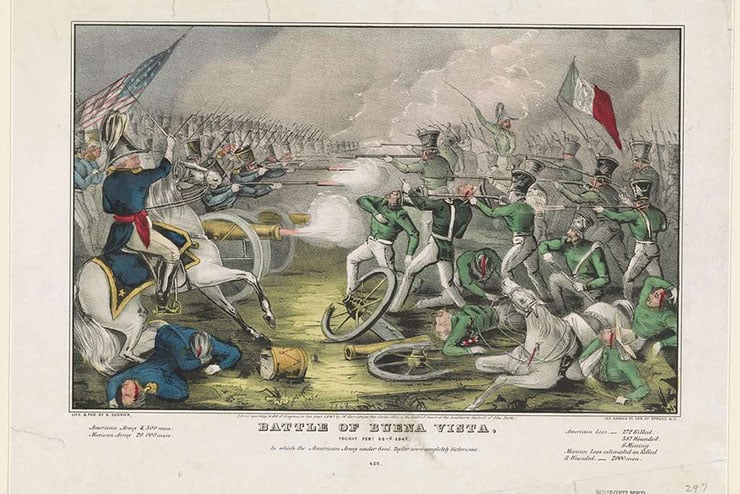
After more than a century and a half of virtual apologies and silence from America’s leading political figures, President Trump finally broke one of the oldest taboos in American politics by issuing a statement celebrating the 178th anniversary of America’s victory in the frequently maligned Mexican-American War. Although the war was condemned at the time and in later generations as a land grab perpetrated by President James Polk, in truth it was brought about by Mexico: Mexican double standards, Mexican chauvinism, Mexican intransigence, Mexican belligerence, and a Mexican attack on the army of the United States.
The road to war was set in motion by the 1845 U.S. annexation of Texas, which had been de facto independent since at least 1836 but over which Mexico still claimed sovereignty. Few, however, are familiar with the history of that time and the many factors muddying questions about the justice of the war, including Mexico’s status at the time, claims of Texan independence, and the effect these facts would have on later Mexican claims.
Mexican independence began in 1821, when Viceroy Juan O’Donoju signed the Treaty of Cordoba. Unfortunately, O’Donoju lacked the authority for this move and it was immediately repudiated by the Spanish government. Reconquest efforts followed until 1829. Spain only formally recognized Mexican independence seven months after Texan independence, in the Dec. 28, 1836 Treaty of Santa-Maria Calatrava—which did not specify Mexico’s border thereby avoiding Spanish entanglement in the Texan question.
Put simply, Mexico insisted Texas could not unilaterally declare independence from Mexico at the very time that Mexico was unilaterally insisting upon its own independence from Spain. Moral differences between Mexican rebels and Texan rebels were limited. If Texans had slavery, Mexicans had peonage—described as a form of debt repayment, which was often slavery in practice.
As Timothy Anna shows in his book, Forging Mexico, 1821-1835, Mexico did not have a stable or longstanding government when Texas rebelled. The First Mexican Empire (under an independent Mexican emperor) lasted from 1821-1823. Next came the First Federal Republic of 1824-1835—during whose brief and chaotic existence the presidency, legally an elected office, changed hands by military coup no less than five times. Yet another coup led to the creation of the Centralist Republic of Mexico in 1835.
It was that change in government which triggered the Texas Revolution—not the longstanding desires of some to preserve slavery or to detach Texas from Mexico or to allow uncontrolled American immigration which had led to small, brief and easily defeated rebellions over the previous decade. Fifteen of Mexico’s 19 states took steps to oppose the Centralist Republic of Mexico through various means. Zacatecas was the first to rebel and its defeat was followed by the sacking of the state capital and murder of 2,000 civilians by General Antonio Lopez de Santa Anna’s army. Fighting began in Texas when the Mexican army’s demand for return of a canon loaned to the town of Gonzales stoked fears that disarmament would be the prelude to another massacre. The “Consultation”—a meeting of prominent Texan political figures which took charge of the rebellion—declared restoration of the 1824 constitution its objective and independence only provisional pending that restoration.
Justified or not, the Texas Revolution was a reaction to developments both widespread and widely opposed within Mexico—and took place at a time of political flux and in the absence of stable well-established government. By the time the United States annexed Texas, its independence and government were well-established and stable realities.
Between annexation of Texas and the outbreak of the Mexican War, it was President Polk who was willing to compromise and Mexico which was determined upon a showdown. Polk’s attitude was illustrated by his approach to the U.S.-Canadian border. He had campaigned on the slogan “fifty-four forty or fight”—the northern latitudinal border of internationally disputed territory from the Rocky Mountains to the Pacific Ocean (not, as some critics assert, east of the Rockies and across the whole of Canada). Once in office, he happily settled on extending the boundary east of the Rockies, at the 49th parallel, all the way to the West Coast.
Polk brought the same spirit of compromise to the question of Texas. In 1840, the Mexican government had agreed to international arbitration (under the Prussian government) of claims for damage made by American citizens and was found liable for over $2,000,000 (equivalent to approximately $70,000,000 today). After paying three of the 20 quarterly installments scheduled, Mexico defaulted on the remainder. Polk proposed that the American government pay the rest of the Mexican government’s debt in exchange for Mexican acceptance of Texas’s independence with the Rio Grande as its border. Mexico claimed that the border was the Nueces River.
Despite Mexico having already ended diplomatic relations with the U.S. over the annexation, Polk attempted to reestablish them with John Slidell as ambassador. Upon arriving in Mexico in November of 1845, Slidell was informed that Mexican President Jose Joaquin de Herrera would only accept him as a special commissioner to negotiate a single matter—Texas. Mexico’s debt was automatically excluded. Even that was too compromising for many Mexicans. Just one month later, General Mariano Paredes stage a successful and highly popular coup—becoming president on Jan. 4, 1846 and immediately reasserting Mexico’s claim of sovereignty over all of Texas.
Talk of war was soon widespread in Mexico City—one popular proposal was a plan to reconquer Texas, then invade the United States and conquer New Orleans. Unrealistic as this now seems, it is important to remember that Polk had not yet reached his agreement with Britain regarding the border of colonial Canada. Many Mexicans believed that America and Britain would soon be at war. While America had its hands full fighting the world’s most powerful empire, the thought was that Mexico would have an easy time grabbing Louisiana.
Faced with this belligerence and Mexico’s refusal to discuss debt payment, Polk ordered an army of 3,500 men under General Zachary Taylor to the banks of the Rio Grande with strict orders not to initiate hostilities. Paredes as a countermove ordered his generals in the area to demand that Taylor withdraw and attack him if he didn’t. If Polk’s decision to send an army across the Nueces into a literal no-man’s land between the two rivers can be criticized and his subsequent claim that the Mexican attack “shed American blood on American soil” was dubious, he nevertheless did little more than was necessary to secure Texas from potential attack and to assure reasonable compensation for Mexico’s unpaid debts.
Once war was declared, American armies won victory after victory—capturing most of the American southwest—but the Mexican government fought on, despite frequently changing hands by coup, until Mexico City itself had been captured. Numerical, geographical, and logistical odds against American forces were so strong that when victory was achieved no less an authority than the aging Duke of Wellington pronounced General Winfield Scott to be the greatest living soldier. (In reality Scott’s campaign was largely planned by one of his staff officers, Captain Robert E. Lee).
Despite the scale of military victory, in the Treaty of Guadalupe-Hildalgo the United States government agreed to pay Mexico’s outstanding debts to American citizens in return for Texas and to purchase America’s almost uninhabited other territorial gains for $15,000,000 (over $550,000,000 in today’s dollars). Calculated for inflation between 1803 and 1848, that was approximately the same price per mile as the U.S. paid for the Louisiana Purchase.
Emphasizing these facts is a denial of faults on the Texan and American sides. If opposition to the Central Republic made the Texan rebellion possible, support of those rebelling for other reasons may have been essential for success. Polk’s combination of brinkmanship with willingness to compromise exacerbated tension. Damage done by private efforts to forcefully detach further territory from Mexico between 1836 and 1845 and the need to prevent repetition should have been given greater consideration. More could have been done to reach a compromise over Texas and the looming Mexican debt before annexation. Polk’s pre-war desire to purchase the southwest should have occurred as a free transaction between equal nations, although Mexico could have declared a non-negotiable guarantee of territorial integrity to be essential for a compromise over Texas.
And that is precisely the point. America was willing to negotiate and compromise while Mexico insisted the United States accept Mexican demands. America was willing to consider Mexican claims while Mexico excluded consideration of its debts to American citizens. America sent an army to act on the defensive while Mexico ordered an army to start a war—after which America paid a fair price for land it had already conquered.
Far from expecting Americans to be apologetic, Mexico ought to finally acknowledge that it got what it asked for in that war of its own making.
Leave a Reply