
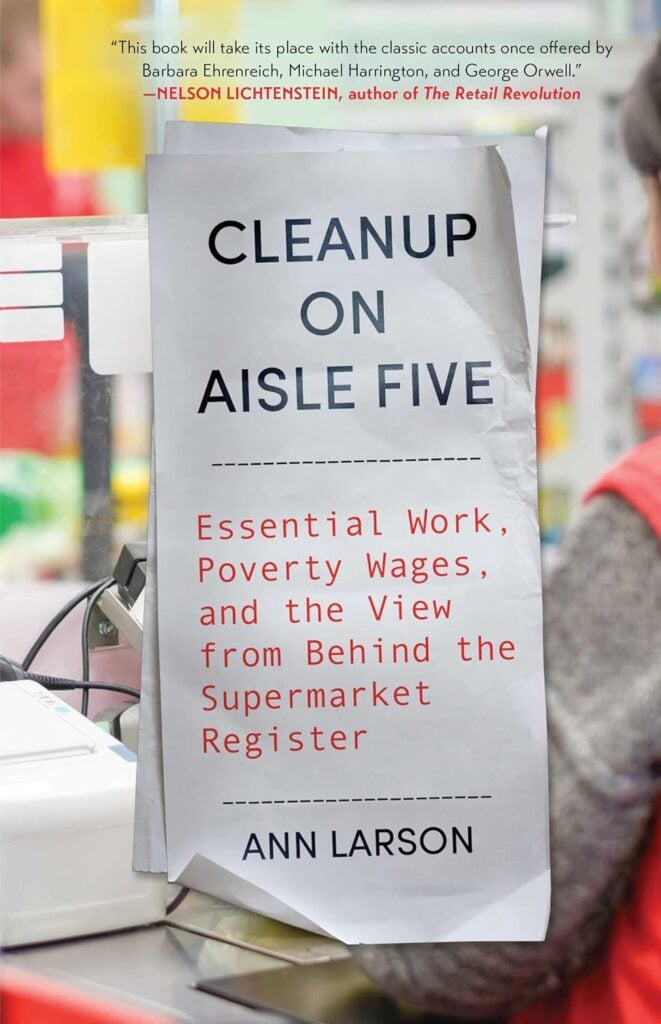
by Ann Larson
Atria/One Signal Books
272 pp., $29.00
Anyone who has ever worked manual labor or in the service industry knows how easy it is while in that position to adopt economic populist or outright left-wing ideas. The work is grueling, there’s not enough time off, and the wages are too low.
That tale is perfectly illustrated in a new book by Ann Larson, Cleanup on Aisle Five: Essential Work, Poverty Wages, and the View from Behind the Supermarket Register, examining the lives and working conditions of grocery store workers. Described by the publisher as a book “in the tradition of bestselling classics such as Barbara Ehrenreich’s Nickel and Dimed and Benjamin Lorr’s The Secret Life of Groceries,” Larson offers “a character-driven exploration of the modern supermarket, unpacking what works and what doesn’t, and delivering a blueprint for a better way to shop.”
After her academic career stalled and the pandemic hit in 2020, Larson worked for a year in a Utah grocery store. Her basic argument in Cleanup on Aisle Five is summed in this paragraph:
Supermarket workers should earn living wages. Cashiers and other grocery employees perform labor that society cannot do without. During the pandemic, their contributions were briefly acknowledged. Some employers offered workers an additional “hero pay” of up to two dollars an hour. But the paltry premium was scrapped a few months later. We should reclaim the idea that grocery workers are heroes—and not just during a crisis. When work is underpaid, the people doing it become devalued. Large retailers have seen record profits in recent years. They can well afford to pay workers what they deserve.
Cleanup on Aisle Five is an interesting book that makes some good points. It’s also flawed. Grocery store work is indeed hard—I’ve worked in a couple grocery stores, most recently Amazon Fresh—and those Americans who work such jobs deserve better pay and better working conditions. However, the problem is not, as Larson puts it, that “capitalism leads to bad outcomes for everyone.” Rather, it’s that capitalism without a moral compass allows owners to believe that it is acceptable to pay workers less than a decent wage and unnecessary to protect them—us—from injury.
Furthermore, Larson is overly heavy on stories of misery, exhaustion, and abuse from irate customers. Most of her coworkers are exhausted all the time, and one even dies on the job. It is fair to note—and it’s something I can corroborate given my years of working service jobs—that these employees never seem to get two days off in a row, like almost everybody else. That is a recipe for burnout.
But I have my doubts when it comes some of Larson’s other stories—like that of her coworkers defending a homeless man who relieved himself in the store, or that they experienced racist and anti-gay slurs from customers. These stories seem like efforts to establish a “woke” narrative. Larson’s work also suffers from a noticeable lack funny stories, and many funny things do happen in grocery stores. I still remember the time when I was working at a store in high school and my friend, on his last day, locked himself in the manager’s office, got on the public microphone, and proceeded to roast all the employees for a full five minutes. Naturally, there was a lot of chaos but part and parcel with that were many moments of hilarity. It beat washing dishes.
As I mentioned, Larson has a fair point when she points out that grocery workers deserve higher pay—and even more appreciation. But she argues that low pay is the result of what one scholar called a “shift from high-wage manufacturing jobs to lower-paid service-sector work.” She cites the North American Free Trade Agreement (NAFTA) as leading “to the offshoring of manufacturing jobs,” whereby ”former factory employees found themselves working in retail stores for lower wages. Pay in the service industry is a direct result of public policy, not free markets.” Larson is correct to trace the loss of manufacturing jobs in the United States back to NAFTA, but it is unclear how NAFTA is to blame for the lower pay in service jobs. Service jobs have always paid less than manufacturing jobs.
The better part of the argument would be to join the populist right in the effort to return manufacturing, as much as possible, to the United States. Still, Larson makes a moral argument about the service sector that many conservatives either cannot or do not bother to answer.
In the year of our Lord 2026 it is immoral to pay a worker in the United States $7.25 an hour, which is the national minimum wage. Just as the natural law tells us that abortion is wrong and that trans “women” are, in fact, men pretending to be something they are not, the law “written on the human heart” knows that underpaying workers is wrong. Moreover, there is plenty of evidence that raising the minimum wage does not have the effect of eliminating as many jobs as many on the right would like to believe. Nevertheless, plenty of neoconservatives and libertarians who have never had to dig a ditch remain at the ready to reject any plan to increase minimum wage by insisting that it will kill jobs. I was at a conservative symposium a few years ago when the question of the minimum wage came up, and the reaction was predictable. But when I asked everyone in the room to name the last manual labor job they had held, none stood up to offer an example.
In the summer of 2024, I was one of a couple dozen people hired to open a new Amazon Fresh grocery store in Maryland. Amazon Fresh was a non-union shop, which meant that conditions could be dangerous and we employees had no bargaining power. However, the hourly pay was over $20 an hour and included health insurance and other benefits that started on the first day of work. So, for those of us looking for an honest day’s work to be rewarded with an honest salary, it was a breath of fresh air.
Unfortunately, Amazon’s foray into the brick-and-mortar grocery business ultimately failed. Moreover, it included some of the most outrageous and innovative examples of a corporation inventing ways to replace employees with foreign workers.
Of course, change is part of any business but change needs to be managed with some common sense and respect for both customers and employees. In Cleanup, Larson emphasizes the communal feel one can get from knowing the person who cuts your meat: “The truth is that supermarket jobs require a variety of technical knowledge as well as focus, concentration, communication skills, and the ability to think on one’s feet.” She also notes that “employees who are angry, sick, or anxious about their futures are less likely to be friendly and polite.” All of that is true. But Larson also defends the takeover of mom-and-pop grocery stores in the early 20th century by big chains. Most grocery stores were once family-owned, but then things changed:
By the 1920s, tens of thousands of the stores with names like Kroger and Safeway were operating from coast to coast. Chains improved on mom and pops by offering individual attention. The Kroger Grocery and Baking Company’s Housewives’ Advisory Service corresponded with customers and hosted conferences and cooking classes. Mom and pops were notoriously dirty and unsanitary. But Kroger cleaned up stores and added ventilation systems. Within a few years, corporate owners were painting chains in soft, pleasing colors and adding “kiddie corrals” with toys so that mothers could shop without having to hire a sitter.
There’s more:
Corporate ownership led to other efficiencies. Prices were set by executives and posted in stores, eliminating bargaining and haggling at the counter. Shoppers no longer had to guess what they would have to spend to get dinner on the table or engage in a potentially embarrassing negotiation with a clerk in front of the neighbors. We can trace the customer service that we know today to the first chains that made shopping easier and less stressful. In the South, Black customers derived profound benefits from chains. In fixed-price shops, they paid the same prices as white shoppers. Corporate stores also treated them more fairly. It had once been customary in mom and pops, one writer explained, for Black shoppers to wait “until all white people were served before advancing to the clerk. . . . The chains came along with a standard service for all customers and changed this condition overnight.” Chain stores did not eliminate discrimination. But centralization ended some long-standing racist customs.
Yet, despite that evidence of improvement, in the conclusion to Cleanup on Aisle Five, Larson goes full Marxist. She calls for “alternative grocery models that prioritize community over profits,” and for “the levers of government power reverse the worst aspects of the service economy.” Government can certainly encourage store owners to pay workers a decent wage and make sure they are safe—though it would also be great if it did more to make sure that illegal immigrants and overseas workers were not taking jobs that Americans are, yes, most certainly willing to do. But there is no need for co-ops or socialist stores or moving in to correct every imagined wrong with the heavy levers of the state.
When Amazon Fresh closed, I went shopping in a grocery store where I worked as a teenager. They had retained many of the same employees for years, remained a union shop with decent benefits, and I knew many of their workers by name. Men and women like them, who work hard and provide a vital service, deserve fair compensation and the same level of respect—indeed, probably more—than most lawyers, politicians, and especially journalists.
Leave a Reply