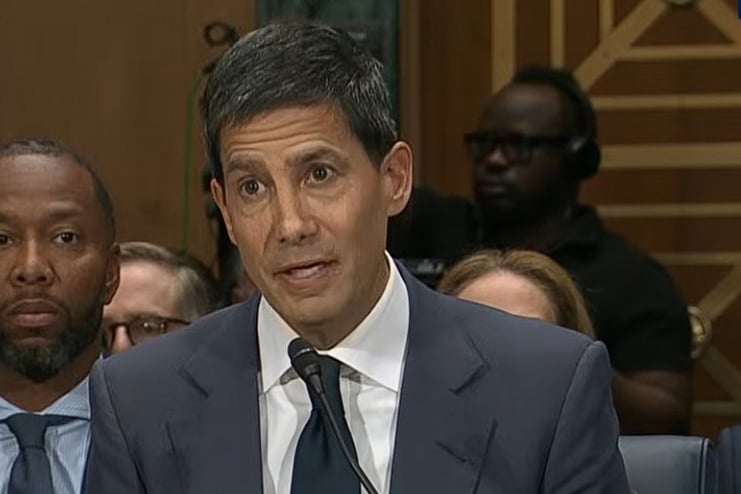
When Kevin Warsh is sworn in as chairman of the Federal Reserve this Friday, he will inherit more than an interest-rate debate. He will inherit a central bank weakened by missed inflation forecasts, the ongoing mistake of calling it “transitory,” new AI-driven supervisory risks, tariff misjudgments, global imbalances, and growing public distrust. Restoring the Fed’s sterling reputation will require more than new rhetoric.
Moreover, the Fed’s credibility will depend not on greater insulation from criticism or politics, but on clearer judgment, constitutional accountability, intellectual humility, and a willingness to confront the problems that economists and central bankers have routinely dismissed until it was “too late.” In concrete terms, that means Warsh should impose a regular forecast audit, make the Fed more candid about what it knows and does not know, build stronger AI and cyber-supervisory capacity, update economists’ outdated assumptions about tariffs, stay within the central bank’s statutory lane, and respect the constitutional limits of Fed independence.
A central banker should have a sterling reputation, but this phrase requires some explanation. “Sterling” was not meant, first and foremost, as a compliment. It was simply a metallurgical and monetary standard. Sterling is the standard of purity for silver: an alloy of at least 92.5 percent silver, the old English coinage standard of 925 parts silver and 75 parts copper. The name may come from Easterling coiners brought to 12th century England under Henry II to improve the coinage, or more plausibly from the Old English “steorling,” a “coin with a star.” Either way, the point is the same. Sterling was not meant to burnish a reputation through inheritance or even by proclamation; it was reputation granted thorough testing, discerning, and refining. It meant the coin had weight, purity, and discipline enough to survive inspection.
That is the standard Kevin Warsh should bring to the Federal Reserve: namely the hard test of sound money, plain speech, and constitutional accountability.
The Fed is not a temple. It is not a faculty lounge with a marble façade, even though its headquarters’ renovation has been as the “Versailles on the Potomac.” It is not a priesthood of models, minutes, dots, and carefully worded prose. The Fed is a creature of statute with public duties. It supervises banks, manages monetary policy, guards financial stability, and speaks with enough force to move every mortgage, paycheck, Treasury auction, and retirement account in America. It should, therefore, have credibility. But credibility is not the same thing as reverence. Credibility, like a sterling reputation, must be earned, tested, and sometimes revoked.
Warsh seemed to understand that at his confirmation hearing. He called the present moment “perhaps the most significant hinge point in a couple of generations,” and he framed the Fed’s task in plain statutory terms: price stability and full employment. He also said something more important than the usual nods to the Fed’s independence. “Inflation is a choice,” he told the Senate Banking Committee, “and the Fed must take responsibility for it.” That sentence should be printed and placed on every desk in the Eccles Building once it reopens. It is clear. It is accountable. It does not hide behind jargon, fiscal policy, or the word “transitory.”
That word, “transitory,” was the great monetary error of the Powell era. The mistake was not merely that the Fed forecasted inflation poorly. Forecasts fail. The greater mistake was that the Fed spoke as if its forecast had earned them trust that the facts didn’t justify. In April 2021, the Federal Open Market Committee (FOMC) said inflation had risen but was “largely reflecting transitory factors,” while it kept rates near zero and continued buying at least $120 billion in securities each month.
Two months later, Fed officials’ median projection still had Personal Consumption Expenditure (PCE) inflation falling to 2.1 percent in 2022 with longer run expectations holding at 2 percent. But the actual June PCE number was 6.8 percent. The Fed was not simply late as the president often puts it; it was late with a statistical confidence.
Accountability is important. The country needs a better kind of expertise, one that can say “we were wrong” before the grocery bill, the mortgage rate, and the car payment make the correction for them. Warsh’s testimony gives him the right language for a break with that culture.
He said central bankers must be “humble enough to be open-minded to new ideas and new economic developments,” “wise enough to translate imperfect data into meaningful insight,” and dedicated enough to make judgments faithfully. He also warned against the Fed’s tendency after the financial crisis to stretch its credibility to the edge of its statutory responsibilities. That is the right diagnosis. The Fed lost trust not only because it missed inflation, but because it grew too comfortable treating its own judgment as the outer boundary of the logic.
According to the next Fed Chairman, “Fed independence is largely up to the Fed.” That statement is incomplete. Fed independence is earned by competence, restraint, and fidelity to law. The Board of Governors is not a personal estate that belongs to a chairman. It is not a shield from the effects of managerial failure. The Fed chairman is an appointed official who is accountable to the president, who appoints him, and to the American people, who depend on sound monetary policy decisions.
The Fed is now facing risks that are not confined to the old formula of maintaining 2 percent inflation and full employment. The Wall Street Journal was right to say Warsh is not inheriting the economy he wanted. He wanted lower rates and a smaller balance sheet. He is getting sticky inflation, a divided committee, a large balance sheet of almost $7 trillion, new tariff realities, high public debt, inflated AI valuations, and a financial system with cyber weaknesses that may now be discoverable by artificial intelligence faster than regulators can map them.
The AI problem is the most novel and least appreciated part of this story. Reuters reported that central banks and financial regulators are lagging in adopting AI. They also lack enough data on emerging threats, which raises questions about whether supervisors can monitor the risks posed by powerful models like Anthropic’s Mythos, which can purportedly exploit the security flaws and cybersecurity vulnerabilities at major banks. Fed Vice Chair for Supervision Michelle Bowman addressed this issue in much the same language and indicated that the Fed needs to develop an effective strategy for approaching these ever-accelerating AI models.
The Fed has long benefited from a perception—an aura, even—of being in possession of superior information. It sees the banks. It sees the payment system. It sees the market. It has examiners, models, supervisors, stress tests, and emergency facilities. But Mythos and other AI models like it threaten that aura of calm and control that has long characterized the Fed. If a private AI model can identify weaknesses in financial infrastructure faster than public regulators can understand, prioritize, or communicate them, the supervisory “mythos” of the central bank begins to crack. This does not mean AI should be smothered. Bowman was right to reject that instinct. She said supervisors should support banks using AI safely and efficiently, and she noted that the Fed, Office of Comptroller Currency (OCC), and Federal Deposit Insurance Corporation (FDIC) amended their model-risk guidance to clarify that it does not apply to generative AI in the same way it applies to traditional models.
Warsh should make this one of his first tests of seriousness. The Fed can become an AI-capable supervisor. It should know which banks rely on which third-party tools, which critical vendors create common points of failure, which payment and settlement systems depend on shared software, and which vulnerabilities could become systemic if discovered by hostile actors at the same time. A cyber weakness in one institution is a bank problem. A common weakness across payment rails, cloud providers, browsers, operating systems, and banking vendors is a financial stability problem.
This is where the Fed’s job is changing. The old central banker watched credit, inflation, unemployment, and the yield curve. The new central banker, as Warsh has acknowledged, must also watch code, cloud concentration, software supply chains, model access, and the speed at which machines can find defects in systems humans built slowly and forgot to maintain. The Fed does not need to regulate every line of code. It does need to understand when a technological shock can become a liquidity shock.
Another major risk for Warsh is that he will likely be the Fed chairman when the next major financial crisis arrives. A full four-year term would carry him through May 2030, long enough for today’s imbalances to stop looking theoretical and start moving markets. Economist Gita Gopinath has described the current AI moment as a “third wave” of global imbalances and warned that policymakers often behave like the blind men and the elephant, each mistaking one part of the problem for the whole.
Before 2008, the financial danger built up in households, banks, housing, and subprime credit. Warsh is inheriting a different economy. The pressure today sits in high government debt, nonbank finance, tech and AI valuations, private credit, foreign ownership of U.S. assets, and the possibility that Treasurys may not behave as the automatic safe haven in the next shock. Gopinath’s estimate that a dot-com-style correction could cut U.S. GDP by 2.5 percent should be read as a warning about Warsh’s chairmanship. If the next crisis comes on his watch, it may come through the extended balance sheet of the government, the shadow-banking system, or an AI-driven asset bubble, not through the mortgage channel the last generation of regulators learned to fight.
Warsh also needs to update the Fed’s stale thinking on tariffs. The consensus class warned that Trump’s tariffs would drag the country toward recession. Goldman Sachs raised its 12-month recession odds to 45 percent after the April 2025 tariff announcement, TD Securities put the risk at 50 percent, and Goldman said it would shift to a recession forecast if reciprocal tariffs went into effect. Yet the fiscal and economic picture has been far rosier than the doomsayers allowed. The Congressional Budget Office projected that tariff increases would reduce primary deficits by $2.5 trillion, cut interest costs by another $0.5 trillion, and reduce total deficits by $2.8 trillion even after accounting for economic effects. Trump’s tariff strategy also produced leverage for new trade deals and helped draw new investment commitments as firms reconsidered where to build. Tariffs can still raise prices and invite retaliation, but the old view that they are automatically self-defeating has not survived contact with the facts. Warsh’s Fed should treat tariffs as instruments with costs and benefits, not as heresies against the old liberal economic world order.
That should also change how Warsh talks. The Fed needs less mystique and more candor. If inflation is too high, say so. If rate cuts risk reigniting prices, say so. If tariffs have mixed effects, say so. If the balance sheet cannot be shrunk quickly without stressing money markets, say so. If AI creates both productivity gains and systemic cyber risk, say so. If global imbalances make the old crisis playbook unreliable, say so. The job is not to preserve the elegance of the old consensus. The job is to tell the country what is known, what is uncertain, and what would prove the Fed wrong.
Warsh should also adopt a forecast audit. Every quarter, the Fed should publish the major things it got wrong, the assumptions that failed, the models that underperformed, and the evidence that would change its policy path. This could be an opportunity for institutional discipline. A central bank that can correct itself in public will be trusted more than one that corrects itself quietly after households have already paid the price.
None of these suggestions would weaken legitimate monetary independence. They would strengthen it. Independence is safest when the Fed is competent, narrow, candid, and lawful. It is most vulnerable when the Fed drifts into social policy, fiscal policy, climate policy, or managerial indulgence while asking the public to trust its expertise on inflation. Warsh said the Fed must “stay in its lane.” He should now enforce that sentence as a rule of governance. But staying in its lane does not mean the chairman is untouchable. Article II vests executive power in the president, and the Fed chairman exercises substantial executive authority through regulation, supervision, enforcement, and economic governance. That is to say, the president must be able to hold executive officers accountable when they fail to perform their duties.
The Federal Reserve Act itself cuts against the myth of total insulation. It provides that governors serve unless “sooner removed for cause by the President,” and the chairman is described as the board’s “active executive officer.” The Fed’s operational independence in setting rates does not translate into personal immunity for the chairman. If Warsh neglects statutory duties, misleads Congress, mismanages public funds, abuses non-monetary authority, refuses lawful oversight, or turns independence into defiance of law, the president has constitutional and statutory tools at his disposal. The ongoing case against Fed Governor Lisa Cook should remind Warsh to act with integrity and be accountable.
Warsh’s inheritance is therefore heavier than interest rates. He inherits the residue of all the disproven talk of “transitory” inflation. He inherits a balance sheet that is too large to ignore and too delicate to simply hack away. He inherits tariff fights that economists oversimplified. He inherits a global system out of balance, with debt and asset prices carrying risks once carried by mortgages and banks. He inherits AI tools that can reveal financial-system weaknesses at machine speed. He inherits a public that no longer accepts central-bank independence as proof of central-bank wisdom.
That is why the word “sterling” is important. A sterling reputation is not bestowed by credential, office, or institutional memory. It is not the applause of economists who missed inflation or the deference of politicians who fear market reaction. It is a coin on a scale. It is metal under pressure. It is a standard that survives testing. Warsh should welcome that test. He should make the Fed narrower, plainer, faster to admit errors, better at supervision, more serious about AI, more honest about tariffs, more alert to global imbalances, and more respectful of constitutional limits. If he does that, he can restore the Fed’s reputation. If he does not, the president is not helpless.
Warsh’s task is to prove that the Fed can still meet the standard its reputation once promised.
Leave a Reply