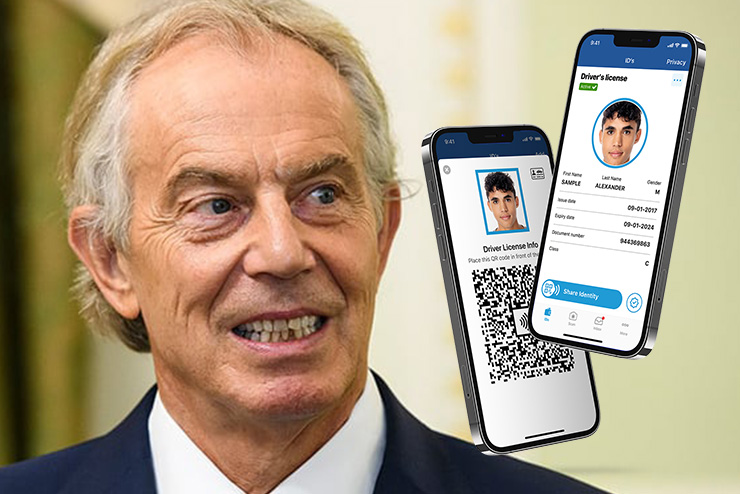
British Prime Minister Keir Starmer’s announcement of mandatory digital IDs for all British subjects came as something like a bolt out of the blue. It was not in Labour’s election manifesto and the public was not consulted. An official petition against the digital ID plan amassed 2.9 million signatures. Yet the government did not accept any debate and responded curtly: “We will introduce a digital ID within this Parliament to help tackle illegal migration, make accessing government services easier, and enable wider efficiencies.” Businesses must comply by Nov. 18.
Well, that’s that! Keep in mind that immediately after coming into office in July 2024, the Starmer Labour government denied they would bring in a digital ID program. Yet now it is here, and virtually everyone in Britain knows it is here because it was willed by one man: Tony Blair.
Ever since the House of Lords blocked his attempt to bring in mandatory ID cards back in 2006, the former Labour Party leader has made it his relentless, almost messianic mission, to right this “wrong” of history. Blair does not suffer defeats, only temporary setbacks. This extraordinarily illiberal and undemocratic measure, which has no popular mandate or support, has been brought in “from above,” largely thanks to what Labour ministers now refer to as “his Toniness.”
For most people, Tony Blair is simply the guy who was Britain’s prime minister 18 years ago. Americans may remember him as the grinning dude next to George W. Bush. However, those with a keen interest in the inner workings of politics, both domestic and international, will know that Blair today is even more powerful than when he held formal office. Some readers may know that Trump’s mid-October peace deal between Israel and Gaza was widely reported to be Blair’s 20-point plan—first offered to Biden Secretary of State Anthony Blinken in 2024, and then to Jared Kushner and the Trump administration, who took it up in favor of the badly received plan to turn Gaza into the “Riviera of the Middle East.”
This is what Tony Blair does now, through his enormous personal NGO empire, the Tony Blair Institute. He comes up with plans to sell to governments, which then adopt and implement them, largely without popular support or public debate. He did this prominently during the COVID-19 pandemic, where his plan for mass testing, vaccinations, and lockdowns was rolled out, not only in Britain but also in most of Africa and the Middle East. In his recent book, On Leadership (a sort of modern Machiavellian manual for leaders), the very first chapter is “Be the Leader with the Plan”. Blair always has a plan.
What is most striking is how Blair appears to operate above the level of democracy and beyond the scope of election manifestos and pledges. Observing his operations is to witness a technocratic managerial masterclass in post-liberal, post-democratic rule. Blair’s two chief funders are Big Tech billionaires Larry Ellison (of Oracle fame) and Bill Gates (of Microsoft fame). But it is not accurate to say that Blair simply does the bidding of Big Tech. It seems to be a mutually beneficial partnership, because Blair can open doors almost no one else in the world can. He has a Rolodex containing practically every world leader, with whom he maintains personal relationships. He meets with them more frequently than the prime minister or the foreign secretary, despite holding no official government office, and he does so in a manner that is practically never questioned or highlighted by the mainstream media. This irreplaceable and unique position accrues to Blair significant personal power, beyond that afforded to the usual sorts of NGOs backed by Ellison or Gates.
Blair always sells his vision, his plan, not only as “progress” but as inevitable. The outcome has always already been determined; the conversation is already over. All that remains is to discuss how best to implement that which has already been decided. The realm of the political, for Blair, is foreclosed. His plan is “reality,” and the whole business of left versus right, Donald Trump this or Nigel Farage that, is a pointless waste of time that gets away from the real business of what must be done. During the pandemic, Blair branded those who refused state-mandated vaccines as “idiots.” He suggested that to accept this needle into your arm is not a political decision. It is “time to distinguish,” Blair said, between the anointed and the benighted: “[it makes] no sense at all to treat those who have had vaccination as the same as those who haven’t.”
The role of the public here is merely to accept the imposition, while the role of national governments, media organizations, NGOs, educational institutions, intelligence services, and law courts is to manufacture consent from the top down in a manner straightforwardly reminiscent of Edward Bernays. This style of government is seriously testing the boundaries of rule without public consent. Starmer sits at an 11 percent approval rating, making him the most unpopular prime minister in history. If a general election were held today, polling shows Nigel Farage’s Reform UK Party winning a massive landslide majority, all but wiping out the two main parties.
Still, robot-like Starmer marches on, stubbornly sticking to Blair’s plan even in the face of widespread revolt. The House of Bourbon in 1792 showed more concern for public opinion than the Labour Party does today. ◆
Leave a Reply