
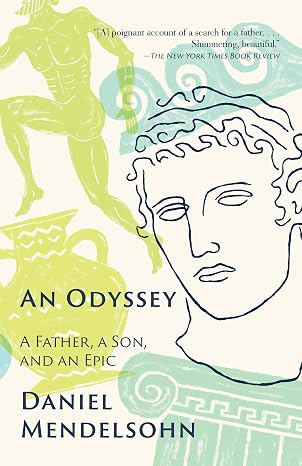
An Odyssey: A Father, a Son, and an Epic
by Daniel Mendelsohn
Vintage Books
322 pps./$27.91
Christopher Nolan’s The Odyssey is this summer’s hot new movie. Nolan’s epic has gained both praise and criticism, the latter coming as a result of the movie’s DEI casting. Black actress Lupita Nyong’o plays Helen of Troy. “Transgender man” Elliot Page has a minor role.
There will be a full review of The Odyssey in a forthcoming issue of Chronicles. Until then I’d like to urge those interested in the film to read An Odyssey: A Father, a Son, and an Epic, a 2017 memoir by Daniel Mendelsohn. Of course, you can also read Homer’s The Odyssey itself. Yet if you are looking for a brilliant exploration of the ancient poem, An Odyssey can’t be topped.
A winner of the National Book Critics Circle Award for Autobiography, Mendelsohn is a classics scholar who teaches a seminar on The Odyssey at Bard College. An Odyssey is part literary exegesis, part memoir, and part psychological study about how Homer’s epic brought Mendelsohn and his father to common ground after years of emotional distance. Mendelsohn’s father, Jay, a retired mathematician and research scientist from New York, had been interested in the classics during his school days but spent his career in the hard sciences. After retiring, he asks to study The Odyssey in his son’s class at Bard.
At first, Daniel is unsure, and even a little embarrassed, by his father’s interest. One of the things that had separated them until that time was that Daniel was more into the arts than mathematics and science. Jay drew a difference between “soft” and “hard” ways of learning. The lyrics of pop music we were “soft,” for example. He would say, “a rhyme is a rhyme, you can’t approximate!” For Jay,
the more difficult something was to achieve or to appreciate, the more unpleasant to do or to understand, the more likely it was to possess this quality that for him was the hallmark of worthiness. X is x. His sense that there is a deep and inscrutable essence to things, an irreducible hardness that he had intuited but which many if not most other people had failed to discern, informed his dealings with people, too.
Jay begins to show his son some more respect when Daniel takes up the study of the classics.
The silence between my father and me started to thaw when I began my graduate study in Classics, when I was twenty-six. Yes, only science was science; but as time went by, it was as if the arduousness of the course of study to which I was devoting myself were eroding his resistance. Whatever he might think of the mushy, subjective business of literary interpretation, he had a grim respect for the classical languages themselves, their grammars as impervious to emotion or subjectivity as any mathematical proof; through mastering them, I had become worthier in his eyes. He started to ask me, with real interest, about the progress of my studies, about what I was reading and how the seminars were conducted.
Jay embarrasses his son. He sits in the back of the room but often interrupts. In his Long Island accent, the word “beer” sounds like “baihhr.” Here he is on Odysseus the man: “I don’t know why he’s supposed to be such a haihhro,” he says. “He cheats on his wife, he sleeps with Calypso. He loses all of his men, so he’s a lousy general. He’s depressed, he whines. He sits there and wants to die.”
Still, the students love him, and Daniel begins to come around. Mendelsohn comes to realize that he and his siblings have “benefited from my father’s conviction that the world is available to anyone who does the work to know and learn it.”
He puts it this way:
The confidence we have in our ability to enjoy what is in the world, country music and oenophilia, species rhododendra and Shelley teacups, Jewish genealogy and Greek syntax, vintage posters and Jacques Demy, is, I now see, a kind of ironic birthright from our father, who showed us that it could be thus, as his own father had not done for him.
Mendelsohn, as Kirkus Reviews puts it, “uses a close reading of the epic to illuminate the mysteries of the human condition, and he skillfully and subtly interweaves the classroom textual analysis and the lessons of the life outside it.”
“That’s how I was trained, and that’s how the people who trained me were trained,” Mendelsohn writes.
If the work has real coherence, all these details will add up, even if they’re not noticeable at first and even if the big picture isn’t clear. Only by means of close reading can we understand what the big picture is and how the pieces, the small things, fit into it.
One example, and something that ties in with Nolan’s style of filmmaking, is Odysseus being described as polytropos, or a “man of many turns.” In her popular yet often derided feminist translation of The Odyssey, Emily Fox translates this as “a complicated man.” I prefer Mendelsohn:
It is difficult to resist the notion that there is something suggestive, programmatic, about making this particular adjective, “of many turns,” the first modifier in the first line of a twelve-thousand-line poem about a journey home. Odysseus, we know, is a tricky character, famed for his shady dealings and evasions and lies and above all his sly way with words; he is, after all, the man who dreamed up the Trojan Horse, a disguise that was also an ambush. So in one sense polytropos is figurative: this is a poem about someone whose mind has many turns, many twists, not all of them strictly legitimate. And yet there is a plainer sense of polytropos. For “of many turns” also refers to the shape of the hero’s motion through space: he is the man who gets where he is going by traveling in circles. In more than one of his adventures, he leaves a place only to return to it, sometimes inadvertently. And then of course there is the biggest circle of all, the one that brings him back to Ithaca, the place he left so long ago that when he finally comes home he and his loved ones are unrecognizable to one another. The Odyssey narrative itself moves through time in the same convoluted way that Odysseus himself moves through space.
It’s no wonder than Nolan was drawn to The Odyssey, because its “many turns” fits perfectly with the motifs of many of Nolan’s films. In films like Tenet, Interstellar, and Inception, time doesn’t go in a line but in circles, doubling back in on itself.
In similar fashion, Mendelsohn’s An Odyssey begins with a summary of the book itself. We are told about the spring semester in which he taught a seminar on The Odyssey, about his father wanting to take the classes, about the Mediterranean cruise they undertook to retrace the mythical route of Odysseus, about Jay’s declining health, and the brief period of reprieve during which Jay recovered a bit of his “old self.”
The movie The Odyssey may have a problem with wokeness—the Chronicles review, no doubt, will discuss that—but An Odyssey has no such problem. “If you’re a classicist,” Mendelsohn writes, “merely to open a copy of The Iliad or The Odyssey is to be reminded of this vast lineage of scholarship, of the immense hivelike labor that has slowly added drops of knowledge over the course of 25 centuries to our understanding of what the poems are and what they say.”
Leave a Reply