Euphemisms and lies share more DNA than humans and chimpanzees. Biologists estimate that men share between 95 percent and 99 percent of their DNA with their hairier kin; yet that tiny difference accounts for the vast cognitive, behavioral, and linguistic differences between the two species. Euphemisms and lies, by contrast, all lead to the same dead ends—misinformation, power grabs, and mountains of corpses.
Jessica Mitford’s vociferous mockery of euphemisms and lies echoed her outlier status as a communist sympathizer among her five more conservative siblings, none of whom likely ever genuflected before a bust of Karl Marx.
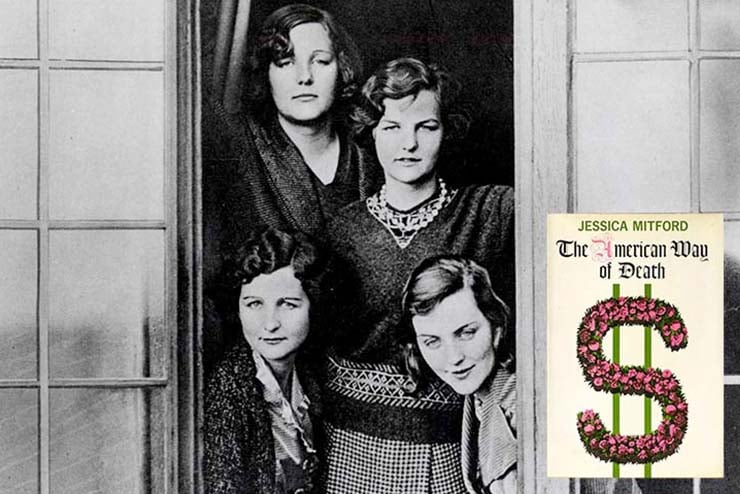
Considering her siblings’ antithetical life trajectories, one wonders what genetic mutation caused Mitford, who rose to prominence as a left-wing journalist in the 1960s, to pledge allegiance to communism. Her sisters liked money and leaned right. Oldest sister Nancy gained fame for her bestselling satirical novel, The Pursuit of Love (1945). Pam married and divorced a millionaire before enjoying her final years as an equestrian in Italy. Diana married Oswald Mosley, founder of the British Union of Fascists. Unity Valkyrie Mitford, better known as “Bobo,” idolized Hitler, an unforgivable sin that earned her familial exile to a Scottish islet during the war. The baby of the family, “Debo,” married Andrew Cavendish, Duke of Devonshire, and busied herself running his ancestral estate. Jessica’s only brother, Tom, slept around a lot. Even worse, he had to endure Jessica’s hysterical accusations that he, too, was a fascist because of his refusal to fight in Europe. Tom eventually got posted to Burma, where he died fighting the Japanese.
Nowhere did Mitford do a better job of lampooning euphemisms and calling out lies than in her 1963 classic, The American Way of Death. Her book, an extended investigative exposé, lambasted the funeral industry’s insatiable greed and underhanded practices. The industry’s exploitation of euphemisms and lies, most obvious in “its peculiar adjectival range designed to anesthetize sales resistance,” galled her. She found high-pressure sales pitches to confused families making once-in-a-lifetime decisions under time constraints unforgivably repellent. The euphemisms and lies the industry used to pry open its clients’ wallets—and grieving hearts—
enraged her, enough so that she wrote an entire book about it.
Looking back, we might summarize the death industry’s mid-20th-century operational mandate as “Out with the macabre, in with the soothing.” The strategy drove Mitford bonkers. Undertakers assured their customers that “funeral vaults,” the unnecessary external liners for coffins, or “coffins for coffins,” provided “peace-of-mind protection.” But protection from what? Organic decomposition of a dead body? And coffins, with their flat, unhinged lids nailed into place, reeked of death’s unpleasant finality. So the industry renamed them “caskets,” from the Old French cassette, a small box for holding jewels. Unlike coffins, caskets’ hinged lids allow for viewing the decedent’s upper body. And side handles make caskets easier to carry from the funeral home to the church and, finally, to the cemetery, with fees charged at each stop along the way.
Open casket wakes give disconsolate families one last glimpse of the corpse. Or, in the funeral industry’s lingo, such viewings create wonderful “memory pictures” of the “loved one” in the “reposing room.” Also, who wouldn’t want Grandma permanently preserved before her last big day—the viewing? Undertakers (sorry, “funeral directors”) summon hearses (sorry, “coaches”) to take the body (sorry, “Mr. Jones”—the funeral industry dictates that a specific corpse be identified by name only) to his grave (sorry, “final resting place”). Thus does the funeral industry transform death’s ghoulish Edgar Allen Poe dialect into jargon that sounds more like a slick sales pitch for a timeshare in Cabo.
Flowers wilt and die. But over-the-top “floral tributes” last forever—or at least their three-digit hit on your credit card bill does. Doesn’t poor Aunt Olive deserve one final floriferous send–off? Cremation kills (sorry!) funeral homes’ profit margins: no burial plot, no caravan to the cemetery, and no army of pallbearers, gravediggers, and insincere clergymen to run up more fees.
Besides, when we think of “ashes,” the verb “scatter” jumps to mind. So funeral merchants perform their own transubstantiation miracles. Ashes morph into “cremains.” Only a heretic would dare to scatter cremains. As a result, families splurge on opulent urns and memorial plaques as talismans to override Genesis 3:19’s immutable truth: “Dust you are, and to dust you shall return.” Instead, an art-urn “featuring elaborately sculpted pieces such as a seascape with leaping dolphins” will stand as a permanent reminder to your cleaning lady that this specific clump of dust doesn’t need cleaning, regardless of what some old book says.
When Jessica Mitford died in 1996, her funeral cost just $533.31. That price covered her cremation and the scattering of her ashes in the sea. Her mourners were free to hold an extravagant memorial ceremony, but she refused to pay for it. Her timing proved propitious; Mitford probably would have died even earlier from mental exhaustion had she attempted to protect us from the tidal wave of euphemisms and lies destroying society today. Although she left us three decades ago, Mitford’s renegade spirit—always ready to call out nonsense when she saw it—stands as her most important legacy.
We might be able to dismiss the funeral industry’s exploitation of euphemisms and lies as another example of unethical capitalists preying on naïve customers. Mitford’s book detailed their duplicity. However, we can’t disregard, forget, or forgive today’s cascade of euphemisms and lies the media and politicians push on us. Their carefully chosen words indoctrinate us. Their rhetoric leads us to reject reality. Their verbal weapons of mass destruction pulverize the common good. Numerous examples abound.
Of all the problems ruining their lives, not having a home is pretty far down the list for today’s “homeless,” who defecate in public, pass out from overdoses, and scream at passersby. The mentally ill menace our streets and terrify innocent citizens. Even sadder, they suffer a Dickensian torment from the inescapable cold, nonstop hunger, and lack of meaningful human contact. The “homeless” need a lot more than just homes.
No thoughtful person would ever think of involuntarily committing someone to a psychiatric hospital because he’s “homeless.” Just give him a house! New York City’s Ugandan-born mayor, Zohran Mamdani, agrees. He has proposed a halt to razing the encampments of drug addicts and the mentally ill and, instead, to expand rental assistance. Doing Mamdani one better, his ideological comrades at the Coalition for the Homeless insist, “The answer to mass homelessness is affordable housing.” We might as well call cancer patients “paraplegics,” buy them wheelchairs, and then smugly move on to our next self-righteous crusade.
Mayor Mamdani himself flies under a linguistic false flag that Jessica Mitford could have easily sussed out even while hog-tied in a coffin. Mamdani proudly identifies as a “democratic socialist.” When New York voters resurrected the Cold War’s losing side last November by electing him, Mamdani’s verbal legerdemain made them think of Scandinavia and not Stalin. They apparently think Democratic Socialists are something akin to the progressives in Germany who push solar power and free university tuition. The New York Times ran cover for Mamdani’s political perversity during his electoral campaign. And the paper won’t let down its guard now that he’s officially commandeering Gotham’s Politburo.
Mamdani looks like an English-speaking Nicolás Maduro to those of us who didn’t elect him. The Times’ sympathy for the Venezuelan narcotraficante forced it to euphemize Maduro as “undemocratic” and “repressive” before conceding that the former bus driver “has fueled economic and political disruption.” As I like to teach my verbose writing students, “Be concise; there’s a single word for that jumble you just wrote.” The Times refuses to use the perfect one-word descriptor here: “socialist.” That apt reference would teach New Yorkers that the trip they thought they booked to Scandinavia last November has now been redirected to Venezuela. Your ration cards are in the mail.
The funeral industry’s rhetorical poison now contaminates all of society. “Gender affirming care” sounds more palatable than castration. “Reproductive rights” don’t include babies’ rights, if I may exercise some euphemistic privilege myself. “Peer-reviewed” means a lazy tenured professor told his overworked PhD student to proofread a journal article. No one remembers the “liberal international rules-based order” (LIO/RBO) when the United States invades sovereign nations like Iraq and Venezuela. But speaking out of the other side of my mouth, invoking the LIO/RBO justifies American support for Ukraine as Russia defends itself against NATO’s apocalyptic eastward expansion.
Plato defined rhetoric as “the art of ruling the minds of men.” Jessica Mitford showed how one industry used euphemisms and lies to exploit people for profit. Neither dead babies nor dead Slavs ever had a chance to read Mitford. We should encourage those who hate their sex or the life in their womb to learn the truths she exposed. ◆
Leave a Reply