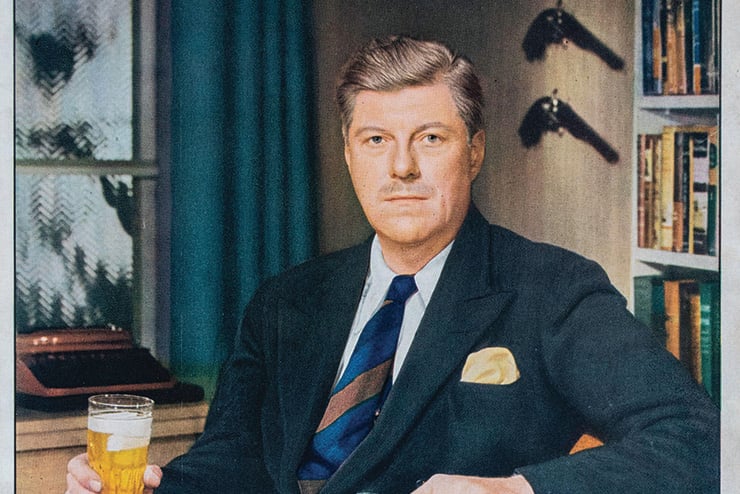
The great movies, directors, actors, and writers of the 1930s, ’40s, and ’50s produced what has since been called the Golden Era of Hollywood. Technological advances, especially sound and color, also contributed. Scripts came from great novels and works of history, and from compelling stories serialized in magazines. One of those who contributed mightily to the Golden Era, in particular to the movies of John Ford, was the writer James Warner Bellah. His stories were powerful, poignant, and filled with men of character and courage. He himself was a veteran of not only World War I but also World War II.
Bellah was born in New York City in 1899 to an upper middle-class family that could trace its roots back to the colonial era. As a youth, he was a voracious reader and excelled in English and history. He was also interested in aviation and thought he might become a pilot one day, although at 11 years old in 1910 he had witnessed the crash of a biplane at a New York air show.
After graduating from high school, he was afraid he would miss the Great War if he waited for the United States to get involved, so he crossed the border to Canada, where he enlisted in the Royal Flying Corps. He passed all the qualifications for flight school and was assigned to a group of cadets instructed by Pete Landry, a short, tough veteran of the great Canadian victory at Vimy Ridge. Landry called his cadets “Huns” because during their training they destroyed more British planes than did the Germans.
With fewer than 10 hours of instruction, Bellah was ordered into the sky for a solo flight. Roaring down the runway, he thought the old Jenny was shaking more than usual, but he pulled back on the stick and the plane soared into the sky. Approaching Toronto, he made a sweeping left turn and headed back to the airfield. His landing was perfect. Beginner’s luck. On his next three landings he broke, respectively, a wheel, a strut, and a tail skid. Whether that was a result of hard landings or the age of the plane was open to debate. What Bellah hadn’t done was crash a plane as had other cadets, including several who died.
More weeks of training and more solo flight time followed. Occasionally, the runway was covered with snow. An officer got the idea that a plane’s wheels could be replaced with skis. Bellah and a fellow cadet got the first chance to try taking off and landing with the new gear. They both succeeded. Bellah said that in those days, he and the others were endowed with the supreme courage of ignorance.
Bellah also said they attempted aerobatic maneuvers without any real instruction. The brass became worried and issued two pages of rudimentary instructions. The first page described how to initiate a particular maneuver and the second how to recover from it. After reading the two pages, Dana Butchart, one of Bellah’s close flying buddies, wadded up the first page and threw it away. “If you don’t read that,” he said, “you won’t need this,” and he crumpled the second page and threw that away, also. Bellah thought they were all on “a path of acute insanity.”
Upon successfully completing flight training, Bellah was commissioned as a 2nd lieutenant. Within days, he was shipped to England, where he joined the newly formed 117th Squadron stationed at Wyton, near Cambridge. It meant more training for Bellah in fighters and bombers, but also day missions across the English Channel. Bellah returned to base one day with bullet holes in his plane, including one in his headrest. By the end of the war, Bellah had been promoted to Deputy Leader of “B” Flight in the 117th Squadron.
Once back home in New York, Bellah enrolled at Columbia University and earned a bachelor’s degree. He later earned a master’s in history at Georgetown University.
With college behind him, Bellah set his sights on becoming a writer. His head was full of stories, and they soon found their way onto the pages of The Saturday Evening Post. He also wrote his first book, These Frantic Years, about the Roaring Twenties in New York City. He later said the book had been forgotten by all—and perhaps deservedly so. Two more books followed quickly: The Sons of Cain, a novel about the fragmented lives of men and women, and The Gods of Yesterday, a fictionalized account of his flying experiences in World War I.
Bellah enjoyed a good income and was living well. He came to know acclaimed authors F. Scott Fitzgerald, Edna Ferber, and John P. Marquand. He knew Charles Lindbergh before he made his daring solo flight across the Atlantic and was a good friend of New York mayor Jimmy Walker. Because of articles Bellah had written about the military, including one supporting Billy Mitchell, there was talk in political circles considering him for an appointment to a post in the Department of War.
Despite all this, Bellah grew restless. He stuck pins in a map of the world, identifying places he’d like to visit. Arthur McKeogh, a good friend, author, and Medal of Honor recipient in World War I, asked Bellah how long he would be gone. Bellah replied, “Probably the rest of my life—and a little longer.”
Bellah first landed in Arizona, where he met Jimmy MacGuire, a New York Irishman who fought in the Spanish-American War in Cuba in 1898 and then went to Canada in 1914 for World War I. He served with the Canadian Light Infantry and came home as a captain decorated with Britain’s Military Cross.
At that time, there was talk about a revolution brewing in Mexico. British general George Melville Boynton, who had lost an arm in World War I, was put in charge of organizing a brigade of mercenaries to aid the Mexican rebels. He appointed MacGuire commander of the 1st Regiment. MacGuire, in turn, offered Bellah command of one of the regiment’s companies. When Bellah learned that his battalion commander would be the famous playwright Porter Emerson Browne, who had been a speechwriter for Teddy Roosevelt and had served with Pancho Villa, Bellah accepted immediately.
It all sounded like high adventure to Bellah. His first contact across the border was with a rebel commander known as El Coronel, who controlled a good portion of northern Sonora. The colonel wore high, beautifully polished boots, a tailored uniform, and silver spurs. He had a silver-plated .45 strapped to his waist. Some of his troops were barefooted Indians. He lived on a large rancho with dozens of workers and servants. He was fond of offering girls barely into their teens to his guests. Bellah thought he had too much power, too much cruelty, and too little intelligence.
El Coronel simply took what he needed when he needed it, saying it would be paid for later. One night, Bellah was dining with El Coronel when a well-dressed, silver-haired man approached their table and addressed El Coronel in Spanish. Bellah could understand it was something about a debt the colonel owed the man. El Coronel suddenly drew his .45 and put two bullets in the man’s belly. The man collapsed to the floor, writhing in pain as he died.
Stunned by what he had just witnessed, Bellah could say nothing. He simply got up from the table, walked out the front door of the dining club, and headed for the border. Old hands such as MacGuire and Browne understood that killing was the reality of life in Mexico. Those with power exercised it at their own discretion, no matter which side of a revolution or a cause they were on.
It was all too much for Bellah, who thought of himself as an officer and a gentleman. He resigned his commission and was off for his second pin on the map, China. He was soon in Harbin, the commercial center and largest city in the province of Manchuria. It was still an international city when Bellah arrived. The largest number of foreigners were from Russia, a consequence of a branch line of the Trans-Siberian railroad that extended from Lake Baikal southeast into Manchuria. It was the Russians who in the early 1900s turned the small village of Harbin into a thriving city.
An old friend of Bellah’s, George Hanson, was the U.S. Consul General in Harbin. Bellah thought Harbin was something like a booming mining camp in the Old West. No single entity actually governed the city. Each nationality looked after its own. Chinese warlords may have exercised power in the countryside, but in Harbin, the Chinese were simply one of many nationalities.
In an effort to bring some order to the city, Hanson hosted a dinner party at the Railway Club, inviting the leaders from the many different communities. He hoped the gathering would result in an informal compact to govern the unruly city. Hanson made Bellah the “chief of protocol.” His chief duty was ensuring that the bartenders mixed all the right drinks and the waiters promptly served them. Martinis and Manhattans were served in honor of the Americans, vodka in honor of the Russians, scotch in honor of the British, rice wine in honor of the Chinese, sake in honor of the Japanese.
Everyone drank, everyone sang, everyone expressed friendship. George Hanson beamed. Several Russians began their famous prisiadki squat-dancing with daggers half-stuffed down the collars of their shirts. Tied to the exposed handles of the daggers were lighted candles. The climax of the dance came when the Russians bounded high into the air and jerked their necks and shoulders forward. The daggers flew out. They were supposed to hit the wooden floor tip-of-blade first and stick with the candles burning brightly. It’s unclear how well the stunt was executed. By this time, it didn’t matter. Well-lubricated Americans, Russians, British, Chinese, Japanese, and others were jovial and feeling no pain. Bellah said it was “the nearest the world has ever come to international amity in the Far East.”
Bellah was soon off to his next pin on the map, Shanghai, then other pins, Hong Kong, and Singapore, and then to France, London, Scotland, and Ireland. In County Galway, Ireland, quite by accident, he ran into William Gargan, who had been one of the best pilots in the 117th Squadron. The two hadn’t seen or known of each other since the war, 14 years earlier.
Bellah returned to New York and wrote furiously, churning out six novels and several short stories from 1932 through 1940. He still had an itch for military life, though, and in 1937 joined an Army reserve unit. Four years later, just before Japan’s surprise attack on Pearl Harbor, Bellah was put on active duty as a first lieutenant.
Bellah hadn’t flown since 1923 and at age 42 the Army was not going to put him through flight training. With his World War I experience, his writing skill, and his sophisticated knowledge of people and places, he was perfectly suited for a billet as a staff officer. He first served in this position stateside with an infantry division, but was later sent overseas to the China-Burma-India (CBI) theater. This put Bellah, who was rising quickly through the ranks, in his element. The CBI theater was the Wild West of World War II. It meant that Bellah could leave his staff duties and volunteer for missions behind enemy lines.
Early in 1944, now a lieutenant colonel, Bellah got himself attached to the 1st Air Commando group led by Col. Philip Cochran. The group’s mission was to insert troops behind Japanese lines in the jungles of Burma to begin a counteroffensive. All was set for the night of March 5, 1944, in what was code-named “Operation Thursday.” The troops would be carried in gliders towed by C-47s, the military version of the Douglas DC-3. Bellah would go with the first wave of gliders.
At six in the evening, the C-47s started taking off from an airstrip in India. The gliders were attached to the planes by long tow ropes. “Our glider jerked and shuddered as our tow ship took up the slack on the ropes,” Bellah wrote. “Then we began to move down the strip and into the dust. On both sides of the field, the long lines of troops were still filing in endlessly to fill the other gliders behind us.” Once airborne, they had to sweat out a nearly 300-mile flight to the landing zone, code-named “Broadway.”
The men inside the glider were packed tightly together with their bodies, gear, and weapons pushing into each other. They were mostly silent. Bellah wondered what would greet them when they landed—if they landed. Would a Japanese fighter pilot with exceptional night vision take off from one of the several Japanese airstrips along the way and intercept them? Would a tow rope break? Would a thunderstorm send them into a mountainside?
Finally, word came that they were approaching the landing zone, and men could see smudge pots glowing in the distance. At some 1000 feet above ground level, the men felt a sharp jolt as the tow rope disengaged. It was now up to the glider pilot to land the heavily loaded crate. “Here we go into a blind clearing at better than a hundred miles an hour,” said Bellah, “howling down the night wind, deep into the heart of enemy territory, with a whole Jap army between us and the following waves.”
Bellah’s glider was one of the lucky ones. It landed without a mishap, and the troops were able to disembark and race for the cover of the surrounding jungle. Bellah was soon leading a recon party to locate gliders that had missed the landing zone. Meanwhile, gliders and wreckage were being removed from the landing zone. One glider was positioned and set up with lights to act as a control tower. A perimeter was established. In a short time, more than 9,000 troops were on the ground, at the cost of 150 dead. Within hours, a fairly secure airfield was in operation 200 miles inside enemy lines. Within days, Mitchell B-25s and P-51 Mustangs were flying off the field to strike at Japanese forces.
Bellah stayed in the CBI theater through 1944 and didn’t return home until late in 1945. He left active duty in January 1946 but would serve until 1957 in the reserves, retiring as a colonel.
In the late 1940s, he bought a home in Santa Monica Canyon, a part of the greater Pacific Palisades community. His son, John, was a sophomore at Palisades High School when I was a senior there. How I wish I could have gotten to know his dad at the time.
Bellah’s postwar years in his canyon home saw his writing productivity equal that of his earlier years. From the late 1940s through the 1960s, Bellah published eight books and three dozen short stories and articles. He also wrote or co-wrote nine screenplays. He will probably be best remembered for his work with the legendary director John Ford. The two first met, not in Hollywood, but in India during World War II. Ford’s famous cavalry trilogy, Fort Apache (1948), She Wore a Yellow Ribbon (1949), and Rio Grande (1950), came from the pen of James Warner Bellah.
I wrote in these pages about the best Western films ever made (“Westerns: America’s Homeric Era on the Silver Screen,” February 2008 Chronicles) and included those three movies. Fort Apache came from Bellah’s short story “Massacre.” She Wore a Yellow Ribbon was based on two of Bellah’s stories, “The Big Hunt” and “War Party.” Rio Grande came from Bellah’s “Mission With No Record.”
Bellah would work again with John Ford, writing the screenplay for the 1951 war documentary This Is Korea! When Ford and Bellah went to Korea to shoot it, they both were still serving in the reserves. Ford was able to go as a captain in the Navy and Bellah as a lieutenant colonel in the Army. Bellah later co-wrote the screenplays for Ford-directed Sergeant Rutledge (1960) and The Man Who Shot Liberty Valance (1962).
Bellah’s work in Hollywood was not restricted to collaboration with Ford. Bellah had a hand in five additional movies, either writing the screenplays or the stories the movies were based on. Probably the best of these films is The Sea Chase (1954), starring John Wayne and Lana Turner.
Bellah died of a heart attack in 1976 at the age of 77 and was buried at the veterans’ cemetery in West Los Angeles. With his stories of courage, derring-do, and valor, he was one of those who made the Golden Era of Hollywood golden. Although he authored 19 novels, dozens of short stories, and nine screenplays, none of that is mentioned on his headstone, according to his wishes. All that is said about his life is: “Col USA, WWII Korea.” ◆
Leave a Reply