Kent State: An American Tragedy
by Brian VanDeMark
W. W. Norton & Company
416 pp., $19.99
In May, we marked the 55th anniversary of the deadly confrontation between student rioters and National Guardsmen on the Kent State University campus in Ohio. The mythology on the left regarding that event began emerging immediately thereafter. Neil Young wrote of Nixon’s “tin soldiers” in his song “Ohio,” which was recorded by Crosby, Stills, Nash & Young barely two weeks after the shootings.
Many Americans fully accept the Kent State myth, which is easily summarized: “Innocent, unarmed, and peaceful students protesting unjust war were murdered by vicious, bloodthirsty soldiers.”
Brian VanDeMark’s book provides a wealth of detail about the shooting, what led to it, and its aftermath. A reader with an accurate moral compass will come away understanding how greatly the myth distorts reality, even though the book’s author does a disappointing amount of advocacy for the very myth that his presentation of the facts belies.
It is odd that a professor of history at the U.S. Naval Academy, in writing a book about student protestors of the Vietnam War, has not a single word to say about the war itself or the extent to which the criticisms of that war were factual or defensible. Instead, VanDeMark bends over backwards to paint the Kent State radicals as reasonable.
He disdainfully describes a “diatribe” delivered by President Nixon that he says “fanned the flames of resentment” among the student radicals. In an exchange with the press concerning the announcement of the Cambodian incursion that Nixon did not know was being recorded, the president contrasted the young men serving in Vietnam—“kids … doing their duty”—with “these bums … the luckiest people in the world, going to the greatest universities… blowing up the campuses.” These remarks, in VanDeMark’s analysis, “helped set the stage for the tragedy.”
Here is the unvarnished logic of this curious analysis: Nixon claimed the portion of the college student population who were “blowing up the campuses” were unsavory and ungrateful, and this description was so hurtful to them that they had no choice but to go out and demonstrate that Nixon was right. The day Nixon’s remark was reported, hundreds of those students he had called “bums” gathered on a busy street in downtown Kent and blocked traffic. They built a bonfire in the middle of the street and rioted along the route back toward campus. Several dozen stores were vandalized and some were looted. When local authorities shut down the Kent bars, the frenzied crowd grew larger and more violent.
Kent’s mayor put in force an 8 p.m. curfew the following morning, May 2, a Saturday. That evening a mob of around 1,500 protestors swarmed the Kent State ROTC building, intent on destroying it. Incredibly, VanDeMark describes this as essentially an understandable inevitability, one that ROTC officers accepted as such. An hour after the start of the curfew, the ROTC building was in flames. Roughly 30 minutes later, the first Ohio National Guardsmen who had been called in by the governor began arriving on campus.
The rules of engagement under which National Guardsmen then operated stipulated that rioters who did not disperse after being read the riot act could be justifiably shot. VanDeMark attempts to make a distinction between “urban riots” and mere “campus protests,” the latter a species spuriously unrelated to the first. One might have liked to hear from shop owners whose businesses were looted, or ROTC students in the aftermath of the destruction of the ROTC building, to get a sense of whether or not they saw the same distinction.
VanDeMark claims the violent atmosphere had largely dissipated by Sunday, May 3. But he admits that guardsmen who patrolled the town were spat on and had bags of feces thrown at them by student radicals. Whatever blame VanDeMark can’t pin on Nixon, he assigns to Ohio governor Jim Rhodes. Rhodes arrived in Kent on that Sunday and compared the rioters to “Brown shirts… the Communist element… night riders and… vigilantes.” The poor student rioters could simply not bear such mean-spirited insults, and they were thus compelled to return to the warpath.
Most of the Kent State students had not rioted or participated in the destruction of the ROTC barracks. But a significant number of them had, and a still larger group were perfectly willing to join mobs that menaced the campus, the local community, and the National Guardsmen. VanDeMark is entirely too ready to sympathize with braindead sentiments like this one uttered by one of the student radicals: “If the president thinks I’m a bum and the governor thinks I’m a Nazi, what does it matter how I act?”
By Sunday night, the thuggish element of the student body again took center stage. The mob grew and began throwing rocks, bottles, and railroad spikes at guardsmen, who prevented the radicals from moving off campus into town. That action probably saved some student lives, as there is considerable evidence that armed residents of Kent were prepared, if law enforcement proved incapable of keeping order, to meet a reprise of the rioting with their own lethal force. Rather than show the guardsmen gratitude for keeping them from the bullets of citizens fearfully defending their homes and businesses, a group of rioters occupied a major intersection just off campus and were finally dispersed only with tear gas.
The next day was Monday, May 4.
VanDeMark spends a good deal of time trying to argue that fatigue, inexperience, and even post-traumatic stress disorder among the guardsmen were major precipitating factors of what would happen that day. He quotes protestors saying that no one in the massive mob on May 4 had guns, as if this is a legitimate criticism of the guardsmen being armed. How could these unarmed students harm anyone, after all?
Well, they might try throwing bricks and rocks the size of softballs, which they did. Many guardsmen were hit by these projectiles. VanDeMark describes one who took a direct hit on his steel helmet, which left a massive dent and cracked the helmet’s fiberglass interior. One lieutenant colonel was hit by rocks six times. Another barely avoided a two-foot log swung at him. One of the guardsmen aptly summarized the situation: “They had hate in them… they were trying to kill us.” Others were terrified that the mob might swarm them and turn their own bayonets and rifles against them.
The guardsmen gave dispersal orders, to no effect. They tear-gassed the rioting students. This, too, was ineffective, and students hurled canisters back at the guardsmen. The mob advanced and split to cut off the guardsmen’s avenue of retreat. Many were chanting “Kill the pigs!” and “Let’s surround them!” Some guardsmen kneeled and aimed weapons in a further attempt to get them to disperse. All ineffectual.
At not quite 12:30 p.m., Sgt. Mathew McManus gave the order to fire warning shots into the air, though he was not technically in a position to give commands at the time. McManus’s intent was to deflate the escalating conflict and preserve the safety of everyone there. But the provocative and threatening behavior of the mob had already ratcheted up the legitimate fear among the National Guardsmen to a dangerous point.
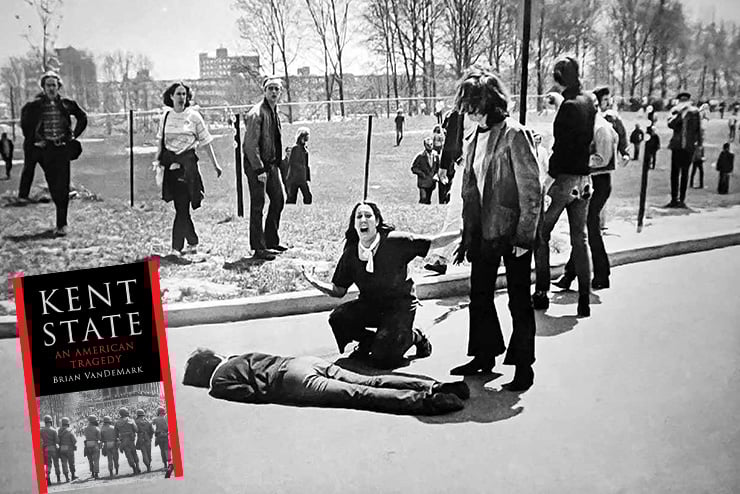
Some 30 guardsmen fired 67 shots in just over 12 seconds. Those rounds killed four and wounded another nine. Almost all of the shots were fired not at individuals but over the heads of the crowd or into the ground, in an attempt to follow McManus’s order. However, the rounds fired over the heads of nearby rioters ended up hitting others farther down the hill on which the guardsmen were standing.
It is clear from the evidence that the rioters bear the blame for this awful event. If you throw bricks at armed soldiers, announce that you are going to kill them while advancing on them in a huge mob, you cannot expect things to go swimmingly.
Two of the four rioters killed were simply walking to class when they were tragically caught by stray rounds. The other two were actively involved in the effort to confront the National Guardsmen, and their actions brought about the deaths of those two innocent students. One of the dead rioters, Jeff Miller, was described by an onlooker as intent on harming someone with the many rocks he hurled. A bullet struck Miller in the face and, as he lay bleeding, another rioter dipped his black flag in the stream of blood and did a war dance. VanDeMark quotes Miller’s mother describing her dreams of “nightmarish National Guardsmen in gas masks who picked out victims to shoot.” That is pure hallucination. What happened is that irresponsible criminals like her son produced a situation, through their violent acts, which made terrible consequences likely.
In the immediate aftermath, the American public understood matters accurately. A Gallup poll shortly afterward showed that six in ten Americans saw the student rioters as bearing responsibility for the deaths, and only about 10 percent thought the guardsmen were at fault. The Ohio National Guard received 10,000 letters; less than 500 were critical of their actions. Eight of the guardsmen were criminally tried after a Justice Department investigation, but all were acquitted.
Kent State should be remembered as one of the key moments in which America’s radical left reaped the whirlwind from the wind it had so avidly sown.
Leave a Reply