Over the course of my nearly 20-year career as a professor of rhetoric, I’ve learned that—stripped to its essence—rhetoric is symbolic force. Not all language is forceful. A statement like “His new car is red,” is descriptive, but it exerts no force on the audience. Rhetoric is the type of communication that aims at producing a tangible effect on something real; something outside the self, beyond the symbolic realm of discourse.
The left has now spent decades asserting that offensive speech is violence. They are half right: rhetoric, like a punch, is an application of force. But rhetorical force, under the right circumstances, serves as a useful alternative to physical violence. Thus, persuasive force cannot be the same as violence. Nevertheless, there are moral considerations that must guide our use of rhetoric.
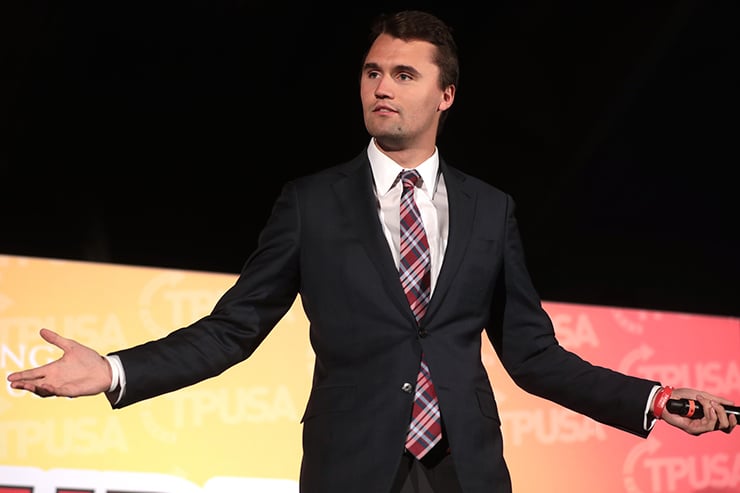
Charlie Kirk’s assassination in Utah dramatized the stakes of our political discourse. Many commentators have noted that Kirk’s recent death represents a “turning point.” This is undoubtedly true, and the crossroads at which we find ourselves relates to our speech. If our aim is to transform America—to make it great again—we must consider which rhetorical choices are most conducive to that goal.
At this moment we have two different approaches to political communication we might take. The first is what we might call the “rhetoric of the salon.” This is the principled rhetoric idealized by teachers in civics classrooms. The rhetoric of the salon assumes the rational capacity and goodwill of one’s interlocutors. It starts from the premise that we can use language to find truth, settle disagreements, and discover consensus. The salon calls for a certain politeness: we are expected to speak the truth, concede the flaws in our own views, and use logic (rather than emotions, credentials, attacks, or dissembling) to convince our audience. When people valorize “deliberative democracy,” they have in mind a society that operates according to the rhetoric of the salon.
The second approach to political communication is what I like to call “the rhetoric of the saloon.” The saloon operates according to a much different principle than the one guiding the salon. The saloon is loud—people talk over one another. Many at the saloon are not in full possession of their faculties and we cannot assume their goodwill or their ability (much less their desire) to reason. And unlike the salon, the possibility of violent conflict looms ominously over the saloon. The rhetoric of the saloon, then, responds to these conditions. It takes a “no holds barred” approach to communication. Recognizing the limitations of logic in persuasion, it freely makes use of other tools. It mocks. It interrupts. It tells half-truths. It manipulates people’s emotions. Sometimes, it speaks the full truth—but accompanied by techniques that aim to magnify its force. The rhetoric of the saloon does these things not because it is unprincipled, but because its practitioners understand their surroundings. In the saloon, where both physical and rhetorical conflict are possibilities, we must be well-trained in methods of both attack and defense.
Undeniably, Charlie Kirk was a master of salon rhetoric. By all accounts, he was deeply committed to the principles of deliberative democracy. In every context, he was a generous interlocutor, assuming the goodwill of those with whom he conversed, and he was fully confident that a rational exchange had the power to change people’s minds (and, by extension, persuade the world). The rhetoric of the salon is still a kind of verbal force, but it’s a more principled, restrained application of it.
Certainly, Kirk was aware of the possibility that he was inhabiting a saloon while operating in the style of the salon. It is a bitter irony and harsh reality that the American university—long the home of the staunchest advocates of salon rhetoric—now operates more like the saloon. Kirk’s work on campuses was driven by the faith that students who only knew the rhetorical saloon might be persuaded of the superiority of the salon. As the outpouring of tributes in the wake of his death show, he was enormously successful in driving home that message.
None of that changes the fact that many people—both on and off campus—are zealously committed to the rhetoric of the saloon. And then, there are others who are even more dangerous. The shooter who killed Kirk came neither from the salon nor the saloon. Indeed, he wanted to circumvent the business of communication and persuasion entirely. He sought to negate the very possibility of persuasion and instead fixated on punishment.
Since the assassination, students at one university posted flyers echoing a message etched in the shooter’s shell casings: “Hey, Fascist! Catch!” Underneath the slogan was a QR code that students can scan if they wish to join the “only political group” on campus “that celebrates when Nazis die.” This is the rhetorical environment in which Kirk was operating.
The task of all political speakers now is to determine which space we inhabit. Are we in the salon or the saloon? Obviously, most of us would prefer the salon. But as Kirk’s death reminds us, our preferences don’t matter. Kirk—a nice guy and expert debater—was killed for practicing the nice kind of rhetoric.
We know where the institutional left has cast its lot: It is fully devoted to the rhetoric of the saloon. And because the left controls most of the media that enables today’s public discourse, American society at large has become the saloon. The rancor of academia is not confined to the campus.
Under these conditions, the utility of salon rhetoric is severely constrained. All it takes to disrupt the delicate conventions of the salon is for one very drunk guy to wander over from the saloon. Or, God forbid, a madman with a gun who wants the whole conversation to end—regardless of the conditions surrounding it.
The problem for those of us who would prefer rhetorical force to physical force is that many of our allies have not been trained in the correct usage of saloon rhetoric. We continue to extol the virtues of salon rhetoric, training our activists for a healthy deliberative democracy that no longer exists.
As the hour grows late and the saloon grows increasingly rowdy, conservatives used to denouncing the rhetoric of the saloon find themselves in the unenviable position of relying on rhetorical cowboys screaming threats from across the bar. This is no way to train an effective political movement in rhetoric.
If the political right is going to win the fight for America without succumbing to the evil siren song of physical violence, we need to get better at (and more comfortable with) the rhetoric of the saloon. We already have some great avatars of saloon rhetoric—Stephen Miller, Steve Bannon, and Donald Trump himself—but we’ll need more. Many more.
As we come to grips with the nasty fact that we are not in a polite debate, but rather in a rhetorical bar fight, there is an understandable hesitance to abandon the virtuous principles of rational debate that we still affirm in our hearts. But if we don’t play by the anti-rules of the saloon that now govern American democracy, we will forfeit any possibility of reinstituting the rules of the salon. Before we have that chance, we first need to win the bar fight.
All of this is not to say that we won’t need men and women like Charlie Kirk going forward. We will. And it is important to celebrate his many victories, his virtue, and what is sure to be his amazing, enduring legacy. But we can’t ignore the limitations (and dire costs) of insisting upon a Platonic dialectic with a pack of drunken cowboys spoiling for a fight. There comes a time when you are forced to do what some will call stooping to their level—if only to survive the melee. But is it really stooping to their level if you manage to put an end to the fight?
If we are going to avoid a physical and bloody conflict in this nation, we must achieve our objectives using rhetorical force. Grab a spot at the bar. And gird your loins.
Leave a Reply