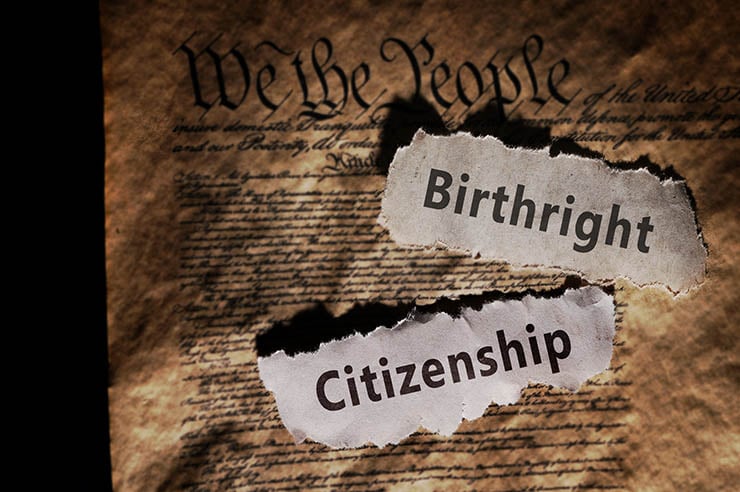
The Supreme Court’s decision in Trump v. Barbara is a grave mistake: it turns citizenship from membership in a nation into an accident of location at birth. The Court held that children born here to parents unlawfully or temporarily present are citizens at birth. But the majority read the 14th Amendment as if “subject to the jurisdiction thereof” meant mere presence, rather than complete political allegiance to the United States.
President Trump immediately announced that Congress must use its Article I power to amend immigration law, codifying that birthright citizenship belongs only to those born under America’s complete political jurisdiction—not to children of illegal aliens, whose families remain politically attached to another nation.
The majority’s error appears in its own language. It treats the decisive test as “American soil and subject to American law.” But that is not what the Constitution says. The 14th Amendment requires birth in the United States and being “subject to the jurisdiction” of the United States. Those words must mean more than obeying traffic laws, paying sales tax, or answering to a police officer while passing through. Illegal aliens may be subject to our territorial laws without becoming members of the American political community. Law governs strangers, but citizenship means something more and binds us together as a people.
Justice Thomas’s dissent gets the point. The Reconstruction Congress did not write the Citizenship Clause to constitutionalize birth tourism. It wrote it to overturn Dred Scott and secure citizenship for freedmen who were Americans in every meaningful sense and were born here, domiciled here, owing no allegiance to a foreign power. Thomas rightly emphasizes the older formula: “born and domiciled.” He also points to the original understanding of jurisdiction as “full and complete jurisdiction,” the same in extent and quality as the jurisdiction owed by citizens.
That is not the old feudal understanding of jus soli (citizenship by soil) but citizenship and membership in a people that is worthy of a republic.
Justice Kavanaugh’s partial dissent supplies the legislative roadmap. He concluded that the executive order conflicted with the existing statute, but not with the Constitution. His central sentence should be printed and placed on every Republican lawmaker’s desk: “Congress could—consistent with the Fourteenth Amendment—amend §1401(a) or otherwise enact new legislation.”
That is the Article I path. If the current statute has been read too broadly, Congress should rewrite it. If courts have mistaken territorial presence for political jurisdiction, Congress should define the term in the statute Congress itself enacted.
This would not repeal the 14th Amendment by ordinary legislation. It would enforce the Amendment’s own limiting words. The Citizenship Clause does not say, “All persons born in the United States are citizens.” It adds a condition. Citizenship for those born into the American political community includes children of citizens and lawful permanent residents, while excluding those whose parents are unlawfully or temporarily here and remain under political allegiance to another sovereign jurisdiction.
Nor does the case law in Wong Kim Ark compel the majority’s sweeping result. Wong was born to domiciled, lawful-resident Chinese parents who had made their lives in the United States. That is a world away from a tourist arriving to obtain a passport for a child, or an illegal entrant claiming the rewards of membership while defying the nation’s laws of admission. To turn Wong Kim Ark into a constitutional guarantee for every temporary presence is not fidelity to precedent.
The majority further ignores the serious issues of birth tourism in the United States, with only Justice Thomas mentioning the extreme dangers the majority’s ruling poses by allowing the practice to continue.
Birth tourism has become a global industry in which thousands of foreign nationals travel to the United States for the sole purpose of giving birth, purchasing for their children one of the world’s most valuable legal statuses before returning home. The result is an American passport acquired not through allegiance, domicile, or membership in the national community, but through careful travel planning.
No serious nation should permit its citizenship to become a commodity marketed by international businesses. Citizenship is the legal bond between a people and their country, not a souvenir handed out to anyone fortunate enough to deliver a child within our borders. That is precisely why Congress should restore the 14th Amendment’s requirement of complete political jurisdiction.
The Court has treated the American nation as a hotel lobby where the prize of citizenship is won by crossing the threshold. Congress should answer at once by making the appropriate changes to existing legislation. Codify complete political jurisdiction. Force the Court to confront the question in its cleanest legislative form. Then, if the justices insist that the Constitution commands citizenship for those never fully under America’s political jurisdiction, the people will know the next remedy is amending the Constitution. The first step is for the people’s representatives to get their act together and define what citizenship is. A republic that cannot decide who belongs to it cannot long remain a republic. To quote Justice Thomas, the Court’s opinion devalues the “dignity and glory” of American citizenship
Leave a Reply