The Founding Fathers never intended to grant citizenship to foreigners who happened to be born on America’s shores. Citizenship, properly understood, means sole allegiance to the United States.
Remember when citizenship meant something real? Allegiance. Belonging. You were part of a people, shielded by a government that was truly yours—and you owed it your loyalty in return. This isn’t some ivory-tower theory. It’s plain common sense, the kind our grandparents lived by. Citizenship wasn’t just paperwork; it was your identity, your duty, your honor.
Men and women have gone to war to defend American citizens. Soldiers have crossed oceans and stormed beaches because the United States protects its own. Governments exist first to secure the rights of their citizens, not the rights of the world. That idea is even older than the Constitution. It is found in the Declaration of Independence, which says governments are instituted to secure the rights of the people who create them. Citizenship is the legal expression of that relationship.
The Founders did not fight the American Revolution to remain subjects of a distant king. They fought to become free and independent people, sovereign in their own right. They rejected the English doctrine of perpetual allegiance. They insisted that political allegiance comes from consent. Citizenship in a republic is not automatic submission to a ruler. It is membership in a self-governing people.
Today, we are told that citizenship is automatic. That it happens by accident. That if a child is born inside the physical boundaries of the United States, that child is a citizen, no matter who the parents are, no matter why they are here, and no matter whether they are here lawfully. That is the modern view of birthright citizenship. It is presented as settled law. It is not.
The text that governs this question is found in the citizenship clause of the 14th Amendment, which reads, “All persons born or naturalized in the United States, and subject to the jurisdiction thereof, are citizens.” The words “subject to the jurisdiction thereof” weren’t tossed in carelessly. They were forged in 1868, right after the Civil War, to protect freed slaves—not to hand out citizenship like candy at a parade.
Senator Jacob Howard, who wrote the clause, made its intention crystal clear:
This amendment which I have offered is simply declaratory of what I regard as the law of the land already, that every person born within the limits of the United States, and subject to their jurisdiction, is by virtue of natural law and national law a citizen of the United States. This will not, of course, include persons born in the United States who are foreigners, aliens, who belong to the families of ambassadors or foreign ministers accredited to the Government of the United States, but will include every other class of persons.
In a congressional debate over the jurisdiction clause in the 14th Amendment, Senator Lyman Trumbull, chairman of the Judiciary Committee, said the clause “means ‘subject to the complete jurisdiction thereof.’” He continued, “What do we mean by ‘subject to the jurisdiction of the United States?’ Not owing allegiance to anybody else. That is what it means.”
Citizenship meant full allegiance to America and being subject to the complete jurisdiction (not partial jurisdiction) of the United States. Think of it like joining a family: You can’t be half-in, half-out. That is plain language. Allegiance mattered.
The Civil Rights Act of 1866, authored by Trumbull, used similar language. It declared citizens to be those born in the United States and “not subject to any foreign power.” That phrase and the phrase “subject to the jurisdiction thereof” are two ways of saying the same thing. Citizenship required full political allegiance to the United States.
That distinction mattered in practice. In Elk v. Wilkins, the Supreme Court held in 1884 that a Native American born within the territorial United States was not automatically a citizen, because he owed “immediate allegiance” to his tribe and not to the United States. Citizenship for Native Americans was granted only later, through the Indian Citizenship Act of 1924. That history shows that birth on American soil alone was not always enough. Jurisdiction meant more than geography.
The case most often cited for unrestricted birthright citizenship is United States v. Wong Kim Ark. In that case, the Court held that a man born in San Francisco to Chinese parents was a citizen. But an important fact is often left out: Wong Kim Ark’s parents were permanently domiciled in the United States. They were lawfully present. They were resident aliens, the 19th-century equivalent of lawful permanent residents today. The Court described them as “resident aliens” under the protection of the United States.
The Supreme Court has never squarely held that a child born to parents who are unlawfully present in the United States is automatically a citizen under the 14th Amendment. That question has simply never been decided. The time is ripe for the Court to address this question in the ongoing case Trump v. Barbara, a class-action suit brought against the president’s executive order restricting birthright citizenship, which he signed on his first day back in office.
There is a difference between territorial jurisdiction and political jurisdiction. If someone is physically present in the United States, they are subject to our traffic laws and our criminal laws. That is territorial jurisdiction. But political jurisdiction is something more. It is allegiance; It is belonging. Senator George Williams explained during congressional debates over the 14th Amendment that all persons born within the geographic limits of the United States are subject to its jurisdiction, “but they are not subject to the jurisdiction of the United States in every sense.” That sentence alone makes clear that the framers understood more than one kind of jurisdiction.
Those who enter the country unlawfully remain citizens of another nation. They owe allegiance to that nation. They carry its passport. They vote in its elections, or at least retain the right to do so. They are subject to its political authority. They are not under the complete political jurisdiction of the United States in the way Senator Trumbull described.
Some may argue that the words “subject to the jurisdiction thereof” exclude only children of diplomats and invading armies. But if that were the whole meaning, those words would do almost no work at all. The Constitution does not waste words. Courts have long held that every clause should be given effect where possible. If birth alone were sufficient, the jurisdiction language would be unnecessary.

Citizenship is not supposed to be cheap. It carries privileges, and it carries burdens. It carries the right to vote and the duty to obey the law. It carries the protection of the American military and, in some cases, the duty to serve. When Americans are threatened abroad, it is American citizens whom the government evacuates. When the nation is attacked, it is American citizens whom the government defends first. That is the point of sovereignty.
It is also worth remembering that at the time of the 14th Amendment, there were virtually no modern immigration restrictions. The kind of mass unlawful entry we see today was not something the Reconstruction Congress faced. Immigration was generally lawful. The question of children born to parents who had violated federal immigration law simply did not present itself in the same way. The text they wrote still governs, but the facts on the ground have changed.
Today, the United States is one of the very few developed nations that, in practice, follows a broad jus soli (“right of the soil”) approach to citizenship, granting citizenship automatically to those born within its borders. The United Kingdom ended automatic birthright citizenship through the British Nationality Act of 1981. Ireland ended it in 2005 after a national referendum and an amendment to its constitution. New Zealand ended its unrestricted policy in 2006. The United States and Canada stand largely alone among developed nations in maintaining jus soli.
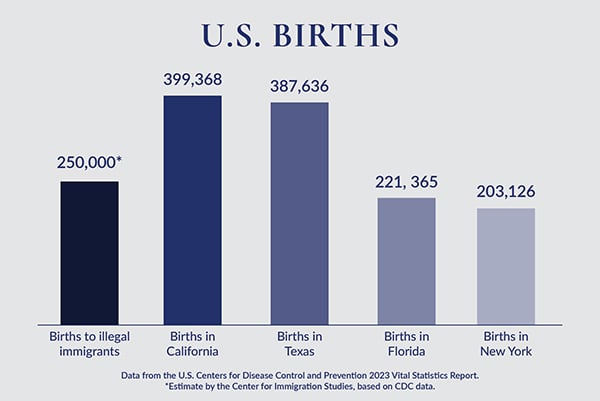
The numbers don’t lie. Policy consequences follow from constitutional interpretation. A 2018 Pew Research Center study found that nearly one in 10 births in the United States was to illegal immigrant parents. Estimates in 2025 suggested that roughly 250,000 births per year were to illegal immigrants, with uncertainty due to surges at the border from the Biden years. Mass immigration has overcrowded local schools, stretched hospital resources thin, and left local communities footing the bill. Is that the America we want?
America’s outdated birthright policy has created the phenomenon called “birth tourism.” Federal prosecutors in California have secured convictions in connection with several schemes that brought pregnant Chinese nationals into the United States on tourist visas, to give birth here so their children would obtain citizenship. Academic research has documented significant international surrogacy activity in states like California, with a large share of clients from China. These are not conspiracy theories. They are reported facts. Birth tourism has to stop.
None of this is about punishing children. It is about restoring meaning to citizenship. Citizenship is not a welfare program or a travel document. It is a political bond. It is the badge of belonging to a self-governing people who fought to be free and who have defended that freedom in every generation since 1776.
The question now is whether we have drifted into a different kind of automatic allegiance, one that says birth on American soil is enough, even when the parents entered illegally and retain allegiance to another sovereign. Reasonable people can disagree about the best policy path forward. Some may argue that change requires a constitutional amendment. Others could argue that the executive branch may interpret and apply the 14th Amendment according to its original meaning unless and until the Supreme Court says otherwise.
The matter is not as simple or settled as it is often portrayed by partisans. The constitutional text contains a qualification that, along with historical precedent, emphasizes allegiance. Other nations have restricted birthright citizenship without abandoning their commitment to the rule of law.
American citizenship must mean something again: full allegiance to this nation, membership within a people who govern themselves, not a free pass based on where you drop anchor. Our country once knew this to be true. That was the understanding expressed in 1866 when Congress debated the meaning of the Citizenship Clause, and it remains the language written into the Constitution today.
As we near America’s 250th birthday, will we honor the Founders’ vision of a sovereign republic, rooted in loyalty and law? Or let it fade into just another spot on the map? The choice is ours—it’s time to choose wisely.
Leave a Reply