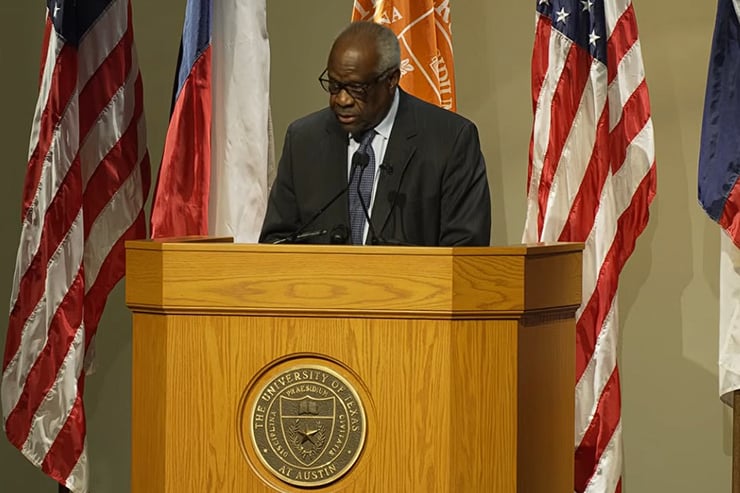
In his recent address at the University of Texas School of Law, Supreme Court Justice Clarence Thomas said something that should have stopped patriots: Progressivism, he warned, “seeks to replace the basic premises of the Declaration of Independence and hence our form of government.” It teaches that rights and dignity “come not from God, but from government,” demanding of citizens “a subservience and weakness incompatible with a constitution premised on the transcendent origin of our rights.”
Therefore, instead of love of country, it has inspired “cynicism, rejection, hostility, and animus” toward America and its founding. It has uprooted the values of 1776.
He is correct. And as America approaches its 250th birthday this July 4, the words of the Declaration are needed more than ever.
The Declaration of Independence does not begin with a justification of government. It begins with a truth held to be self-evident: “that all men are created equal, that they are endowed by their Creator with certain unalienable Rights, that among these are Life, Liberty and the pursuit of Happiness.” Only then does it name what government is for: “to secure these rights.” The person comes first. Dignity comes first. Rights come first. Government comes after, solely to protect what it did not create.
Georgetown constitutional scholar Randy Barnett, one of the foremost natural rights legal theorists in America, has argued precisely this for decades. In his landmark book Our Republican Constitution, Barnett wrote that the American system of government “is based on the primacy of rights,” that rights precede the state and the Constitution exists to protect them, not to invent them. In a 2006 article on the Ninth Amendment, Barnett argued that the unenumerated rights people possess prior to the formation of government should be accorded the same protection as those enumerated in the Bill of Rights. Justice Thomas and Barnett arrive at the same place: Government is downstream of rights, always.
When that order is reversed, when rights become permissions issued by institutions, freedom becomes fragile. A government that believes it grants all rights will eventually believe that it may ration them.
The practical benefits of the Founders’ vision are not abstract. When the state is bound to recognize pre-existing rights rather than manufacture them, it cannot easily revoke them. Free speech, due process, religious liberty, and equal protection are durable precisely because they do not depend on the goodwill of whoever currently holds power. The durability of rights is freedom’s greatest advantage.
That’s what makes comments that have resurfaced from Bishop Yvette Flunder, who has been associated with Texas Senate candidate James Talarico’s progressive religious orbit, so troubling. Flunder declared that the New Testament “is not the Word of God” and called for a third testament because the existing scriptures have become, in her words, “problematic.” She proposed simply pulling out the offending pages.
This is exactly what Justice Thomas warned about vis-à-vis the Declaration and Constitution, except Flunder is targeting something that extends beyond politics into the foundations of Western moral order itself. If Scripture can be revised when it becomes inconvenient to the prevailing ideology, then no text is safe. Not the Bible. Not the Declaration. Not the Constitution. Once the principle is accepted that authorities may rewrite inherited moral truth to fit present preferences, the logic has no stopping point. Rights become whatever the editors decide this season.
America has not always lived in perfect fidelity to its founding principles, but the genius of the American order is not that it presumes human perfection. In fact, it is that it begins from the opposite premise. Our Constitution was framed by and for fallen men, not angels, and our rights were understood to come not from the state but from God. That truth is what gives them permanence, dignity, and universality.
The great reforms in American history did not prevail by repudiating the principles of 1776 but by summoning the nation back to uphold them. They appealed to the Declaration’s moral clarity and demanded that the country honor in practice what it had already proclaimed in principle. The answer to national failure was never to discard the Declaration. Rather, the answer was to apply it more faithfully, more consistently, and more equally to every citizen.
That is the standard Thomas is calling the country back to as we approach our semiquincentennial, not a partisan program but a first principle: Government exists to protect rights it did not create, belonging to persons it did not make.
The Declaration closes with a pledge of lives, fortunes, and sacred honor. The signers knew what was at stake in getting the order right. That order still stands—rights first, government second—and it is the only order that makes freedom more than a revocable license.
Leave a Reply