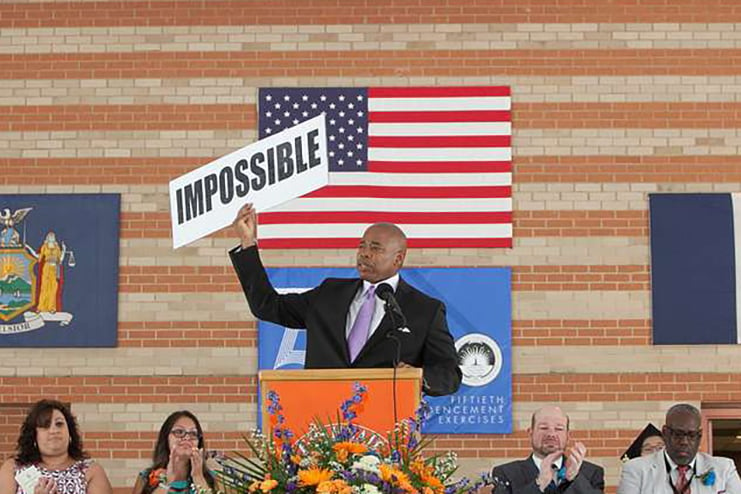
New York City Mayor Eric Adams has been in Albania lately, attempting to use his final weeks in office hawking his declining city’s dubious business and tourism prospects to that Balkan nation’s controversial prime minister Edi Rama. They make a pretty pair.
Adams is the only incumbent mayor of New York ever to be indicted, following an FBI investigation into his foreign financial dealings, while Rama was a noted figure in the FBI’s investigation of its disgraced former counterintelligence official Charles McGonigal, who is currently serving a six-and-a-half year prison sentence, in part for concealing payments that he received from an Albanian intelligence official.
Adams looks happy in the official photos from this foreign visit, but he was in a much worse mood when he ended his independent reelection campaign on Sept. 28.
Adams’s cited reason for his departure was “constant media speculation” about his future, while his polling wallowed in the single digits. Much of the gossip centered around rumors that the Trump administration, whose Justice Department in April quashed Adams’s indictment, was trying to induce both him and Republican candidate Curtis Sliwa to leave the race so that New York’s disgraced but higher scoring former Democratic governor Andrew Cuomo, another independent candidate, could concentrate opposition and, possibly, prevail over radical left Democrat nominee Zohran Mamdani.
Sliwa, for his part, has refused to drop out of the mayoral race and denies all contact with the administration. Adams has admitted to being in contact with the administration but has not divulged any details about a deal to drop out, though some have speculated that he could be—or could have been—offered the ambassadorship to Saudi Arabia.
No matter the reason for Adams’s dropping out, his exit seems unlikely to make any difference in the outcome. In a poll by Suffolk University, the last one taken before the mayor left the race, Mamdani held a commanding 45 percent plurality of New York City voters. Cuomo trailed him by 20 points, at 25 percent, with Sliwa at 9 percent and Adams languishing at just 8 points.
Even if every single Adams voter switched to Cuomo—instead of backing Sliwa, finding something to like about Mamdani, or staying home in apathy—the numbers would still see Mamdani enter office with a decisive 45 percent to 34, with Sliwa static at 9 percent. Worse, even if Sliwa leaves the race and his voters all back Cuomo, Mamdani would still prevail by three points.
To be fair, Adams’s departure did give Cuomo, who has called Mamdani “an existential threat” to New York City and claimed “it’s a totally different campaign” after the mayor dropped out, some signs of life. The former governor’s fundraising haul ticked up, with $400,000 arriving within 36 hours. Super PACs aligned with him also registered some gains. The amounts involved, however, pale in comparison to donations sent during Cuomo’s race for the Democratic nomination this past spring, which he lost in embarrassing fashion to Mamdani.
The optimistically named “Fix the City” PAC, for example, raised $22 million for Cuomo in primary season but only $334,000 for the former governor in the week after Adams left the race.
Mamdani’s prospective socialist policies and his repeated expressions of sympathy for radical Islamist groups have provoked wealthy New Yorkers, including some Republican businessmen and political operatives, to back Cuomo more decisively. Nevertheless, on Monday New York’s former GOP mayor Rudy Giuliani, the grandee of New York City Republicans, endorsed Sliwa.
President Trump, who feuded almost daily with Cuomo during the COVID-19 pandemic, has identified the former governor positively as the candidate most likely to defeat Mamdani. Cuomo has also ramped up his media appearances, expressing apparent agreement with Trump’s assessment that a Mamdani victory would be a “gift” to the Republican Party, which will almost certainly hold out the Democratic nominee as the voice of the Democratic Party next year.
More ominously, as National Guard units move into problematic Democrat-led cities across America, Cuomo has suggested that Mamdani’s radicalism could provoke a federal takeover of New York, a fate that he would avoid.
No new polls have appeared as of Tuesday, but oddsmakers are giving Mamdani a nearly 90 percent chance of winning, with Cuomo coming in at under 10 percent. While there can be little doubt about the outcome in next month’s election, with consequences that we can only guess at, New York’s prospects of being ruled by an irresponsible would-be Marxist are a safe bet.
Leave a Reply