
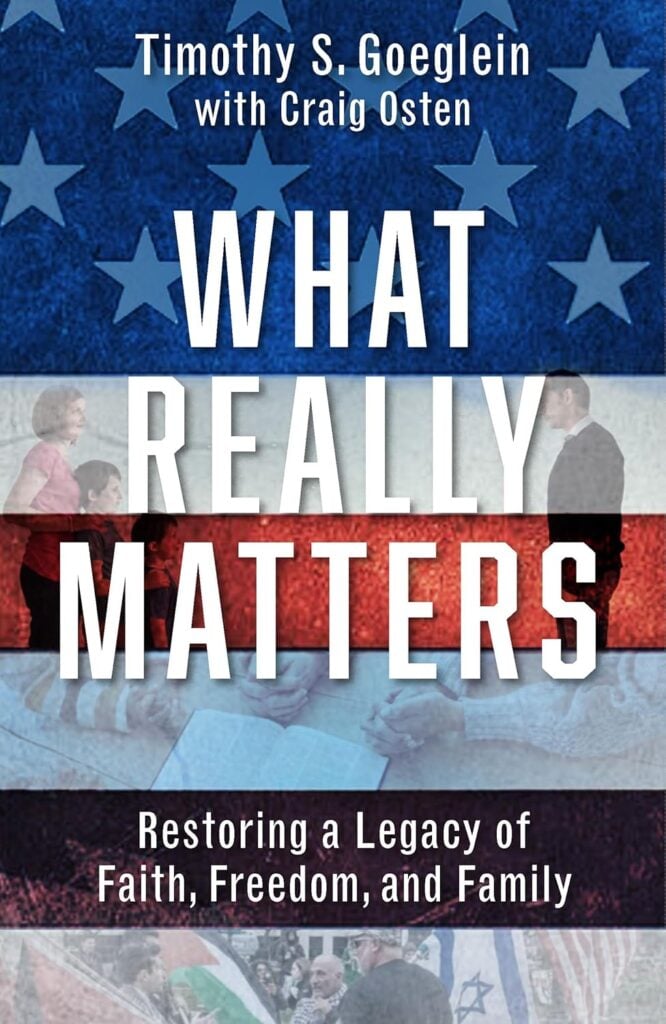
What Really Matters: Restoring a Legacy of Faith, Freedom, and Family
by Timothy S. Goeglein with Craig Osten
Fidelis Publishing
264 pps. $28.00
For all the differing assessments of what harms our society the most, there are just as many proposed solutions. For some, hate and division are the main problems. For others, it is mass migration and rapid demographic change. Still others see it as something more specific, like China’s world dominance and America’s shrinking role on the international stage.
As troubling as these issues are, none is the root cause of everyday American despair, or the reason we are becoming more isolated and more sexually and morally degenerate. Timothy S. Goeglein, who was special assistant to President George W. Bush, argues that the root cause is the national degradation of faith and family. In his recently released book of compiled essays, What Really Matters, Goeglein expresses his hope that “communities and relationships will be restored as we acknowledge and practice our faith through treating our fellow citizens with dignity and respect, children are provided loving and nurturing homes, and schools once again become places of learning rather than indoctrination.”
Most of Goeglein’s book will, or at least should, be seen as wholly uncontroversial to people on the broadly defined right, especially his chapters on “Restoring Marriage,” “Restoring Family,” and “Restoring Faith.” It is only in the last decade or so that any self-proclaimed conservative would disagree with any of those things. Now, however, we live in an era where outspokenly gay “conservative podcasters” can gleefully post ultrasound photos of their future children born to surrogate mothers and receive applause from major political actors on the right. It seems we can barely agree on what the family is, much less whether we should go about restoring it.
Goeglein’s advice to us on exactly how to restore the family is shockingly practical, in contrast with the vague and toothless pronouncements on the right about the importance of the family. Goeglein advocates that the family dinner make a comeback, that parents invest more in relationships with their kids than in financial success, and that mothers and fathers protect their young children from the perils of the internet at a young age.
The chapter most likely to cause uproar among self-proclaimed conservatives is the one on the crisis facing American men. Males are an easy target nowadays, even among conservatives. “Girlboss conservatism” still dismisses the unique contributions of men in society and encourages women to “do everything a man can do, but in heels.” Republican Rep. Nancy Mace notoriously celebrated her status as the first female to graduate from the formerly all-male military college, The Citadel. Mace and others are completely unaware, or perhaps simply don’t care, that their actions are destroying important, traditionally all-male spaces, especially ones where military men train for camaraderie and strength.
Goeglein writes, “men are confused and abdicating their role as providers and leaders of their families, with tragic results.” He ties this abdication of the masculine role to our current crisis of fatherlessness, which leads to “increased violence, out-of-wedlock pregnancies, directionless boys, and promiscuous girls.” Children are left behind because of the phenomenon Goeglein calls “the prodigal father.”
But marriage-minded women are also suffering because of this, as Goeglein points out. The eligible dating pool is shrinking for women who want a man who is a natural leader and makes enough money that she can step back from, or outright quit, her career to raise their children. Yet men have been told for the past few decades that their desire to fulfill their natural role as provider is “toxic.” By villainizing men for wanting to care for and protect women, “we deny women and children the type of husband and father who will allow them to thrive as well,” Goeglein writes. Women don’t want weak men, and men don’t truly want to be weak. In other words, no one wins in a society that penalizes masculinity.
The task ahead of us is daunting. Correcting course on the redefinition of marriage, the dissolution of biological sex, and the very nature of reality, “won’t happen overnight,” as Jim Daly of Focus on the Family and John Stonestreet of the Colson Center write in the book’s foreword. Instead, “a long series of small corrections” is needed to put us back on track. What exactly these course corrections will look like—whether they are policy changes, a national revival, personal development, or some combination of all three—Goeglein doesn’t definitively say. Nevertheless, his diagnosis of how far we have strayed invites readers to consider their own family lives, marriages, and communities.
Leave a Reply