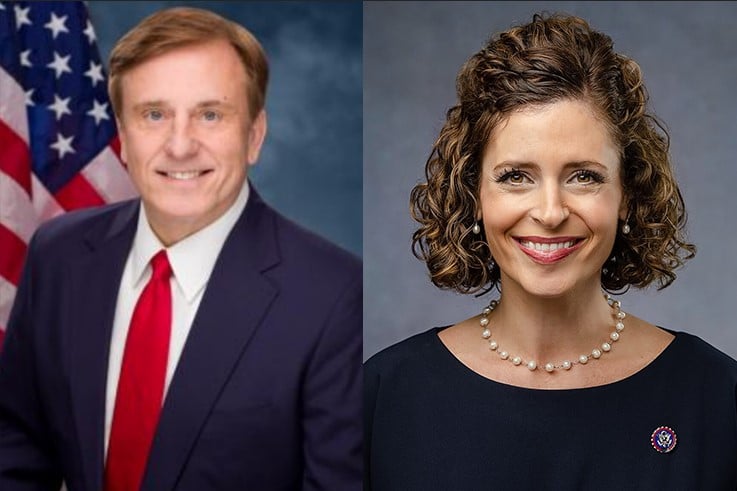
Now that Louisiana Republicans have rejected Senator Bill Cassidy, they have an opportunity to select a more steadfast conservative as their Senate nominee. Only one of the two candidates now vying for the GOP nomination appears to fit that description.
Cassidy, one of seven Republican senators who voted to convict President Trump on impeachment charges after he’d already left office in 2021 (five of the seven have since been rejected by voters or else chosen not to face them), was defeated in last month’s Republican primary by Representative Julia Letlow and State Treasurer John Fleming. Since no candidate received a majority of the vote, Fleming and Letlow will now compete in a runoff for the GOP nomination on June 27.
Whereas Fleming brings a wealth of experience and a track record of principled conservatism to the race (full disclosure: I know and have worked closely with Fleming), Letlow championed diversity, equity, and inclusion (DEI) during the summer of 2020. That was the summer of George Floyd and Black Lives Matter, when Americans’ willingness to stand up against toxic wokeness was put to the test. Some were revealed as courageous defenders of longstanding American norms, while others were exposed as malleable pawns of the left. Letlow was in the latter camp.
I first met John Fleming in the spring of 2017, when we were both Trump political appointees at the U.S. Department of Health and Human Services (HHS). Fleming has been a family physician—as well as a Naval officer, a businessman, and a congressman—so he knew firsthand that the federal government was doing a lot to wreck private-practice medicine. It was doing so in part by issuing rules stating that Medicare (with private insurers following suit) would pay doctors based on five different “evaluation and management” codes.
The first of the five codes indicated the doctor wasn’t there; the other four required extraordinary amounts of largely meaningless documentation to determine what level of pay the doctor should get if he or she was there. Ever wonder why doctors often seem so focused on their computers during your visits? It’s because the federal government has made entering data more lucrative than interacting with patients.
John and I met regularly and crafted a plan to liberate private-practice doctors (and their patients) from the tyranny of the federal health-care payment system. We proposed simplifying the five codes into two: “Doctor is there” and “Doctor is not there.” So, instead of taking up hours of doctors’ time each day, documentation would consist of three or four words. If present, the doctor would get compensated at the average rate of pay under the 5-code system for visits (with adjustments for specialties known to be more time-consuming). Under our proposal, doctors would be paid the same in aggregate, and the federal government would stop incentivizing them to turn their backs on their patients and type at their computers—something that was causing many good doctors to leave private practice.
HHS adopted a portion of our plan, eliminating much redundant information required of doctors. So, it was a partial victory. What I learned about John during this process was that he is knowledgeable, personable, courageous, and dedicated to fighting the administrative state. He’s the kind of guy who works to solve problems—and who knows that most problems identified by the federal government are traceable to the federal government. In short, he’s a principled patriot, one capable of getting things done.
Three years after John and I were trying to save the private-practice doctor for the benefit of everyday Americans, Julia Letlow was interviewing for the presidency of the University of Louisiana at Monroe. During that August 2020 interview (you can watch it here at about the 39:00 mark), she was asked, “[A]t ULM, the student body is 67 percent female, but the tenured faculty in the university is 63 percent male. So, my question is: How would you go about supporting diversity and equity in the faculty ranks?”
Rather than rejecting the premise of the question—that having five-eighths of tenured faculty be male was somehow surprising or problematic—or rejecting DEI, Letlow responded with a full-throated embrace of that woke, leftist philosophy: “It is important,” she said. “I’ll just be candid with you. We have an issue on this campus. We do. And one of my first initiatives would be to address it.”
Letlow then called for the creation of a new Division of DEI at the university: “So, one of the first things I would do, I believe we need a division on this campus, a Division of Diversity, Equity, and Inclusion.”
Letlow made clear that this new division would be powerful and that any decision made by the university would need to get its sign-off: “a Division of Diversity, Equity, and Inclusion” would have “leadership that goes all the way to the top, with a full staff, because our issues are so great.” She added that “those concerns that you just raised, and those metrics, and those numbers”—that 63 percent of tenured faculty were male—“are shameful, truly.” Thus, “I believe that having that strong division, having that leadership, if you have a person around the table that is cognizant and fighting for diversity, equity, and inclusion, before any decision is made for the university, then that’s how you change.”
Nor did Letlow present this as a temporary measure: “It’s a long-term plan of action, that is long-term and never-ending.”
Letlow then suggested that residents of Northeast Louisiana are rubes who don’t recognize their rampant (albeit unconscious) racism and sexism: “I believe that there are so—there are a lot of people on this campus who have never heard of unconscious bias. They don’t know that it exists. A lot of people have lived in Northeast Louisiana their whole lives.”
Letlow also expressed her preference for having professors and students share the same demographic traits: “I want students…to see themselves reflected in their faculty who are teaching them.”
Summing up her commitment to embracing and expanding DEI, Letlow said, “And so that would be number one for me. I’m glad you asked that question.” She concluded, “Of course, it affects me personally. We don’t have enough women at the top. We don’t have enough women of color at the top. And so I would be committed to that…. It’s time. It’s time.”
Despite her shameless ode to DEI, Letlow didn’t get the job.
When running for the Senate this year, Letlow was asked about her support for DEI in that ULM interview. Her response was perhaps even more problematic than her initial enthusiasm. Letlow told Fox News, “DEI six years ago was introduced in higher education as something that could be a tool to encourage students, staff, faculty to work hard and go achieve the American dream.” Then, she claimed, DEI changed. “But what I saw firsthand was that it was hijacked by the radical left and turned into something else entirely,” she said. “It became about division, ideology, and identity politics. Once that became clear, I opposed it.”
In truth, DEI wasn’t hijacked by the left; it was invented by the left. It was always about division, ideology, and identity politics. While Letlow was singing DEI’s praises in her interview, leftists across the country were alleging “systemic racism” in America, pledging to “defund the police” on those grounds, and pushing to expand DEI programs across the land.
Even before Letlow entered kindergarten, President Reagan was taking aim at affirmative action—DEI’s older, and perhaps less malign, cousin. In 2019, a year before Letlow called for expanding DEI, conservatives like Tom Klingenstein were already talking about how “the principle that all ‘marginalized’ groups … are oppressed by white males” constitutes a “political revolution” that threatens “America’s way of life.” Where was Letlow then?
Indeed, a month after Letlow said that DEI should be expanded at ULM, Trump issued an executive order saying that “race and sex stereotyping and scapegoating” is “contrary to the fundamental premises underpinning our Republic: that all individuals are created equal and should be allowed an equal opportunity under the law to pursue happiness and prosperity based on individual merit.” Trump basically accused the Julia Letlows of the world of abandoning core American principles.
For Letlow to say that DEI circa 2020 was “a tool to encourage students, staff, faculty to work hard and go achieve the American dream”—and that such a system of group-based discrimination was only later “hijacked by the radical left”—is truly incredible. It suggests inordinate ignorance, disingenuousness, or both.
NBC News reported back in January that Letlow “would only get into the race if Trump committed to endorsing her.” Trump encouraged her to run, saying she would have his endorsement if she did. It seems clear that he offered his endorsement in exchange for her running because he wanted to take down Cassidy and thought she might be able to topple him.
But now that Fleming and Letlow have combined to defeat Cassidy, leaving a two-person race, Louisiana Republicans have their choice of the conservative candidate or the DEI candidate. It’ll be interesting to see which one they choose.
Leave a Reply