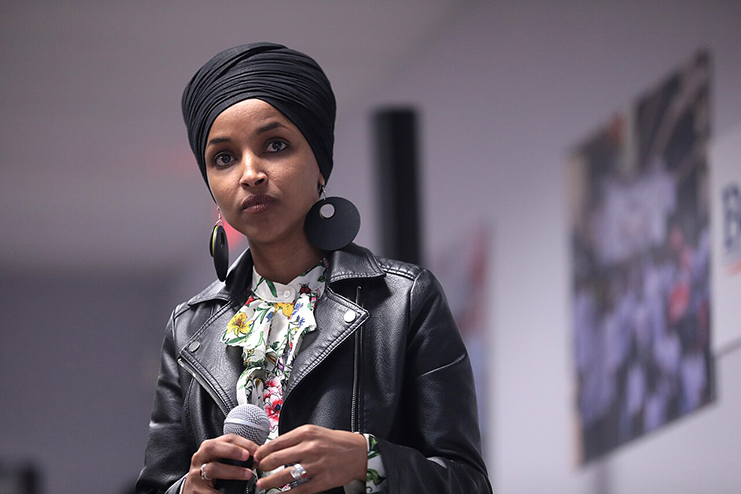
Minnesota’s Somali Congresswoman, Ilhan Omar, has been at the center of several major scandals, including the Feeding Our Future scheme that robbed the federal taxpayer of hundreds of millions of dollars, and, of course, the story that Omar allegedly married her gay brother to extricate him from London decadence and bring him to the U.S. where he could be watched closely. Then, just last week at a town hall meeting in Minnesota, an assailant sprayed her with an unknown (but apparently nontoxic) substance.
Yet there is another issue Omar’s critics strangely overlook: female genital mutilation (FGM).
FGM, sometimes referred to as FGC, or female genital cutting, is nothing like male circumcision—even if there are ritual similarities. In FGM, the external female genital organs are severed partially or fully. The entire clitoris is often removed, and in extreme cases, the vaginal opening is stitched. The practice has a high chance of creating severe short- and long-term complications, including infection, back pain, urological problems, sexual dysfunctions, and infertility.
As many as 200 million girls and women around the world have been victims of this practice, according to the Centers for Disease Control and Prevention (CDC). The barbaric custom is practiced in wide swaths of Africa and the Muslim world. In Omar’s native Somalia, it’s near-universal.
Aayan Hirsi Ali, a refugee from Somalia turned anti-Islamist activist and politician, described her experience with FGM in her memoir Infidel. Aayan was cut alongside her sister and her brother when all three were in their middle childhood years. All three were traumatized by the experience. But while the brother recovered relatively quickly, her sister experienced multiple complications. Hirsi Ali blames FGM for her sister’s eventual descent into madness.
In the late 20th century, the agreement in the West was near-universal—genital cutting must end. It seemed self-evident that the effect on women’s health and well-being was profound. These types of procedures are technically banned in the United States today.
Yet when I was studying anthropology at UC Berkeley in the early 2000s, the consensus among fellow graduate students—today’s cultural elites—was that FGM is merely something that other cultures do, and supposedly enlightened Americans need to understand that they have their reasons for doing it. The cultural relativism of that decade was without limit—I once took a class with a young lady who believed that human sacrifice was justifiable on the grounds of multiculturalism.
While it’s true that the women who experienced genital cutting often internalize their oppression, which explains why they so often turn around and do the same to their daughters, we are correct to judge this practice not by the standards of their culture but by the harm it does to human beings. The fact that the victims often become perpetrators, if anything, makes this tradition even more dangerous. This makes it exportable, and it becomes a warning that it can take root in places where it was not formerly found—including on our own soil.
The CDC has been keeping tabs on this alien practice in America. A 2016 indirect estimate suggested that
as many as 513,000 girls and women could have experienced FGM/C or be at risk of experiencing it in the future. This number was a three-fold increase from a 1997 estimate and was largely due to the growing number of U.S. residents from countries where FGM/C is practiced.
A 2019 CDC study of 1,132 “U.S.-resident women aged 18 to 49 who were born, or whose mothers were born, in a country where FGM/C is a common practice” revealed that 55 percent of them were victims of genital cutting. Remarkably, 91 percent of the subjects told researchers they believed the practice should be stopped.
A 2021 Johns Hopkins study of the Somalian community in Arizona found a 77.4 percent genital cutting rate—consistent with its prevalence in the home country. Numbers that high seem to suggest that the practice is alive and well in America—or at least that girls travel back to the home country to be cut, which is also illegal.
I can’t find any evidence of Somali FGM rings in the United States. However, given that Somali corruption is notorious and that Somalis were able to commandeer medical services in Minnesota to procure fake autism diagnoses, should we be shocked if we discover that they have also been organizing illicit genital mutilations in medical settings? Not that it’s necessary—traditional societies find ways to remove genitalia without modern medical training.
But where is Ilhan Omar in all of this? Omar is the proud Somali who, at the height of the #MeToo movement, proudly identified as an “intersectional feminist,” and led the Women’s March Minnesota in 2017. Taking center stage at that event, the newly elected U.S. representative declared: “Our liberation, our freedom is the freedom and liberation of all humans.”
But what is this liberation that she is talking about? Omar is marketed to white women as a champion of feminism, but this is a strange kind of feminism. The politician from Mogadishu neglects the most basic issue facing women in her own community—including, perhaps, her daughters. Not everyone can be a hero like Hirsi Ali, who went into hiding after the murder of her co-author Theo Van Gogh. Nor is everyone ready to openly discuss such intimate matters. That’s understandable, but if the congresswoman is not working for positive change for the women she represents, people are right to question why the progressive movement champions her.
It’s not just that I don’t believe a self-declared intersectional feminist from Somalia whose main issue is anything other than FGM. FGM is a ritual, a rite of incorporation—it radically marks a woman as a member of an ethno-religious community. Our civilization finds it revolting, a fact of which Somalis are intensely aware. Every time a cut woman visits a ladies’ or locker room, she is reminded of her differences.
Somalis live in a social order set apart from our mainstream, and cutting is the instrument of initiation. With Somali women separated from the mainstream in such a crude manner, we are guaranteed to have generations of Somalis resisting assimilation. And that means the endemic corruption of their culture, with welfare as lifestyle, and the funneling money to terrorist groups in East Africa is sure to continue.
Will another Somali woman speak up about the atrocities endured by her sisters? Will we listen?
Leave a Reply