America’s elite institutions still speak in the old language of learning, truth, inquiry, and formation, but their function has changed. They do not primarily cultivate wisdom. They certify status. They do not preserve civilization. In short, they no longer seem certain about what education is. What remains is the outward form of the university without its older soul: ivy on the walls, Latin over the gates, and an elite credentialing regime within.
The pattern is much the same, no matter the campus. The university looks like a monastery and functions like a passport office for the regime, certifying entry into Washington, Wall Street, academia, nonprofits, the judiciary, consulting, and the deep administrative state.
Students may be impressive and ambitious. Internships, clerkships, fellowships, consulting pipelines, résumé construction, networking receptions, and LinkedIn-maxing dominate the atmosphere. Yet despite the rhetoric of diversity, the range of permissible thought is often narrow. Students arrive from different backgrounds only to be processed through the same ideological and professional meat grinder.
This is how the university perpetrates the fraud. It claims to liberate minds while training them to obey. It claims to challenge power while feeding students into the institutions that exercise it. It claims to cultivate critical thinking while enforcing a rigid orthodoxy. The modern university no longer asks what is true, good, or beautiful. It asks who may be certified.
I came to this realization slowly. Like many young Americans raised to believe education represented self-improvement, I pursued advanced degrees, believing universities were ordered toward truth. I believed they existed to cultivate disciplined minds, moral seriousness, civic character, and learning in the humanities. After years of accumulating credentials in elite academic environments, however, I gradually realized that they no longer do any of the things I was expecting.
That realization sharpened while I was at the University of Oxford. There, I encountered the legacy of John Henry Newman. Newman regarded the university as an institution concerned with the cultivation of the intellect, the enlargement of the soul, and the disciplined pursuit of truth. Education, for Newman, was based on formation.
That older understanding survives mostly in brochures and donor literature today. Harvard’s motto illustrates this civilizational shift. The word associated with Harvard University is Veritas, Latin for “truth.” But Harvard’s older motto was Veritas Christo et Ecclesiae, “Truth for Christ and the Church.” Harvard was originally tethered not to some abstract notion of truth, but to Christ, the Church, revelation, reason, and a coherent order. When that structure was removed, universities were stripped of their spiritual foundation. In time Havard, Yale, Princeton, and other onetime Christian centers of learning would also cease to be world centers of scholarship in the humanities.
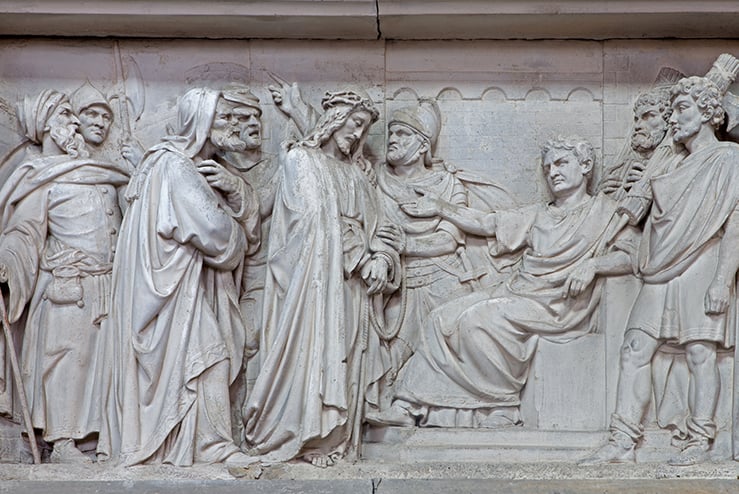
The modern university still invokes truth, but like Pilate before Christ, it increasingly asks, “What is truth?” and comes up empty. If truth is detached from Christ and the Church, if it is grounded only in reason, social consensus, managerial expertise, or ideological power, then truth becomes whatever the institution is prepared to enforce.
This is not just Harvard’s story. Many of America’s oldest colleges were founded to train clergy and order the mind toward God. Schools that once prepared ministers, pastors, priests, and Christian statesmen have become among the most secular institutions in our national life. Places founded to train shepherds now train bureaucrats. The seminarial impulse has not disappeared; it has been inverted. The modern university still catechizes. It still disciplines belief. But the creed has changed.
In place of theology, we have the study of self. In place of sin and redemption, the oppressor and oppressed. In place of ordered liberty, liberation from nature, tradition, and family. In place of pastoral formation, the woke and weaponized language of DEI, gender ideology, and bureaucracy.
The secularization of today’s institutions cannot be understood as simply neutral. The schools did not move from Christianity to unadulterated reason. They moved from Christianity to another religion, one less honest about its dogmas because it mistakes them for enlightenment. The old colleges once trained men to preach from pulpits. The new university trains graduates to preach from HR departments, agencies, classrooms, nonprofits, and courtrooms.
The modern university is a credentialing apparatus attached to the managerial economy. Degrees no longer signify intellectual achievement so much as one’s ability to navigate institutional systems. The JD, MBA, MPA, and countless other specialized master’s degrees increasingly function as bureaucratic passports into gated professional classes.
Administrative explosion reflects this shift. As universities abandoned intellectual formation, they embraced managerial supervision. Vast bureaucracies emerged to oversee compliance, therapeutic intervention, ideological regulation, Title IX enforcement, and diversity programming. These offices increasingly define the mission. The university has become the administrative state in miniature: procedural, technocratic, therapeutic, punitive, and suspicious.
The humanities suffered most profoundly as critical theory replaced older methods of learning. Inherited tradition became an object of suspicion. The canon was not something to enter, understand, and wrestle with, but something to expose. Self-examination took its place. The critique eventually displaced stewardship. Students were trained less to seek what was true, good, or beautiful than to identify hidden structures of domination, oppression, exclusion, and power.
Artificial intelligence now threatens to expose the hollowness at the center of this credentialing regime. For decades, universities justified tuition and credential inflation by promising access to the knowledge economy. Students accepted debt because credentialing their labor appeared to secure them prestige. But generative AI reveals how much white-collar work consists of mere formulaic information processing, bureaucratic jargon, standardized communication, and managerial abstraction. And the machines can do much of this.
Of course, all is not lost to the machines. But at the same time, it is important to consider who trains the machines. A recent paper from the Center for Renewing America argues that America must develop AI rooted in the American tradition and Christian anthropology. This requires us to remember the important distinction between things that are “made” and those that are “begotten.” AI can produce something resembling human thought, but it lacks depth, personhood, moral agency, and wisdom. It processes; it does not know. It optimizes; it does not judge. It makes; it does not beget.
Recalling this distinction helps us illuminate the crisis in higher education. The modern university increasingly treats students in a way similar to the approach AI has to wisdom. It manufactures credentialed outputs rather than cultivating human beings. The irony is devastating. Universities spent decades replacing humane education with technical-professional credentialing just as technology began rendering large portions of generic cognitive labor vulnerable to automation.
AI is not a threat to genuine education. It is a threat to the credentialism that has been masquerading as education. A student formed by a knowledge of God’s Word, Tocqueville, Augustine, Shakespeare, constitutional history, moral philosophy, logic, and rhetoric is not easily replaced by a machine. But a student trained merely to produce bureaucratic prose and navigate institutional incentives may discover that the machine can do much of what he knows how to do faster, more cheaply, and without complaint.
The alignment question raised by the development of AI applies equally to universities. Aligned with what? The modern university pretends to be neutral, but it is not. It is aligned with managerial liberalism, secular progressivism, therapeutic anthropology, bureaucratic control, and professional-class reproduction. It credentials students for service inside that worldview.
A society that forgets the difference between education and credentialing may continue to produce experts indefinitely. But it will struggle to produce wise men. When machines arrive to perform the tasks for which credentialed men were trained, the fraud will become harder to hide. The elite institutions will have to answer the question they have avoided: What is education for? If the answer is merely certification, AI will do most of what their students know how to do, and better. If the answer is formation, America must recover the older truth that education is not the manufacture of professional-class credentials but the cultivation of souls capable of receiving, preserving, renewing, and handing down a civilization.
Leave a Reply