
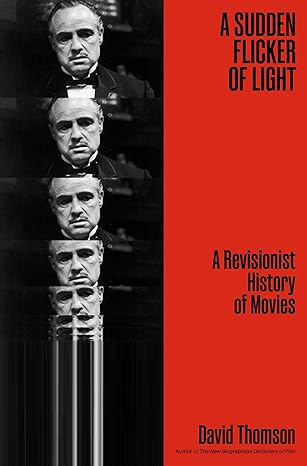
A Sudden Flicker of Light: A Revisionist History of Movies
by David Thomson
Simon & Schuster
368 pps./$30.00
Trump is the bad guy.
I just saved you $30 and 368 pages of reading.
David Thomson is a well-known movie critic, the author of The Big Screen: The Story of the Movies, A Light in the Dark: A History of Movie Directors, and The New Biographical Dictionary of Film: Sixth Edition. His new book is A Sudden Flicker of Light: A Revisionist History of Movies.
Thomson is a unique writer, combining sharp prose, funny and iconoclastic opinions, and an encyclopedic knowledge of motion pictures. In A Sudden Flicker of Light, however, what we get is a strange, discursive, and ultimately sickening book, the point of which is hard to grasp until you reach the end. Thomson himself admits that the reader might be wondering what the point of all his ramblings is in this work. It is then that he admits that his own editor advised him not to unveil the big reveal until near the end of the book.
Then we get the shocker: Movies have made people susceptible to fantasy and vulnerable to the evil spell of one Donald J. Trump. In other words, Thomson, who spent his entire career writing about movies, now thinks that movies may be a malevolent force because they made us passive and receptive to bad ideas, thus bringing us President Trump.
Movies, Thomson argues, have “turned us into watchers, half aware that we cannot have what we see.” He claims that movies promote fantasy over real life. Furthermore, it’s been going on for a long time. When tens of millions of fans flocked to early silent films, for the first time, everyone in America was watching the same thing at roughly the same moment. “How could any idea of God keep up?” Today, “little happens now that is not like a movie.”
Nonsense. It’s true that movies can make us feel things deeply—Roger Ebert called film “an empathy machine”—and even reconsider our thoughts about politics and love. Everyone acknowledges that, and it’s even part of the reason why I am helping to sponsor an Anti-Communist Film Festival. Yet Thomson is suggesting something else, entirely. He is asking us to believe that movies render us incapable of distinguishing between fantasy and reality.
As an example for his thesis, Thomson cites a comment by Haskell Wexler. Born in 1922, Wexler was a brilliant cinematographer who had worked on movies such as Who’s Afraid of Virginia Woolf?, In the Heat of the Night, and The Thomas Crown Affair. Wexler was also a rich leftist who “quarreled with his own privilege.”
In a 1975 interview, Wexler said the following, which, according to Thomson, “lights the blue touch paper for this book’s unease”:
I have rather complex feelings about filmmaking. Through . . . this mechanical power, you have a sense of immediacy, you alter the manner in which you perceptually relate to the world. I was on the beach yesterday and there was a young couple walking, hand in hand, by the shore. I looked at them and thought, I cannot look at these people today as I looked at them when I was a young man. I see them behind a camera at seventy-two frames per second. I almost superimposed a Coke bottle or Goodyear tire as though I were shooting a commercial. We have expropriated so many of the private moments and sold them in the marketplace. And this is part of the corruption of the reproducible media.
Thomson adds this:
Don’t we look and wonder in the way Haskell Wexler saw a couple on a beach and felt at the brink of his disenchantment with what he had been doing—making lustrous images that confuse our footing in reality? Or fill us with dread? It’s playing with ‘the facts,’ and that can seem perilous, or disturbed. Fantasy is a readiness for surpassing fact, an itch of madness, and photography set it free. But hasn’t that habit passed into us, so that we can’t stop seeing tomorrow? We walk around seeing the world, stepping over the bodies, et cetera, while behind our gaze we are seeing a story named “Desire.” This is conjecture, but that’s what looking frees.
Again, nonsense. What Wexler was describing was how his daily work bled into his life. It’s like a butcher going to a baseball game and briefly seeing a meat cleaver instead of a bat. It’s a brief glitch of the brain that comes from doing the same thing repeatedly for years. It doesn’t make an entire population, one that has never reached Wexler’s total immersion in film, lose its grasp on reality. I worked in a movie theater for several years while in college in the 1980s and saw more movies than I can count. Beer consumption made me lose track of reality much more than Tom Cruise ever did.
At the conclusion of A Sudden Flicker of Light, Thomson does something truly obscene. He posits that President Trump might have enjoyed getting shot in Butler, Pennsylvania because it made him look like a movie star. Thomson’s sick idea deserves to be quoted at length:
July 13, 2024, a day so bright outside Butler, Pennsylvania, that you could miss a flash of light. This is photographed live, soon after 6 p.m. local time, as he takes the stage to speak. This is what he lives for, the being on and seeing how he will play. For years now, he has sounded bored, or lethargic, in a stupor with the words he repeats, masturbating his close-ups. He is growing older, you see. But in July 2024, his opponent had gone dead on camera, staring into an abyss in which we felt the nausea of utter loss. He knows this vacancy will come for him, too. But will anyone notice? He feels himself congealing. Then, outside Butler, there is a tiny crack in the air and he flinches. There are more shots as he is surrounded by the bulk of Secret Service, as if they have nothing to do with the “security” that is supposed to stop a shooter shooting. There is a huddled confusion from which his golden head arises. This is not being critical or unsympathetic: A boy wants to stand up after a splinter of something has stung him in the ear. But what is so striking about this victim is his mix of pathos and bravery—such a movie trope—that understands how thoroughly he is on and how the image of him with his fist upright, and “Fight! Fight! Fight!” will play on T-shirts and posters for a while. This is not to say the Butler shooting was designed or directed—he’s not competent enough for that. But the immediacy with which he took his movie moment, that was destiny and our disappearance. Little happens now that is not like a movie. Our seeing has been trained in the habit. Being spectators has undermined the spectacle. Some anxiety in us understands that everything may be a trick.
So there it is. Trump is the devil, manipulating us with theatrics.
“From time to time in this book,” Thomson writes,
considering the glamour of the moving train that will not stop at our station, and the haunting way in which Charlie Kane and Michael Corleone and so many other fellas have been gang leaders who secured Donald Trump’s rapture at the movies, I have realized that he is our movie man.
Thomson didn’t want to spoil the ending, he insists, writing: “I held back, urged on by my editor: Not yet, keep it for a big finish.”
Finally, he had to go there, because “any theory of seeing had to know that this was as hideous as Germans telling themselves they really could not smell what was coming down the country road. And still this was not simply his fault. It was part of the degraded system, the surrendered idea of education and moral purpose, the sleep that had voted for him twice.” Oh, please.
One film the author of A Sudden Flicker of Light should have examined is I Am Legend. The twist in that science fiction classic is that the protagonist, a man who thinks he’s fighting monsters, is himself the biggest monster.
Leave a Reply