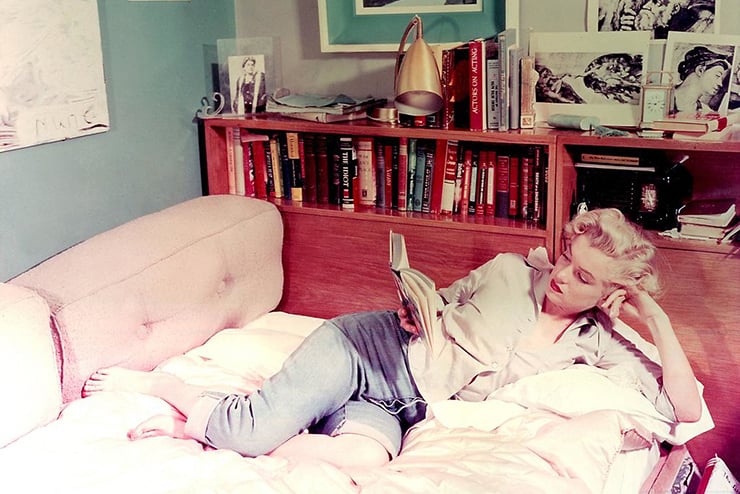
Marilyn Monroe read books. A lot of them.
That’s the revelation of Marilyn and Her Books: The Literary Life of Marilyn Monroe, a fascinating new volume by Gail Crowther. It isn’t a grasping-at-straws attempt to make Monroe a literary figure based on her love of a few good novels. Crowther has done her research, itemizing the books Monroe owned when she died, finding receipts for books she bought at the Ivy Bookstore in Los Angeles, and going through old letters in which Monroe discussed her favorite books. Monroe was a reader, which may explain why she was drawn to one of her husbands, the playwright Arthur Miller—a man who made his living with words.
When Monroe died in 1962, her collection included more than 400 books. “These books,” Crowther notes, “some dating from her childhood, had followed Marilyn around from one address to another.” Crowther describes the collection:
The scope of Marilyn’s personal library and the number of genres it contained was impressive. She read literature from all around the world, America, England, France, Germany, but certainly favored Russian novels. She enjoyed poetry, politics, psychology, plays, biographies, science, short stories, cookbooks, horticulture, contemporary novels, children’s books, religion, crime, adventure, art, pets, music, reference, and self-help. She was probably one of the few readers in the world whose personal library contained a biography of herself (Marilyn Monroe “Her Own Story,” 1961, by George Carpozi).
Monroe loved D. H. Lawrence and owned a poetry collection, the novel Sons and Lovers, a collection of his travel writings, Etruscan Places, and a critical study of Lawrence and his works by Mary Freeman. She also owned copies of The Great Gatsby and Tender is the Night by F. Scott Fitzgerald. She owned a first edition of Ian Fleming’s From Russia, With Love, a book that included a chapter titled “The Mouth of Marilyn Monroe.” Monroe loved Russian literature, bonding with actress, columnist, and writer Sheilah Graham over Dostoevsky, Tolstoy, Chekov, Turgenev, and Pushkin.
Monroe also had “an edgy liking for banned books.” This included The Last Temptation of Christ by Nikos Kazantzakis. Monroe’s copy of the novel sold for $3,220 in a 1999 auction. She also owned a 1934 first edition of Ulysses, published after the ruling that the James Joyce novel was not obscene and could not be banned.
Most of Monroe’s books went to private collectors. One anonymous woman from Boston purchased five of her books and then donated them to the Schlesinger Library at the Radcliffe Institute for Advanced Study. The books were each written by an American woman: My Ántonia and Lucy Gayheart by Willa Cather; The Portable Dorothy Parker by Dorothy Parker; The Ballad of the Sad Café by Carson McCullers; and The Little Disturbances of Man, a collection of short stories by Grace Paley. In January 2000, the library put the books on public display, and the then-acting director, Jane Knowles, said, “We are thrilled to receive these books from the library of Marilyn Monroe. This just goes to prove that there was more to Marilyn Monroe than the movie star and popular icon. She was also a reader. We are delighted to add her books to those of other illustrious women at the Schlesinger Library.”
Photographer Henri Cartier-Bresson said Monroe “had this strong air of Americanness about her, more so than other of her peers.” On the set of the film The Misfits, he observed, “She’s American, and it’s very clear that she is. She’s very good that way—one has to be very local to be universal.” He also noticed she had been underestimated: “There’s something extremely alert and vivid in her, an intelligence.” This probably accounts for the fact that among her books were included such titles as American Rights: the Constitution in Action by Walter Gellhorn and Democracy in America by Alexis de Tocqueville.
Monroe, apparently, was not a fan of gothic literature. She didn’t own copies of Wuthering Heights by Emily Brontë or Jane Eyre by her sister, Charlotte. Both novels eventually became Hollywood classics, with Wuthering Heights starring Laurence Olivier, whom Marilyn would eventually appear alongside in The Prince and the Showgirl, and Jane Eyre, produced by and starring Orson Welles. She did not own copies of Frankenstein by Mary Shelley, Dracula by Bram Stoker, or Turn of the Screw by Henry James. No ghost stories, no Edith Wharton, no Oscar Wilde. “Somehow it doesn’t seem too much of a surprise that Marilyn avoided gothic literature,” Crowther observes. “Maybe her life was gothic enough with her bleak childhood in an orphanage and her mother in an asylum.”
Crowther calls Monroe’s books “an emotional constant” in a life that had a lot of uncertainty. Monroe had a turbulent childhood, but held onto books she had owned during that period, including The Little Engine That Could by Watty Piper. Many were religious: Science and Health with Key to the Scriptures and Poems Including Christ and Christmas by Mary Baker Eddy, Catechism for Young Children, and And It Was Told To a Certain Potter by Walter C. Lanyon.
Crowther spends a couple of chapters trying to explain the reasons why Marilyn read. The most basic one, she notes, is that America was a more literate country when Monroe was alive. In the 1950s, America was a more cultured and literate society. Social historian Fred Siegel once explored how the American masses embraced art in the 1950s, as philanthropists and gatekeepers worked hard to offer the public exhibitions of the best of Western culture. Americans at the time, wrote Siegel, “were sampling the greatest works of Western civilization for the first time.”
In a 1956 collection of essays, Mass Culture: The Popular Arts in America, an interview with a salesman, more than the essayists themselves, revealed that mid-century America was a time of popular intellectual and cultural striving. This salesman noted that “twenty years ago [or, the America of the 1930s], you couldn’t sell Beethoven out of New York. Today we sell Palestrina, Monteverdi, Gabrieli, and Renaissance and Baroque music in large quantities.” There was a 250 percent increase in the number of local symphony orchestras between 1940 and 1955.
In 1955, writes Siegel, “15 million people paid to attend major league baseball games, 35 million paid to attend classical music concerts. The New York Metropolitan Opera’s Saturday afternoon radio broadcast drew a listenership of 15 million out of an overall population of 165 million.”
Siegel notes that in the early days of television, the gatekeepers assisted in channeling this great art to the people: “NBC spent $500,000 in 1956 to present a three-hour version of Shakespeare’s Richard III starring Laurence Olivier. The broadcast drew 50 million viewers; as many as 25 million watched all three hours.” Siegel observes that “on March 16, 1956, a Sunday chosen at random,” the viewer could have seen a discussion of the life and times of Toulouse-Lautrec by three prominent art critics, an interview with theologian Paul Tillich, an adaptation of Walter Van Tilburg Clark’s Hook, a documentary on mental illness with Dr. William Menninger, and a 90-minute performance of The Taming of the Shrew.
Even more than high-brow television, however, in mid-century America, books, serious ones, were hugely popular. Saul Bellow’sThe Adventures of Augie March, a National Book Award winner, sold a million copies in paperback in the early 1950s. Other bestsellers included Doctor Zhivago, East of Eden, Advise and Consent, and From Here to Eternity. Marilyn Monroe read those kinds of books, but in those days, so did a lot of Americans.
Leave a Reply