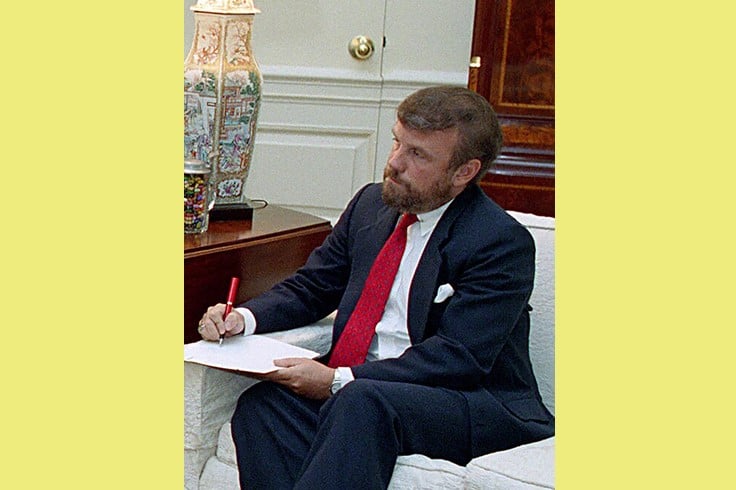
March 8 marked the 43rd anniversary of President Ronald Reagan’s famous “Evil Empire” speech before the National Association of Evangelicals in Orlando, Florida. It was during that speech that he labeled the Soviet Union an “evil empire.” This year’s anniversary of the speech was not a milestone, but it was the first since its author, Anthony R. Dolan, died one year ago this month at age 76.
Dolan’s famous contribution to the Cold War lexicon was not inspired by George Lucas’ filmography. Rather, it drew upon a profound understanding of institutional evil. Prior to serving as Reagan’s chief speechwriter, Dolan faced a miniature evil empire. Foreshadowing his later career, Dolan engaged it with the most powerful weapon in the rhetorical arsenal—truth.
A Connecticut Yankee in cowboy boots, Dolan’s early life was a study in incongruity. A conservative voice at the Yale Daily News, his writing earned him the patronage of fellow Nutmeg Stater William F. Buckley. After a postgraduate stint in the army and a brief career as a guitarist, banjoist, and singer-songwriter in the niche conservative folk song genre, Dolan served as an aide to Senators James Buckley (Conservative Party.-N.Y.) and Jesse Helms (R.-N.C.).
A desire to learn the art of speedwriting prompted Dolan to trade politics for journalism. After a brief stint with a newspaper in Westchester County, New York, Dolan landed as a reporter with the Stamford, Connecticut (pop. 110,000) Advocate (circulation 30,000) on April 18, 1974. Exactly four years later, Dolan would become the youngest person to receive a Pulitzer Prize for investigative journalism.
Dolan’s path to the Pulitzer was paved by 75 articles exposing organized crime’s control over Stamford’s municipal government. The corruption permeated eight city departments and implicated city employees in arson, bribery, drug trafficking, and murder. The capstone of Dolan’s long exposé was a five-part series on the Stamford Police Department, revealing that the head of the narcotics bureau controlled most of the illegal gambling and drug trade in the region.
The impact on the City of Stamford was explosive. Eight separate federal investigations into Stamford’s municipal government led to the firings, forced resignations, and prosecutions of numerous city officials. Dolan was the recipient of countless threats and acts of intimidation. But he never gave in, and he selflessly donated the $1,000 that accompanied his Pulitzer to the family of Don Bolles, an Arizona Republic investigative reporter who was killed by a car bomb.
After winning the Pulitzer, major media outlets, including The New York Times, offered Dolan jobs, but he remained with the Advocate until joining the Reagan presidential campaign in 1980. In 1982, Dolan was invited by Attorney General William French Smith to brief the Justice Department on what he uncovered in Stamford. From there sprang the Reagan administration’s war on organized crime in the U.S.
Once in the White House, Dolan and his boss set their sights on another criminal regime, one that had enslaved half the globe and sought to enslave the other half. Both Reagan and Dolan believed that institutional evil was inherently unstable because it was divorced from the truth. And a prerequisite for any successful strategy to confront institutional evil is telling the truth about it. Failure to do so “is the first and most important defeat free nations can ever suffer, for when free peoples cease telling the truth about and to their adversaries, they cease telling the truth to themselves,” Reagan said.
Like a demon recoiling from a crucifix, institutional evil cannot stand to be confronted with the truth about itself. It has the added benefit of boosting the spirits of those oppressed by the evil regime, who always represent the most proximate threat to the regime. Dolan knew this as well as anyone, and so his words contributed to the collapse of not one, but two evil empires. How’s that for a legacy?
Leave a Reply