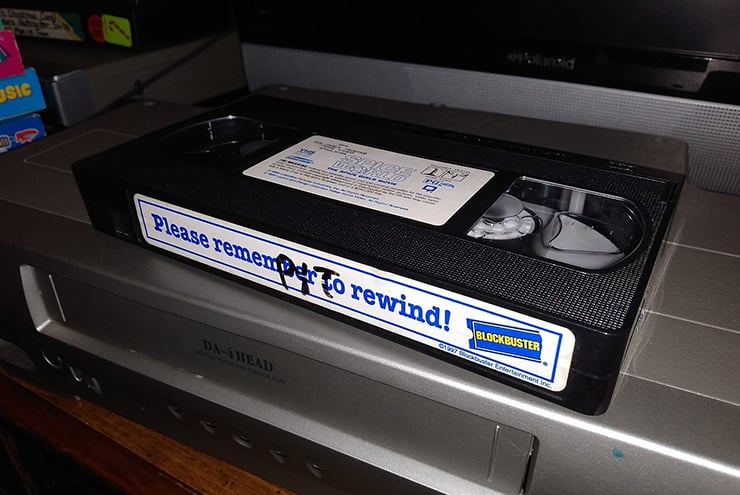
In March, the Criterion Channel, the premier streaming service for the best and most interesting movies, is offering “VHS Forever.” It features a series of films that celebrate the 1980s era of the videotape. “Fifty years ago,” the promotional copy reads,
the introduction of VHS to the consumer market revolutionized the way people watched movies, bringing classics, the latest hits, obscure cult favorites, underground bootlegs, and disreputable marginalia alike into their homes with hitherto unimaginable convenience.
Criterion is offering “a panoramic meta-history of the distinctively grainy, static-flecked medium that forever altered our relationship to the moving image.”
While featuring some great films—Videodrome (1983), Body Double (1984), 52 Pick-Up (1986), and more—Criterion has missed a great opportunity here. “VHS Forever” is the perfect forum to feature Chuck Norris vs Communism. This 2015 documentary explores how, during the last two decades of the Cold War, there was a black market for American films smuggled into the communist countries. These films were smuggled in on VHS format, which was compact and easy to hide.
The film, which boasts a perfect 100 percent rating at Rotten Tomatoes, might even inspire up-and-coming filmmakers to challenge left-wing systems in the West.
Oana Godeanu-Kenworthy, a professor at Miami University, is the author of a great new book, Videotape, which offers an insightful history of the VCR and the VHS tape, from their invention in Japan to the last-standing Blockbuster store in Bend, Oregon. One of the most interesting chapters, “Viewing Parties and the Party,” recounts the history of the VHS in Eastern Europe and the Soviet Union in the 1970s and ’80s. As VCR players became more affordable and popular in the ’80s, more and more of them were smuggled into Communist countries. Kenworthy describes the “viewing parties” that sprang up in the Eastern Block:
Crammed in small apartment buildings, a dozen or so people split the costs of the VCR rental or paid a small entry fee to the host of the party. News of the parties spread by word of mouth, from teenagers loitering behind the blocks of flats, to neighbors, relatives, or work colleagues. The most popular genres were films featuring Jean-Claude Van Damme or Bruce Lee, the action films of Chuck Norris, Sylvester Stallone, and Arnold Schwarzenegger, but also miniseries such as The Thorn Birds (1983), or Shogun (1980). Since most VHS tapes ran for two hours, and most feature films were 90 minutes, the space left at the end was filled with MTV music videos or even advertisements. Commercials were an unknown genre in the communist economy and, unlike in the West, where the videotape enabled viewers to fast-forward past the ads, in Eastern Europe, they functioned as sheer entertainment, since the products they promoted could not be found on the local market. In the Soviet Union, where the legal penalties against illegal videotapes were harsher than in Romania, people found even more creative ways to dodge the police. Instead of hosting in a private apartment, in Baku, Azerbaijan, grubby taxi minivans of Latvian manufacturing, popularly known as Rafiks, doubled as mobile screening rooms equipped with a VCR and a color TV. They’d tour the city and then show up in neighborhood streets at random times, like an American ice-cream truck, offering Soviet children a motley fare of Tom and Jerry cartoons, B-category action movies, and silly Hollywood comedies crudely dubbed in Russian, but immensely enjoyable anyway.
Kenworthy notes the irony of Nikita Khrushchev telling Richard Nixon in 1959 that he was wrong to boast of Americans having color TVs while the Soviets did not—that the technology responsible for color television was irrelevant. In fact, it was that very technology that, years later, would help bring down the Soviet Union.
Despite missing on Chuck Norris vs Communism, Criterion is showing another film as part of “VHS Forever” that has real, and frightening, contemporary meaning.
1983’s Videodrome, starring James Woods, reads as a prescient warning about AI and the degradation of American culture. Woods plays Max Renn, a producer at a cheap, sleazy cable TV station. One night, he comes across a violent sexual torture show called “Videodrome.” Renn tries to find the origin of “Videodrome,” which is a precursor to today’s AI. Soon, Renn is investigating conspiracy theories and pushing boundaries of decency with a new woman he meets, played by Deborah Harry.
Written and directed by David Cronenberg, the film features groundbreaking makeup effects by Academy Award winner Rick Baker. Videodrome charts the nightmare of virtual reality, making us lose our sense of actual reality, and, through it, we come to understand the related loss of tenderness and humanity.
“Cronenberg’s nightmare was never that we’d be poisoned by filth, but that perversion itself could be perverted,” Charles Bramesco once observed in the Guardian.
Every freakazoid with a passion for splatter pictures and stag films knows they’re not real, their artifice key to their charm. The trouble starts when shadowy forces chip away at our precious human ability to tell the difference. Just as the Silicon Valley startups behind chatbots and image generators won’t rest until they see the whole of art conquered, monetized and vanquished, Videodrome situates its horror and sci-fi conceits in a political climate of mounting reactionary influence. The mind-scrambling terror contagion eating away at the edges of Max’s reality isn’t just something that’s happened, but a deliberate act of offensive warfare.
Welcome to AI.
Leave a Reply