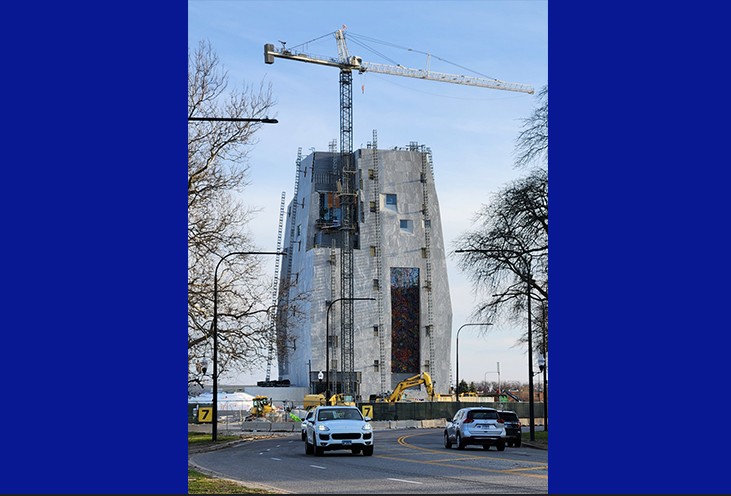
Pictures of the Obama Presidential Library under construction have gone viral. People have compared it to a Soviet grain silo, a sci-fi prison complex, or a dystopian social housing project. It is difficult to imagine there will any reading or any other fruitful intellectual activity going on inside of those drab walls.
Few things have the power to dampen the human spirit or kill civic pride as much as what passes these days for modern architecture.
Sometimes it even kills in the literal sense. At four in the afternoon on Jan. 2, 2006, the flat roof of a modernist ice rink in the Bavarian spa town of Bad Reichenhall in southeastern Germany collapsed under the weight of a deep layer of wet snow, killing 15 people, including eight children.
As always happens when disaster strikes, the bereaved asked, “Who is to blame?” Sometimes no one is. Sometimes bad things happen to good people for no particular reason. But, then again, sometimes negligence is involved, from the builders to the municipal authorities whose job it was to certify the building plans.
In another sense, thinkers of the past, most of them long dead, are also culpable, if only indirectly. In a letter to a fellow scientist, Sir Isaac Newton wrote, “If I have been able to see farther, it was only because I stood on the shoulders of giants.” Human beings are blessed with big brains, but very little in the way of innate abilities or instincts. What separates us from the hairless apes is the accumulated learning of the countless generations that have come before. A handful of us might, if we are lucky, add a thing or two to this store of knowledge. Art and architecture, like all human endeavors, builds on the collective memory of what has been proven to work in the past, and what has not.
This goes to the heart of Modernism. As we reflect on its consequences in literature, music, and art in general, we do well to recall that the old traditional forms pre-dating Modernism certainly conformed to Sturgeon’s Law, that “90 percent of everything is crap.” Every era has its share of rote and uninspired works. If you bothered to dig them up, most collections of sonnets written a century ago contain enough sunsets and daffodils to send you into a diabetic coma. We can’t all be Petrarch. But at least the traditional forms of arts and architecture protected a committment to a minimum of craft, even if that craft did not originate in the maker himself. Outside of the hands of its pioneers and most gifted practitioners, Modernism carried no such guarantee. When everyone is tasked with reinventing fire and the wheel, even the most talented among us are lucky to end up with a smoldering sled.
Which brings us back to roofs. Once upon a time, in the northern parts of the world, if you said the word “roof,” most anyone would automatically, without even considering why, imagine a sloping plane in one form or another. The reason for this might, without much thought, seem self-evident. People living in climates with lots of rain and snow soon discovered a slanted roof that shed snow and water was a rather good idea. But like many things people have been taught to take for granted, it apparently wasn’t so self-evident after all. In the aftermath of World War I, bored and disillusioned with the standards of the past, artists and architects not only set out to improve upon old forms, but to repudiate them utterly.
The Italian futurist Marinetti wanted to fill in the canals of Venice and replace the palazzi with modern factories, while the Swiss architect Le Corbusier wanted to tear down Paris and replace it with “machines for living.” Everything had to go: Sainte Chapelle, the Louvre, Notre Dame, and the irregular nooks and crannies of the Latin Quarter, presumably to be replaced with structures like we see today in the banlieues so recently convulsed by riots and vandalism.
The frills and ornaments of even modest buildings in the past were not deemed “functional” so, even though they made these buildings psychologically fit for human habitation, they and anything not conforming to straight and angular lines were banished as anathema. It was a utopian architecture and, like most utopian schemes, Modernism disregarded the realities of the everyday world people live in. Its sin is not even primarily in its disdain for Vitruvian neoclassical forms, but against traditional, local, vernacular architecture.
It turns out that people like the frills, ornaments, and idiosyncrasies of older buildings. Given the choice (and money permitting) they, and even most architects, choose to live in them, and eschew the “modern” machines of said architects and city planners. The brutalist assault on what these modernists consider kitsch ornamentation and sentimentality betrays a palpable contempt for ordinary people’s very humane taste for traditional comforts.
If you engage the architects of these monstrosities, or the public servants who approved them, in debate you may finally get them grudgingly to concede that their buildings are as ugly as shaved bats. But they will invariably fall back on the argument that they are “functional.”
But are they even functional?
Many of these architects overlook the fact that in the real world, their designs are subject to substandard cement, weak plaster wall segments, and cheap, easily corroded steel. Add to that the fact that these pristine, flat, white surfaces they favor, are inherently high maintenance. The lack of eaves to protect against the elements and a means to drain water beyond the walls, meant that within a year the surfaces designed to be elegant and seamless are stained with unsightly brown discolorations.
With a large enough budget and if it is scrupulously maintained, modernist architecture can yield striking results, as certain villas for the wealthy or Mies van der Rohe’s Seagram Building attest. But applying Modernism to whole cityscapes, including housing for the poor, has wrought little but disaster.
Even the most callous of us have an abiding respect for beauty. Other than the mentally disturbed, people shrink from taking a hammer to a work of art, or even something that is mildly aesthetically pleasing. But ugly cheers on ugliness. And the grey, cracking concrete manifestations of utopian modern architecture in most cities invites use as literal latrines.
Of all the arts, architecture is the one with which we interact the most. It shapes us and our actions in a very real way. Anyone who has tried to work in both a handsomely appointed office in a noble old building and the drab confines of a cubicle in some modern office hellscape will know the difference. Surroundings devoid of human sympathy elicit little sympathy or care in return.
Even in southern climes, where Modernism’s flat box-like roof designs are at least viable, the result of modern architecture was the creation of slums—inhuman urban wastelands of endlessly reflecting mirrors exposing our ennui and misery. Under the guise of alleviating social ills, urban planners ended up creating machines for grinding the poor even further into the ground. And as it has been applied with wilful disregard for local traditions and craftsmanship, the results (as happened with the ice rink in Germany) are sometimes even lethal.
In what way is a flat-roofed rectangular box functional in Germany, Norway, or Minnesota? Explain how it’s “functional” to need to employ a guy to rush up on the roof and shovel snow every second day in winter, just so the roof doesn’t cave in and kill everyone inside? Whatever the original intentions of architects and builders, it is difficult to call collapsing roofs a positive contribution to architecture or any meaningful human progress.
Leave a Reply