Trust is one of the most accurate indicators of a healthy society. Societies with high levels of trust among members are typically at the positive end of many other social variables. Economic productivity is high, crime rates are low, and general levels of health are high in high-trust societies.
Most of us could guess that levels of trust in this country are not strong in these times of vicious political polarization. And, in fact, a new study from the Pew Research Center shows that Americans’ trust of one another has been declining for some time.
But a brief look at several other social indicators gives us good reason to question whether declines in other social goods may account for that drop in trust.
There is plenty of evidence that Americans are objectively less trustworthy than they once were. To give just one obvious example, our attitudes on infidelity, which are steadily moving in the direction of greater acceptance of cheating on a spouse, are a big indicator of how much we value honesty, commitment, and keeping our word.
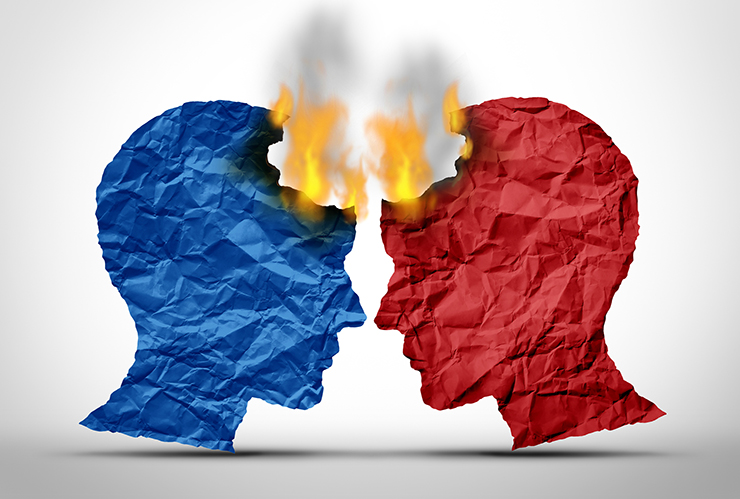
Political polarization undoubtedly contributes to the decline in trust. Many of us no longer really think of the country as fundamentally united, but instead see division and conflict as the normal state of American society. Large majorities of us, on both political sides of the spectrum, believe our side is losing and the other side is winning. Near majorities of us on both sides of the political aisle say we are fearful that the other side is an existential threat to the future of the country. Such attitudes are unlikely to drive social trust upward.
Religiosity has been declining in the U.S. for some decades now, although it may recently have started to level off. Even if the drop is coming to an end, it remains true that the group in the U.S. that has grown most significantly since the early 2000s is the unchurched, who are now about a third of the entire population. Those who recognize no God are typically trusted less by those who do.
What’s more, religious diversity, which is another trend in the U.S. in recent decades, further decreases trust, as people tend to trust their coreligionists more than they do those from other religions.
This last point—the steady increase in diversity across the board—merits some further exploration. Predictably, Pew does not venture at all into the topic of diversity and its relationship to trust. But, as Robert Putnam has shown, the best evidence indicates that increasing diversity causes levels of trust to go down. (Though, to be sure, there are steady efforts to produce a warped interpretation of these data by those who desperately want to hang on to the multiculturalist myth that “diversity is our strength”).
Take a look at the states where trust is highest in the Pew data—e.g., New Hampshire, Oregon, and Utah—and then at those where it is lowest—e.g., Alabama, Arkansas, Louisiana, Mississippi. Now examine the racial demographics in those states. As a rule, consistent with the Putnam study linked above, the more trusting states are more racially homogenous, and the less trusting more heterogeneous.
The critics of the “more diversity lowers trust” argument claim this is simply because whites are prejudiced, i.e., distrust grows only because whites do not like nonwhites, for no reason other than their own wicked racism. But there are ways to test that hypothesis. Compare the rates of violent crime in the high- and low-trust states. You will note another pattern that Pew either does not see, or sees and furiously wants to ignore: High-trust states tend to be among the states with the lowest crime rates, while low-trust states have statistically much higher crime rates—with several of them concentrated among the worst offenders.
This suggests that it is not simply that whites unreasonably disdain nonwhites. It is more plausible from these facts to infer that whites reasonably recognize that when the racial demographics of a state get more diverse—which, in the U.S., means larger percentages of blacks and Latinos, the two largest minority groups by far—the risk of crime typically starts to rise. (Indeed, black and Latino crime rates are substantially higher than crime rates among whites and Asians). Whatever one thinks of this reasoning, the causal argument—higher diversity produces higher crime rates, and higher crime rates produces lower rates of social trust—is at least a plausible interpretation.
Pew ignores all of this. What do they think is causing the rise in distrust? Predictably, they think it is lack of education. More-educated states are more trusting, they note, and less-educated states less trusting. If we could just get more education in those less-educated states, then those benighted people living there would be better equipped to see why it is wrong to distrust other people, and trust rates would go up.
They do not note that education correlates positively with socioeconomic class, which correlates negatively with crime rate. Highly educated states and communities are likely to have less crime, which, to reiterate, is likely to produce greater trust.
The insinuation of Pew’s interpretation is that all we need to do is sprinkle more magic education dust over the poorer states and this will inevitably make them both wealthier and more trusting. The fact that this is precisely what we have been trying to do since at least the Great Society of the 1960s, with pretty modest results, eludes them.
Pew’s method of ideologically spinning their survey on trust almost makes one believe that one should not trust Pew much.
Leave a Reply