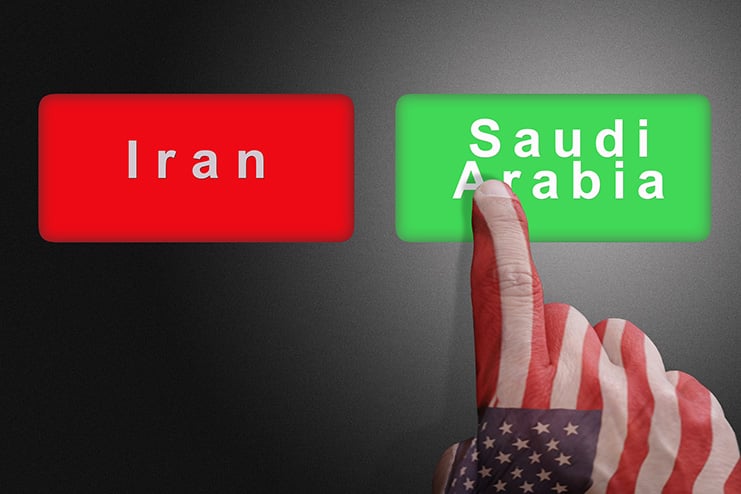
On July 22 the United States and Saudi Arabia announced the signing of a landmark agreement that will allow the Kingdom to develop a civilian nuclear program. The text of the deal was not made public, but media reports say that it will allow the Saudis to enrich uranium which can be used as fuel for power plants—but also to make nuclear weapons.
If reports are accurate, this agreement is highly unusual because it paves a pathway for Saudi Arabia – an inherently unstable political edifice – to enrich uranium on its own soil. The U.S. has never before allowed any partner country to enrich uranium domestically, as this sensitive capability carries severe nuclear proliferation risks.
Furthermore, such a deal would depart from the stricter, non-enrichment “gold standard” agreement the U.S. signed with the United Arab Emirates in 2009. It is additionally noteworthy that the reported agreement does not include the International Atomic Energy Agency’s Additional Protocol, which allows for more intrusive, short-notice inspections and verification.
It appears incongruous that the U.S. is providing the Kingdom of Saudi Arabia with unprecedented uranium enrichment rights while simultaneously fighting a war with Iran, the primary objective of which is preventing the Islamic Republic from enriching and reprocessing nuclear materials.
The Saudi nuclear deal seems detrimental to the American interest ab initio because it makes the end of the conflict with Iran less likely. In view of this agreement, Iran may become even more determined not to accept any peace agreement which would include a permanent ban on enrichment at any level. It is hard to imagine, in fact, any government in Tehran—even, a theoretically post-Islamic one—which would accept such severe enrichment restrictions when they demonstrably do not apply to Iran’s primary Sunni rival on the other side of the Persian Gulf.
More fundamental, perhaps, is the problem of the reliability of the Saudi regime, its character and its modus operandi.
In the aftermath of the 2018 murder of Jamal Khashoggi inside the Saudi consulate in Istanbul, the question was raised whether the U.S.-Saudi alliance could be saved. That question, however, was based on a false premise: There was no such alliance then, and there is none now. The Kingdom of Saudi Arabia is neither a friend nor an ally of the United States. It is a polity founded on Wahhabism, a supremacist ideology of permanent conflict and conquest, which is structurally unamenable to compromise with non-Islam.
The Saudi state has a highly developed legal, political, and moral doctrine which, at its core, denies the right of expressing itself to any other belief system and social organization on its own soil.
“Saudi Arabia and many of the countries that gave vast amounts of money to the Clinton Foundation want women as slaves and to kill gays,” candidate Donald Trump declared in 2016. He accurately described the Saudis as “bullies and cowards” who were “paying ISIS” and imagined that they could “control our U.S. politicians.” He also demanded release of the missing 28 pages redacted from the congressional report on the 9/11 terrorist attacks, hinting that the Saudi rulers had helped the hijackers, and adding that “it’s sort of nice to know who your friends are, and perhaps who your enemies are.”
Little has changed since he uttered those words a decade ago. Saudi Arabia is still the global center for promotion and financing of Islamic extremism. While the nature of its regime remains unchanged, a true partnership based on mutual trust seems unlikely. The legacy of Muhammad ibn Abd al-Wahhab is alive and well in the kingdom he inspired, and it continues to pose a threat to all “infidels,” everywhere, at all times.
The Kingdom of Saudi Arabia is still the most intolerant Islamic regime in the world. While it continues to build mosques all over the world, tens of thousands of Christians among the millions of foreign workers must worship in secret, if at all, or risk arrest, lashing, and deportation. Khashoggi’s grisly demise hit the headlines eight years ago, but it is not widely known that hundreds of Saudis and even foreign citizens are routinely subjected to executions by beheading, stoning, or firing squad every year—at least 356 executions in 2025 alone, almost one a day. Most of them were held incommunicado for months, without access to lawyers, and tried in camera by Shari’a rules.
The only successful Saudi industry is that of Islamic obscurantism. Five Islamic universities produce thousands of clerics, many more than will ever be hired in the country’s mosques. Thousands will end up spreading Wahhabism to the Muslim diaspora in the Western world, generously supported by the Saudi state.
Saudi Arabia is still managing to square the circle of its ostensible “partnership” with the United States, while maintaining its leading role as the promoter and bankroller of Islamic interests in the outside world. The ability of the inherently fanatical and mendacious—as well as profligate and corrupt—rulers of the desert kingdom to square any circles at all is entirely due to its oil reserves. This is their only, albeit enormously powerful, card.
In reality, the rulers of Saudi Arabia differ from their prodigal coreligionists in the caves of Afghanistan only in degree, not in kind. The result, for now, favors an oppressive plutocracy without elected representative bodies, an ugly regime which is light-years and worlds apart from all that Americans should hold near and dear. It hard to see how it could be otherwise, because Saudi Arabia is defined, and exists, as an Islamic polity rooted in the virulently intolerant and aggressive brand of Islam.
This reported Saudi deal should be reexamined in light of America’s pragmatically defined security interests. It is worth modifying it to comply with the stricter, non-enrichment “gold standard” applicable to the UAE and to include the International Atomic Energy Agency’s Additional Protocol.
If and when the Saudi Arabia Prince Mohammad bin Salman presides over collapses, the beneficiaries will be puritanical Islamists who will bring it down, and whose inheritance may well include the U.S.-supplied capacity to make nuclear weapons.
Providing bin Salman with the capacity to enrich uranium—at any level—is a fundamentally perilous proposition. It has the potential to make the already volatile Gulf region even less stable than it is now, and—more importantly—to make America less safe.
Leave a Reply