Christopher Nolan’s Long, Woke Voyage to Nowhere
The Odyssey (2026)
Directed by Christopher Nolan ◆ Screenplay adaptation by Christopher Nolan ◆ Produced by Universal Pictures and Syncopy ◆ Distributed by Universal Pictures.
“Hahaha. Very proud to say we got the Odyssey removed from the curriculum this year!” Lawrence, Massachusetts, high school teacher Heather Levine tweeted in 2020, responding to a post from a fellow “scholar-educator” who called Homer’s epic poem “trash.” The Wall Street Journal reported that the teachers were part of an online group of left-wing activist educators who tried to get Homer’s epic and other classics of Western literature banned from classrooms because of their supposedly racist, sexist, and ableist contents.
These undoubtedly enlightened purveyors of knowledge have yet to register any reaction to this summer’s blockbuster release of Sir Christopher Nolan’s film adaptation of Homer’s epic. Nolan’s film, which he co-produced with his wife Emma Thomas and for which he wrote the script, debases The Odyssey so cheaply that Hellenophobic New England schoolmarms might well be pleased, assuming they are not too triggered to see the film.
Nolan was on tap to direct Troy, an adaptation of Homer’s Iliad executed more than two decades ago by Wolfgang Petersen, but the studio eased Nolan out of the project, giving him Batman Begins as a consolation prize. Nolan has said in interviews that at the time, he felt ill-prepared to tackle The Iliad. He only conceived his Odyssey project in 2024, after the stunning success of Oppenheimer, his disjointed biopic of the troubled atomic bomb scientist J. Robert Oppenheimer, which won seven Academy Awards. According to interviews, Nolan kept the subject of his next film secret for nearly a year while he read several translations of Homer’s epic, along with various related media, apparently including comic book adaptations.
Perhaps naturally, Nolan contextualized The Odyssey within his larger oeuvre of feature films, many of which, including Memento, Interstellar, and his Batman trilogy, relate existential quests involving emotionally tortured men who suffer from familial loss. From that perspective, Homer’s epic—a hero’s 10-year voyage home from a distant battlefield to a faithful but beleaguered family—may have seemed a natural fit. Nolan had the time, money, and opportunity to make a stirring and searching literary adaptation of great significance, if for no other reason than that a serious film adaptation of The Odyssey hasn’t been undertaken since Italian director Mario Camerini’s flawed 1954 attempt in technicolor, Ulysses, starring Kirk Douglas.
Much work certainly went into Nolan’s version of The Odyssey. Notably, it is the first feature film to be made exclusively with IMAX cameras. IMAX cameras have the highest possible resolution, but they are also limited to shooting segments of about three minutes, separated by breaks to reload the next sequence. The film’s acting, such as it is, looks seamless to anyone unaware of this technical challenge. On-location filming spread across much of the globe, including Greek and Italian settings identified with the epic as well as remote locations in the United Kingdom, North Africa, and even Iceland, which was the setting for Odysseus’s sojourn in Hades. Nolan took great care to capture the gritty experience of soldiers at war and returning from it. His production and costume designers, both Oppenheimer veterans, invested a great deal of time and energy into recreating Bronze Age clothing and weapons to capture as much authenticity as possible from the extant material record.
Although it has gone largely unnoticed, the film also incorporates recent archeological scholarship to situate the time of the Trojan War and its aftermath within the so-called Late Bronze Age collapse, a period of several decades around 1200 BC, when a series of cataclysms around the Mediterranean littoral caused several powerful civilizations to disappear or decay. Nolan’s dialogue makes ominous references to the “Sea Peoples,” marauders of theorized provenance who are believed to have wrought havoc in the region around that time.
Indeed, the film concludes with Odysseus musing that his civilization stands on the verge of a “dark age”—a period of several centuries following the collapse—in which his deeds will only be sung, because writing will become a lost art amid general cultural degradation.
The theorized historical dimensions of the epic are thoughtful, if debatable, and Nolan might have made more of them. Alas, the drama does not rise to the intellectual challenge. Most of his nearly three-hour film falls flat, with visually impressive but poorly scripted action scenes alternating with tedious meditations on the characters’ misfortunes. Their hurts and losses are acute, not because they represent the moral messages of The Odyssey, but because they myopically miss its timeless messages about the nature of courage and hubris, duty and ambition, fate and resignation, heroism and triumph.
The ensemble dialogue was so trite and peppered with hackneyed American slang that I found myself rooting for the Cyclops and the sea monster Charybdis. Matt Damon’s wooden Odysseus plods through the character’s tasks and challenges, but he never seems to care much about returning home to Ithaca. Even when he uncovers the nymph Calypso’s ruse—feeding him lotus leaves to keep him sensual and sedated—he reacts like it was a schoolgirl’s trick and departs with all the conviction of someone leaving a bad party. Ironically, it is Charlize Theron’s performance as Calypso that is the film’s most alluring. Her charms are lost on the unemotive oaf she keeps around, if not on the viewer who witnesses their drama.
It is often said that contemporary films about the past inevitably say more about our own times than the times they are meant to relate. In Odysseus’s occasional meditative moments, Nolan imagines him guiltily dwelling on the destruction of Troy—an action that, for most of world history, was regarded as a heroic deed. Nolan casts it as a crippling source of “trauma” that Odysseus spends much of his 10-year voyage home trying to reconcile with the ethics of a culture he believes he has betrayed. In the process, our “hero” emerges more as an “anti-hero,” and a guilty white male one at that.
If Odysseus is dogged by self-doubt, his ancient civilization certainly has far more room for notions of female and minority empowerment than I recall from my childhood reading of Robert Fitzgerald’s translation of the poem. In Nolan’s film, a reminder of Odysseus’s chronic guilt emerges in frequent visits—or are they hauntings?—from the goddess Athena, whose corporeal vision turns out to be that of a Trojan woman executed at the goddess’s altar when her city fell. The specter of gender-based violence sweeps away any notion of martial achievement.
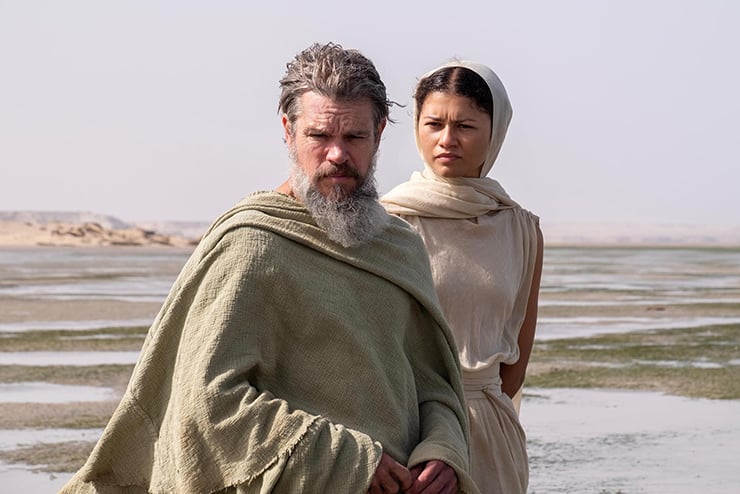
Perhaps to strengthen the point, Athena is played poutingly by Zendaya Coleman, a biracial actress whose appearance recalls the late political scientist Martin Bernal’s thoroughly debunked 1987 thesis—presented in a controversial work titled Black Athena—that the ancient Greeks were really of African origin. Odysseus’s crew and other actors have Asian, Latin American, and Middle Eastern heritage, but seemingly as a matter of course, the work’s foundational victim—Helen of Troy—is played by black actress Lupita Nyong’o.
In Odysseus’s absence, his wife Penelope—played with grating stridency by Anne Hathaway—must manage the household of suitors who abuse ancient hospitality laws to court her. They intend to win Ithaca’s throne on the assumption that Odysseus has died and that she is now an available widow. Led by Robert Pattinson’s hissable Antinous, they are an obnoxious lot. But does confounding them really require an anti-patriarchal screed against a system that denies a woman’s right to rule even as she claims to do all the work of a king?
Between Athena and Penelope, Odysseus must also grapple with Circe, a Homeric siren whom Nolan reimagined as a liberal white woman. The men she has transformed into pigs, she explains with passive-aggressive rage, are not victims of diabolical witchcraft but merely realizing their true nature. According to woke Hollywood, the true nature of men is that of bottom-feeding predators who must be neutralized—and, one might presume, eliminated—for the good of the world. Samantha Morton’s plain features and disheveled appearance make Circe look like she just returned from the nearest protest march. Odysseus instructs his rescued men to leave her be, essentially mandating that they validate her “truth.” Even in ancient Greece, apparently, we must “believe all women.”
This appears to include when they claim to be men. Nolan lifted a small episode from Virgil’s Aeneid—the Latin epic that chronicles Rome’s founding by Trojan survivors—to present the audience with Elliot Page, a biological woman who started her life and career as Ellen Page, in the small role of Sinon. She/he announces the “gift” of the Trojan Horse that will carry Odysseus and his warriors into the walled city. One can only wonder what the real infiltration is.
Alas, even a woke film is not immune from ideological error. At least one scene was filmed in Western Sahara, a United Nations-designated “non-self-governing territory” that Morocco has occupied since 1975. Angry commentary published in The Guardian on the eve of the film’s release accused Nolan and his production team of cultural insensitivity because the indigenous population claims to be oppressed and facing “erasure” while also suffering severe limitations on self-expression, including in filmmaking. A boycott of the film has been demanded. Apparently, the human struggle can only continue.
(This film review will appear in the September 2026 issue of Chronicles: A Magazine of American Renewal.)
Leave a Reply