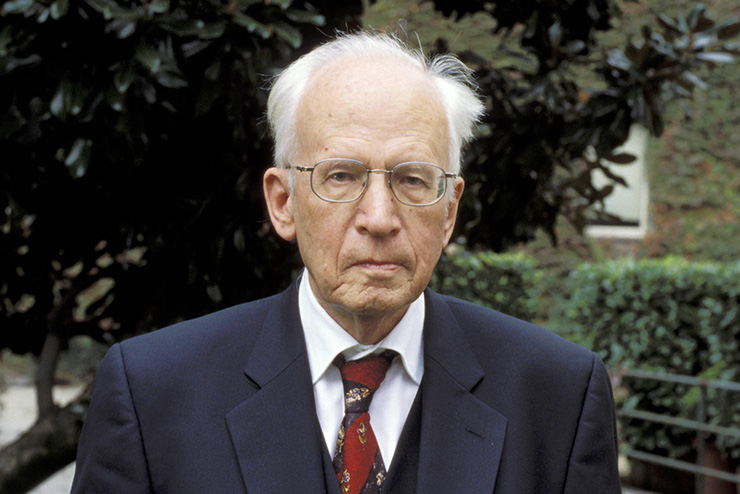
I first saw Ernst Nolte in 1993, in the packed lecture hall of the Freie Universität Berlin. The course he taught, “Reflections on 19th-Century History,” was guaranteed to create controversy, coming from a man whose comparative studies of National Socialism and Bolshevism had gotten him accused of revisionism, heresy, and worse. There wasn’t a seat left. Graduate students, professors, the curious, the hostile, the admiring—they all squeezed in, as if something risky were about to unfold. In a way, it did.
Nolte had just published Streitpunkte (Points of Contention), a defiant collection of essays extending the arguments he first advanced in his 1986 essay “Vergangenheit, die nicht vergehen will” (“The Past That Will Not Pass”), in which he suggested that Nazi crimes, including the Holocaust, might be historically contextualized in part as a reaction to Bolshevik violence, and seen in the context of a European civil war. The article sparked a furor during which other historians accused Nolte of engaging in a form of relativization or justification. The event was memorialized as the Historikerstreit (“Historians’ Dispute”) and earned Nolte lasting notoriety in German intellectual life.
Although Streitpunkte avoided the front-page controversy of the 1980s, it still sparked unease: the leading German magazine Der Spiegel noted Nolte’s continued attempt to relativize the Holocaust, reviving echoes of the 1986 uproar. Surprisingly, the large newspapers Die Zeit and Frankfurter Allgemeine Zeitung remained silent, offering no full reviews, and Süddeutsche Zeitung merely mentioned it in passing.
Yet here we all were—packed into that crowded lecture hall, leaning forward to listen to a historian most of the press had quietly dismissed. The tension felt real because the questions Nolte posed still carried shockwaves. He did not look like a rebel. No trench coat, no glint in the eye, no Churchillian defiance. Nolte spoke in a quiet, high-pitched voice, more suited to seminars than sermons. His sentences were dense, measured, sometimes exquisitely constructed, and delivered with the sort of academic precision that would have lulled half a less-charged audience to sleep. But there was something riveting beneath the formality: not charisma exactly, but gravity. He was a man at odds with his age—and unshaken by the fact.
Why were so many drawn to him? The answer may lie in the paradox that defines Nolte’s legacy. He was not a provocateur by temperament, yet the questions he raised touched nerves no one else dared expose. He suggested that the epoch we had been taught to view in black and white—Nazism as absolute evil, Bolshevism as merely flawed—was in fact far murkier. That fascism might be more than brute evil: a response, a reaction, a symptom. That history might not deliver easy verdicts.
In that moment, Nolte became something rare in academic life: a figure at once vilified and magnetic. To some, he was a whitewasher of genocide. To others, he was a scholar with the courage to ask unpermitted questions. To me, he was simply a man trying to follow a line of reasoning to its logical conclusion. That this conclusion often led straight into taboo territory may have been precisely the attraction.
Ernst Nolte first emerged as a historian of note in 1963 with Der Faschismus in seiner Epoche (Fascism in Its Epoch, or Three Faces of Fascism, in its 1965 English translation). Rather than isolating National Socialism as a purely German aberration, he placed it within a continental pattern of ideological movements, juxtaposing it with Italian fascism of Mussolini and the French Action Française. He emphasized how these movements conceptualized themselves, focusing on their ideas and metaphors rather than looking solely at their actions.
Nolte’s proficiency in languages was central to this approach. Fluent in German, Italian, English, and French—and, later, proficient in Russian and Arabic—he delved into primary sources in their original languages, enriching his comparative analysis with authenticity and depth. This facility helped Three Faces of Fascism earn acclaim for its philosophical rigor and its innovative theory of a “generic fascism.”
He described his method as “phenomenological,” aligning himself with the tradition of 19th-century historians like Jacob Burckhardt and Wilhelm Dilthey, for whom the self-understanding of historical actors and cultures is integral to the very phenomenon being examined. Rather than giving primacy to battlefield events, statistics, or mass movements, Nolte “bracketed” these factors and focused on how politicians like Mussolini, Maurras, and Hitler conceptualized their causes, as shown in their repeated motifs, metaphors, and self-explanations. He treated their own words and philosophical leanings as analytical windows into the ideological essence of fascism.
Born in 1923 in Witten, three fingers on Nolte’s left hand were congenitally shortened into stubs—an oddity that exempted him from military service and profoundly shaped his life’s trajectory. While his peers were drafted in 1941, he remained in Freiburg, immersing himself in philosophy, philology, and Greek—most notably attending seminars with philosopher Martin Heidegger, whose thought left an indelible mark on his later work.
After the war, he taught high school Greek and Latin while researching fascism in his spare time. He led seminars on Nietzsche and Marx, and one of his students, Annedore Mortier, became his wife and intellectual partner. She once told me with unmistakable pride and devotion that she had read every line he ever wrote.
In Three Faces of Fascism, his only book translated into English, Nolte argued that fascism functioned as an intellectual anti-movement, mobilizing against Communism and Marxist utopianism;Bourgeois social values; and modernity’s twin impulses. These impulses he described as “practical transcendence”—the loosening of traditional ties through material and social progress; and “theoretical transcendence”—the drive toward universal, all-encompassing ideological systems.
Some on the left saw Nolte’s early comparison of fascist movements as inspired by Marxist thought, in that it housed diverse authoritarian currents under a single analytical roof. But his schema broke with both Marxist and totalitarian narratives by restoring ideas and language to the center of his analysis, emphasizing fascism as an ideological reaction to modernity’s deep currents. The historian Klaus Epstein, with some reservations, praised this shift as an act of “comparative audacity” and “philosophical depth,” marking it as a rare intellectual achievement.
Nolte’s ideological journey began amidst the chaos of Germany’s 1968 student movement while he was a professor at the University of Marburg. Once seen as left-leaning, he soon found himself facing jeers and boycotts from radicals. He retorted that, in their zeal to topple authority, the radicals had merely installed another form of it.
By 1974, following the substantial acclaim accorded to Der Faschismus in seiner Epoche, Nolte released his next major work, Deutschland und der Kalte Krieg (Germany and the Cold War), which introduced the European System, an analytical system that translated the medieval Empire-versus-Papacy struggles to modern ideological poles: a left oriented to abstraction and universalism versus a right grounded in tradition and plurality. Within this system, Nolte described the United States as the first modern “State of the Left” and identified the Confederacy as an early form of the extreme right.
As a young Southerner studying under Nolte, I found his framing both uncanny and exhilarating. Here was a German Heideggerian professor placing my Louisiana roots at the heart of Europe’s ideological narrative.
When Nolte’s 1986 essay detonated a cultural landmine, he argued there was a causal “nexus” between Bolshevik terror and the Nazi Holocaust. He did not deny the singular nature of the Holocaust; rather, he defended its uniqueness while demanding historical context. Still, it’s unsurprising that his framing—suggesting Nazi atrocities arose in reaction to Soviet brutality—prompted sharp criticism. The critical theorist Jürgen Habermas accused him of engaging in “apologetic nationalism,” while historian Eberhard Jäckel denounced his work as a “game of confusion,” arguing that posing “hypotheses dressed as questions” threatened both moral clarity and academic rigor.
What exploded in 1986 wasn’t a genocide-denial campaign—it was a fierce debate over moral and methodological boundaries. Should historians provide context for horrors? Nolte insisted that the answer should be “yes.” His critics feared that by doing so, he risked blurring the event’s moral lesson, even though he affirmed the Holocaust’s singular horror.
When he returned to the topic six years later with Streitpunkte, he did not come to apologize, but to reassert his argument by posing unsettling scholarly questions to Germany’s historical consensus, namely: Was the Holocaust truly sui generis, or might it fit a broader historical pattern? Does Germany’s “culture of remembrance” regarding World War II result in unearned moral certainties? Are historical comparisons dangerous—or essential?
These were not mere questions, but intellectual grenades. Critics—particularly in Jewish scholarship—objected to perceived relativization of the Holocaust. Yet Nolte defended both the right and the necessity to rigorously question historical narratives, even as he found himself increasingly isolated for doing so.
In his late writings—especially 2011’s Späte Reflexionen (Late Reflections)—Nolte’s probing intensity sometimes tipped into contentious overreach. His critics noted he occasionally understated the “indescribable cruelty” of the Nazis and allowed analogy and speculation to overshadow finer historical scrutiny. It is clear his later work was in tension with the nuanced methodology of his earlier career.
Today, Nolte’s name has been nearly erased from the university canon. In Germany’s sanitized “culture of remembrance,” where moral consensus often masquerades as truth, Nolte’s call for independent thought is regarded as subversion. He remained the perpetual outlier, insisting that scholarship must grapple directly with difficult questions, not merely echo sanctioned narratives. And so, as the consensus drones on, remember Nolte. In a world allergic to doubt, his legacy still dares to whisper: “Think freely.”
Leave a Reply