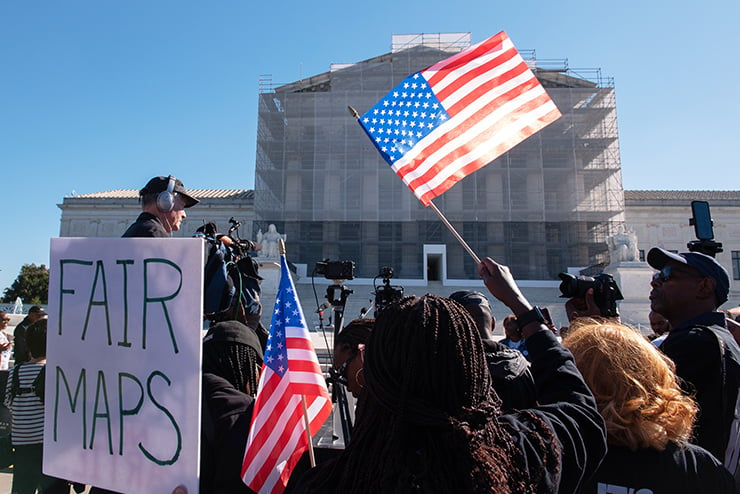
In Louisiana v. Callais, the Supreme Court appeared to sever one of the civil rights regime’s largest appendages: race-conscious congressional redistricting. Fighting the civil rights regime, however, is a lot like fighting the hydra: so long as it lives on, it will only regenerate and return with twice as much force and indignation.
In question was Louisiana’s new, predominantly black congressional district, which twisted and splayed across the state like the remains of a crushed spider. The victorious six justices easily demonstrated that this redistricting went against Section Two of the Voting Rights Act, which clearly bans voting discrimination based on race.
This would seem to be a slam dunk, except for other parts of the act, especially Section Five, which seems to confirm what many who supported the VRA and the dissenting leftist justices in Louisiana v. Callais believed. Because blacks had once been kept from voting, they were long “underrepresented” in how elections turned out, and this caused their influence in national politics to be unfairly minimized. In Section Five, an attempt is made to right this situation by creating a preclearance process for areas that had supposedly discriminated against black voters. Any attempt to change congressional districts in areas that carried such a sinister history, according to Section Five, had to be cleared with the Department of Justice.
Areas that were thought to engage in voting discrimination were not limited to the former Confederate states but were also thought to exist in New York, Alaska, and other northern and western states, wherever the black vote was considered disproportionately low. This preclearance process ended in 2013, following a Supreme Court decision in which most justices concluded that the states subject to preclearance were no longer suppressing the black vote. Despite this decision, racial gerrymandering took place in Louisiana in 2022, when a court judged that blacks were “underrepresented” in the state’s congressional districting. Blacks constituted one-third of the state’s voters, but there was only one majority-black congressional district out of six total. This allegedly constituted a form of black underrepresentation.
The VRA helped bring about a critical change in American electoral history. It tripled the black vote nationally. This vote has gone overwhelmingly to the Democrats, and often to the Democratic Party’s left fringe. It is doubtful that leftist judges and politicians would be so eager to increase black representation if that vote went to Republicans and did nothing to advance leftist politicians and agendas. There is no question that the Democratic Party gains enormously each time it succeeds in increasing the weight of the black vote.
Moreover, the idea that the black voting bloc is about to go Republican because a few percentage points more of it occasionally votes Republican is pure Fox News wishcasting. The black vote in Virginia went 93 percent for the white Democrat, Abigail Spanberger, even though her Republican Evangelical opponent, Winsome Earle-Sears, was black. In Texas, the wacko Democratic senatorial candidate James Talarico, who believes men menstruate and can give birth and that God is nonbinary, is leading with black voters against any Republican opponent by over 50 percent, according to polls conducted by Texas Public Opinion Research. Republicans obviously have benefited from the black vote far less than the Democrats. The court’s decision in Louisiana v. Callais cannot be adequately considered unless we weigh its electoral and ideological implications.
We might also examine the conclusion of conservative journalists that justices Thomas and Alito were restoring “the original meaning” of the VRA. Whether that happened depends on what one emphasizes in the act, for example, whether one is looking at Section Two or Section Five. Unquestionably, the VRA was not passed in a historic vacuum. I observed the pressures at work while the landmark civil rights legislation was being framed. Such laws cannot be properly examined without considering the shaping circumstances in which they were enacted.
Racial unrest became widespread in the ’60s. Between 1964 and 1969, the country was convulsed by violent black (and some white) segregationist demonstrations, which came after the mostly peaceful black protests of the 1950s and early 1960s. The anti-discrimination laws of the time were not exactly drafted in a leisurely, contemplative manner, and they almost invariably led beyond their apparent intent into more radical measures, particularly at the state and local levels.
The creation of what Christopher Caldwell characterizes as the “civil rights regime,” and which I have described in my books as “the managerial therapeutic state,” occurred during that period of turbulence in this country. Caldwell describes the civil rights acts as our imposed “unwritten constitution,” which, despite its intent, has led to continued civil unrest.
This unrest, however, was not, for the most part, caused by the national parties. In the 1960s, a less radical Democratic Party than the present one generally had no interest in fanning civil strife. Indeed, a large part of that party’s constituency was then made up of white Southern Protestants and blue-collar ethnic Catholics. Republicans, as the self-proclaimed “party of Lincoln,” did sponsor civil rights legislation, but like the Democrats, their leadership hoped to quiet things down by pacifying the activists. Moreover, the civil rights demonstrations were often intertwined with anti-war protests, and legislators might have hoped that by passing anti-discrimination laws, they could appease leftist protesters.
Unfortunately, an expanding public administration fixated on social control, leftist organizations that later became authorized NGOs, and a very engaged judiciary had different interests. All of them fought to expand the “civil rights regime,” and the looseness, contradictions, and ad hoc nature of antidiscrimination laws opened the door to further encroachments on our privacy and freedom. Title Two in the 1964 Civil Rights Act, which bans discrimination in places of public accommodation, has been a godsend for the social engineering left. Its now extended applications have rendered men’s clubs (as opposed to women’s, gay, and transgendered clubs) all but impossible. The idea that social and commercial activities should be kept out of the purview of social engineering judges and administrators seems, by now, a distant memory, and for the mainstream media, one that should be expunged.
Later developments in the war against discrimination can be easily traced to earlier phases. Without the legislative milestones of the mid-1960s, the construction and expansion of our social-engineering administration would not have developed as fully as it did. This is not to overlook the justified grievances of segregated blacks or of those blacks who were kept dishonestly from casting votes. But most revolutions are precipitated by moral outrage over injustice. The problem is that these transformations typically lead to even worse abuse, often by tyrannical governments.
The imposed “solutions” often avoid the smaller steps that might have been taken to address the initial grievances. In 1951, blacks could look back on their greatest economic progress over the preceding 30 years. This solid economic improvement was more than American blacks had achieved in any prior 30-year period, as Thomas Sowell copiously documents in Race and Economics and other books. Black families were still largely intact, and violent crime in their communities was far lower than it became after the civil rights revolution.
I am not attributing the disastrous social disintegration and political radicalization of the American black community to the “civil rights regime” entirely. But I doubt these problems are unrelated. The civil rights revolution generated unrealistic expectations about black progress through protests and government actions, and the Democratic Party, which put itself in the vanguard of black activism, keeps the subject of systemic white racism on the front burner in maintaining its almost absolute control of the expanded black vote.
I contend that most of the black population (as opposed to black political elites) gained little under the new regime, while the rest of us were placed in an ideological straitjacket. Moreover, it would have been hard to keep the anti-discrimination industry, both within and outside of public administration, from metastasizing after the mid-1960s. For all these reasons, I must confess my bemusement when I hear Jason Riley at The Wall Street Journal or Laura Ingraham at Fox News tell us about all the monumental racial progress that has taken place since the racist 1960s. Apparently, our present, rampant antiwhite racism is not a part of the story of race relations in America.
In May, I listened to a black female member of the Dallas County Republican Committee explain that screaming, furious black politicians in the Tennessee legislature, some of whom appeared in bogus African adornments protesting the added Republican-leaning district that the Republican majority just passed, “do not represent American blacks.” Since those black Democratic protesters whom I was hearing were elected by overwhelmingly black districts and were loudly denouncing Republicans as racists, I’ve no idea how they didn’t have the support of black constituents. And although I believe the GOP did very little to earn this black animosity, clearly, racial polarization does exist in this country.
If we no longer have state-enforced segregation against blacks or the denial of black voting rights, black leaders in the U.S. attack whites and even black Republicans as racists nonstop. These attacks are far worse than anything I have ever heard, even during the height of state-enforced segregation. The charges and incitement continue, no matter how many set-asides for blacks and other minorities the government provides. It would be refreshing to hear our conservative media recognize the gravity of this hate, 60 years after the passage of congressional civil rights laws.
At least we might hope that our conservative establishment would stop pretending that the passage of the civil rights legislation of the 1960s brought the races together. Judging by the rhetoric of black leaders, black relations with white America have gone south in the last 60 years. But it seems necessary for the conservative establishment to cast a blind eye on this fact and engage in gushing happy talk, because it helps relieve their anxiety about being viewed as “racists.” This anxiety stems from accepting the left’s narrative about the U.S. being a racist country, and then hoping in vain that conservatives somehow won absolution for that original sin through the passage of landmark civil rights legislation. In this narrative, in the 1960s we were rendered whole for the first time in our history as a nation, and American blacks are expressing their appreciation by voting increasingly for Republicans. Even if this isn’t happening, the will to believe may be stronger than obvious reality.
Less would have been more when it came to the necessary anti-discrimination measures in the 1960s. Black citizens who were denied the vote should have been allowed to bring their grievances to a nonpartisan panel of judges; the federal government should have withheld funding from public institutions that denied American citizens of any race access. But it was no business of the government to push further in reconstructing human interactions. If hotels and restaurants in some regions of the country kept black customers out, then blacks and others were free to protest these practices. Personally, I find nothing admirable and much to deplore about racial segregation, but the war against all forms of “exclusion” has greatly reduced our freedom in this country and throughout the Anglosphere and Western Europe.
Most importantly, the message that should have accompanied the modest civil rights reform package should have been the one that New York Senator (and then paradigmatic liberal) Patrick Moynihan offered, to the indignation of the civil rights establishment. Further progress for American blacks would have to come from their own collective efforts. Moynihan urged the government to practice “benevolent neglect” rather than throw more public funds at black uplift programs and efforts to make up for past discrimination.
I wouldn’t underestimate the American influence on the spread of government-led crusades against “prejudice” and “racism” in other countries. In my books Multiculturalism and the Politics of Guilt and The European Left in the New Millennium, I try to show to what extent American moral crusades prefigured comparable ones in other Western countries. It is no coincidence that many of those laws and agencies, designed by European administrations and highlighted by the European media to address “prejudice,” closely resembled those the American government had conjured up in the 1960s. Europeans typically moved into this “anti-discriminatory” frenzy about 10 years after we did. Europeans and Canadians now engage in this activity more fully than we do, partly because they have no First Amendment to protect the targets of their therapeutic states.
I’m delighted that Alito, Thomas, and several other justices decided against racial gerrymandering because it violates Section Two of the Voting Rights Act. They were perfectly correct to do so. But this does not exclude the possibility of interpreting the VRA as intended mainly to increase black electoral representation, something it accomplished in prodigious fashion after 1965. One can’t blame the left or the court members associated with it for advancing an alternative interpretation of the VRA. This construction does not seem entirely unfounded and is fully consistent with where the civil rights revolution led. That event did not end when and where our conservative establishment would like us to believe it did. Nor did it usher in an age of racial harmony, any more than feminist anti-discrimination directives enhanced domestic tranquility. We are living through an incremental revolution promoted mainly by the media, public administration, and educational institutions, and this spectacle goes on and on.
—Paul Gottfried
Leave a Reply