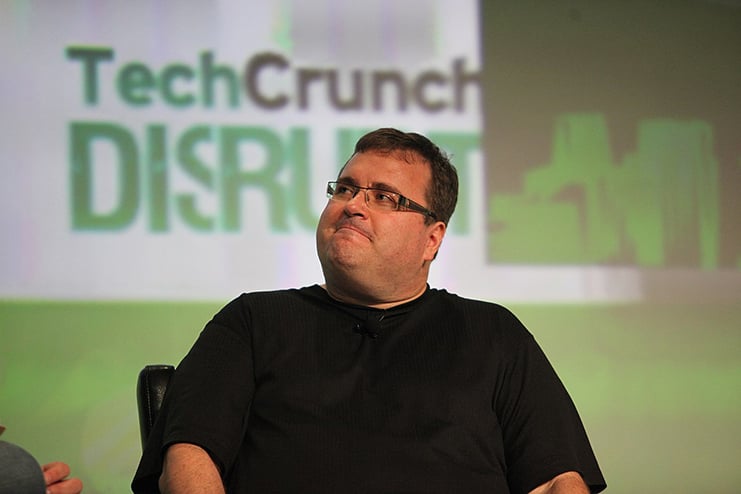
LinkedIn founder and far-left billionaire Reid Hoffman is in the news again. From Reuters:
The U.S. Justice Department has opened an investigation into a group tied to billionaire Reid Hoffman over its partial funding of writer E. Jean Carroll’s lawsuits against President Donald Trump, a person familiar with the matter said on Thursday. The investigation, being run out of the U.S. Attorney’s Office in Chicago, is focused on potential money laundering and obstruction associated with the group, American Future Republic, according to the source, who spoke on the condition of anonymity to discuss an ongoing investigation.
It appears that Hoffman was funding Carroll’s ridiculous sexual abuse and defamation lawsuits against President Trump. Hoffmann took to X to respond:
Trump was found liable for sexually assaulting E Jean Carroll, defaming her, and now he’s going after her again.
Trump cannot be allowed to use the full weight and power of the US Government to come after women who speak up, or anyone who supports them in doing so.
Because of my own involvement in the 2018 confirmation fight over Supreme Court Justice Brett Kavanaugh, I am all too familiar with how Hoffman and his operation work. So I responded to Hoffman on X:
You paid for Christine Blasey Ford’s private plane to DC because she was “afraid to fly.” She had no fear of flying. She was delaying because extortion witness tampering and threats were not working on me. I’d say get bent but you’d probably like it.
Indeed, in 2018, Reid Hoffman paid for Christine Blasey Ford to come and testify before Congress. Ford needed Hoffman’s private jet, it was said, because she was “afraid to fly.” This was a lie. Ford was claiming this phobia because the deep state cabal that set up her hit on Kavanaugh had run into a snag. That snag was me.
One of the most frustrating things about writing about this episode in my life is that for the last several years, so many people—not just left-wingers, but even conservative journalists who should know better—think I bring this up out of some personal obsession and that every time Kavanaugh is mentioned, I have to make it “all about me.” They don’t get that this has been a long journalistic project revealing the ties between the anti-democratic forces behind Russiagate, election rigging, state censorship, and the Blasey Ford hit. They are all the same people. Once you have been in the crosshairs, it’s impossible not to recognize the patterns.
When, in 2018, Blasey Ford accused Kavanaugh of sexually assaulting her in 1982 and further claimed I was in the room when it happened, it wasn’t just some craziness from our youth in the 1980s. It was, as Kavanaugh said, a “well-orchestrated political hit.” Reid Hoffman funded E. Jean Carroll. He also put Blasey Ford on his private jet. These things don’t just happen by chance.
The left’s servants in the media know this, which is why a recent profile of me that was set to run in Washingtonian magazine was spiked at the last minute. For over six years, a successful writer named Cathy Alter pestered me to let her do a profile on me. I resisted, not only because I was tired of reliving the events of 2018, but because I knew what was coming. I would spend a lot of time revealing to Alter the nature of the hit on us, naming names and insisting that she talk to people like Monica McLean—Ford’s childhood friend who will no longer speak to her—and McLean’s attorney, deep state operative David Laufman. I would get invested again, and it would all come to nothing.
That’s precisely what happened. Alter recorded an interview that lasted over an hour and extended beyond 28,000 words. Then, at the last minute, the story was spiked. Alter then refused to let a more politically neutral outlet like Quillette consider the piece for publication when that offer was extended and now refuses to even release the recording and transcript of our interview.
Washingtonian magazine and Reid Hoffman are both deeply tied to the deep state. In 2018, Congress created the Cybersecurity and Infrastructure Security Agency (CISA). The agency was sold to the public by the Department of Homeland Security as one that would protect things like pipelines and electrical grids, but CISA soon claimed its job was also to monitor all communications passing over computer networks.
A month after CISA was created, a cybersecurity firm called “New Knowledge” issued an explosive report to the Senate alleging Kremlin penetration of American politics via social media platforms.
Ostensibly created to prevent the spread of disinformation, New Knowledge was soon exposed in The New York Times as having run its own information operation using the very tactics it decried in its Senate report. The operation was called Project Birmingham, and it was designed to swing the 2017 Alabama Senate race between Republican Roy Moore and Democrat Doug Jones. According to New Knowledge’s own internal report: “We orchestrated an elaborate ‘false flag’ operation that planted the idea that the Moore campaign was amplified on social media by a Russian botnet.”
In his book The Information State, Jacob Siegel describes it this way: “With funding from LinkedIn founder and heavyweight Democratic donor Reid Hoffman, New Knowledge created fake Facebook accounts posing as conservative voters in Alabama, which it tried to link to the Kremlin.”
While New Knowledge was operating and the FBI was setting up its task force within Twitter, a government-backed project called Hamilton 68 inundated Twitter with a propaganda campaign. Technically a “dashboard” exposing networks of Russian influence on social media, Hamilton 68 was launched as an initiative of another recently formed group, the Alliance for Securing Democracy, which itself is a subsidiary of the U.S. government–funded German Marshall Fund. Hamilton 68 claimed to have a secret list of 600 Twitter accounts linked to the Russian government.
Siegel sums up the new reality well:
Groups like the Anti-Defamation League, counterterrorism veterans, trust and safety officials, countering violent extremism experts, social scientists, political operatives, FBI agents, millennial journalists, and CIA officers all rubbed shoulders on the counter-disinformation party bus housed inside the social media companies. This information war was more than just a policy mandate; it was a sociological phenomenon with its own professional mores and cultural impetus.
The aim was “not to appeal to public opinion, but to control it.”
On June 27, 2018, Justice Anthony Kennedy announced his retirement from the Supreme Court. The next month, President Trump nominated Kavanaugh to replace Kennedy. This caused panic on the left, particularly in leftist enclaves like Palo Alto, California, where Christine Blasey Ford, a professor who liked using hallucinogenic drugs, lived.
“I started panicking,” Ford told Ruth Marcus, a reporter for the Washington Post. In her book Supreme Ambition, Marcus describes Ford’s reaction this way:
In Santa Cruz, she and her friends spend hours in the ocean: Ford paddles her surfboard, looking out for sharks, while her friends swim. One morning, a few days after Kennedy’s retirement, the sharks were in the water, which meant no swimming. Ford pulled aside a beach friend, Jim Gensheimer, a photojournalist, and poured out her story. She felt a responsibility—”civic duty” was the phrase Ford used repeatedly—to alert someone.
One of those people who received an alert was Facebook COO, Sheryl Sandberg. As Marcus wrote in her book:
In one example of the way the information circulated through the Palo Alto community, a friend of Ford’s knew someone who knew the sister of Sheryl Sandberg. The Facebook executive, without being given Ford’s name or the specifics of her allegations, suggested that she hire a lawyer, preferably one without partisan ties, and offered up a few names.
Sandberg, former COO of Meta, famously turned down an offer from Reid Hoffman to become the CEO of LinkedIn in 2007. Instead of joining Hoffman, she chose to join Facebook as Chief Operating Officer in 2008. Facebook, as Jacob Siegel notes, was easily “brought to heel” by Obama and got involved in censorship and propaganda.
Hoffman and Sandberg were intent on ruining Brett Kavanaugh and me. There were others. One of them was Ford’s friend, the photographer Jim Gensheimer. Gensheimer had started his career as an intern at National Geographic in the early 1980s. It was at this time that my own father, Joe Judge, was a senior editor at that magazine. I was at the magazine’s offices all the time, and there is no doubt Gensheimer knew who I was.
In Supreme Ambition, Marcus explains how Ford and Gensheimer tried to figure out what to do:
She and Gensheimer imagined alternative scenarios, remote possibilities that seemed fanciful even at the time and that look even more so in retrospect. One possibility: Ford would call Mark Judge, remind Judge of what had happened, tell him to call Kavanaugh, and advise him to spare his family the ordeal. She dug up Judge’s Twitter handle but wasn’t sure how to go about contacting him.
At the time, I was a journalist with a wide social media presence. Ford didn’t know how to contact me? That’s a joke. They never contacted me because they were planning an opposition research hit, and those don’t work if the target knows it’s coming.
Gensheimer holds a B.A. degree from Western Kentucky University and an M.A. degree in photography from Ohio University, where he attended as a Knight Fellow in 1999. In 2017, the Knight Foundation and Reid Hoffman (along with the Omidyar Network and the Hewlett Foundation) jointly launched the Ethics and Governance of Artificial Intelligence Fund. The $27 million philanthropic initiative was established to research AI for the public interest, emphasizing ethics, accountability, and the societal impacts of algorithms.
In other words, this is more of the same people telling us what we can read, say, and think.
Instead of criticizing me, instead of saying I’m always talking about Kavanaugh and making it all about myself, conservatives, and any honest journalists who are left, should be asking Reid Hoffman and Sheryl Sandberg about their connections to Christine Blasey Ford. They should also be demanding that Cathy Alter release the audio and transcript of our interview.
Leave a Reply