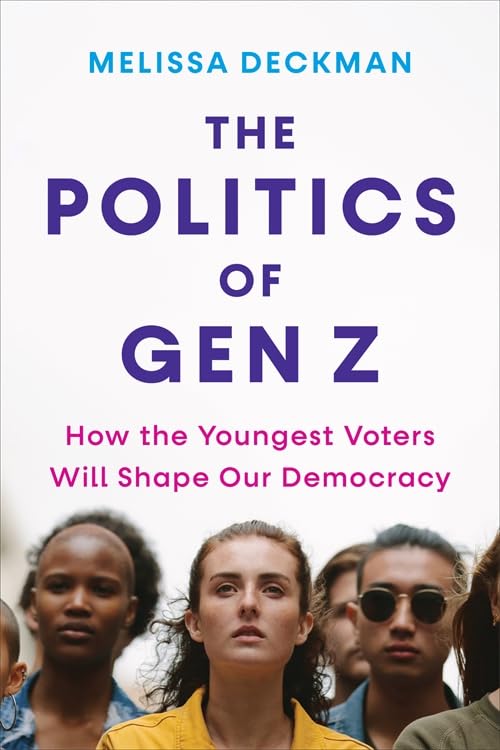
The Politics of Gen Z: How the Youngest Voters Will Shape Our Democracy
by Melissa Deckman
Penguin Random House
320 pp., $26.00
Traditionally, the young are not interested in politics. Though the media constantly encourages the youth to participate in politics, we should all be happy that typically they are more interested in bad pop music and worse Hollywood movies than in voting or political activism. When they do get involved, their political ideas reliably tilt heavily toward the vapid and the idealistic, and too often toward the revolutionary.
Political scientist Melissa Deckman, who previously authored a book on the role of women in the Tea Party movement, has now written a book full of helpful insight into just how politically out there today’s youth are. Of course, it was not Deckman’s intention to criticize Generation Z’s role in politics. In fact, she comes off as sympathetic to the most extreme among the so-called Zoomer generation’s political activists. But her evidence speaks for itself.
The book is based on 87 interviews with Gen Z activists, 15 focus groups with college students, and two national surveys of young people in this generation. Deckman gives us lots of activists’ accounts of how they see the world and what they want to do to that world. Marvel at this small sample of wisdom from these youngsters, to whom the media are encouraging us to give the keys to the culture:
“Our planet is dying…If we don’t have a planet in ten years, there’s no point in fighting for all these other issues.”
“The most oppressed group in the world is black women. We are dealing with so many systemic issues.” (This, according to a black woman with a degree from the prestigious Howard University.)
“I’ve been in school shooter drills since third grade. I don’t know how to explain the feeling of being ten and locked in the bathroom for an hour.” (Apparently, this child has never listened to Robert Klein hilariously discuss the nuclear holocaust drills all of us who experienced childhood during the Cold War
somehow survived.)
“To meaningfully engage with politics… requires you to talk about… what you’re passionate about… straight, cis gender [Gen Z] men are not socialized to express what makes them feel scared or hopeful. A lot of these emotions that are so central to activism are emotions that men are told not to express or… feel.” (Politics, in other words, is about emotions.)
“Young women have more to worry about than young men… they don’t have to think about the things we have to think about, and it’s just always been like that.” (Never mind that young men do all of the fighting in wars and work the most dangerous jobs.)
“There’s just a lot of things that I have to think about as a young woman of color in this country… you know, when I want to have children, whether or not I’m going to leave the hospital alive… I have to think about police officers.”
Simply allowing young people to talk about their politics is itself a good vaccine against the dangerous, viral temptation of taking them at all seriously as political actors. It should be said that it is not unusual in history to find young people full of themselves, as these are. The fault for the political damage they do lies less with them and more with the adults who constantly cheerlead for them and give them influence they otherwise would not have.
Deckman also provides insightful biographical narratives for her subjects. The book begins with a young woman whose career as a “political organizer” began in the fourth grade, when she demanded of her gym teacher that boys and girls should play together rather than in separate groups. Two years later, in sixth grade, this girl saw Al Gore’s An Inconvenient Truth and organized an environmental pep rally, handing out reusable straws. Another girl, a fifth grader from a Bangladeshi immigrant family, went on a family visit and saw “waterways overrun with algae.” This inspired her to organize a school walkout over climate change. Both girls have subsequently made political activism the core component of their identities.
Deckman uses the term “political revolution” to describe the impact of Gen Z. It is women and LGBTQ-identified individuals (and women are more likely to be so identified) who are leading this revolution. Among American Zoomers, there is what Deckman calls a reverse gender gap. Gen Z women are more politically active than the men—a first in human history. And these activists are decidedly leftist. Gen Z women are twice as likely to be Democrats as Republicans, and there are nine LGBTQ Zoomer Dems for every one Republican.
Gen Z women are more politically active than the men—a first in human history. And these activists are decidedly leftist.
A look at the generation’s demographics gives insights into the causes of their politics. More than four in 10 Gen Z women, and six in 10 LGBTQ-identified Zoomers, are religiously unaffiliated. Women have been more likely to earn a college degree than men for half a century now, and the educational gap between women and men is growing. Education correlates neatly with political participation, as it exposes children to leftist propaganda on every imaginable issue, from elementary school onward, and increases the intensity considerably in college.
The more time an individual spends in educational institutions in the contemporary United States is thus an accurate measure of the likelihood and degree of her capture by the reigning elite ideology. These young women are being endlessly indoctrinated through politicized curricula, partisan extracurricular clubs and activities, Get Out the Vote campaigns, outreach by leftist candidates to university populations, and other such mechanisms. And it is worth noting that these Gen Z women are heavily influenced in those educational institutions by the steady increase in female (and generally feminist) faculty, counselors, and extracurricular activity staff.
Generation Z begins in the mid-1990s, so the oldest members of that cohort were college juniors and seniors when Trump won in 2016. The defeat of Hillary Clinton was a collective trauma from which they have not recovered. Gen Z women and LGBTQ individuals were especially psychically damaged by the event. They tend to be much more negative about the state of America than men in their generation, and such negative feelings help drive their higher levels of political participation.
Gen Z activists are addicted to social media and the online world, and much of the tenor of their unrealistic catastrophism comes from the weird extremities that dominate those media worlds. Deckman notes that they use these media not only to do their organizational work, but to inform themselves about reality. Their sources of education on political matters are Instagram, TikTok, and Snapchat material produced by other young know-nothings who are just like them. They create online communities that become bubbles impenetrable to any facts about the world contrary to the emotional druthers of their members.
Gen Z evinces great concern about the politics of “reproductive rights” (that is, keeping abortion as unregulated as possible) and “menstrual justice” (meaning “no tampon tax” and “free period products in schools, shelters, and prisons”). There is considerable interest here in reinvigorating the moribund Equal Rights Amendment to the Constitution, which would enshrine sexual politics within U.S. law. Sex and gender issues are treated “intersectionally” by Zoomers, which means they mix race and other indices of oppression into the brew.
Sexual radicalism goes deep in Gen Z. Twenty-five percent of Zoomers identify as LGBTQ of some variety, which is much higher than in the general population. When one looks at this topic generationally, an intriguing pattern emerges. The LGBTQ-identifying rate goes downward in big drops as one goes generationally backwards: 15 percent in Millennials, 7 percent in Gen X, and only 4 percent in Boomers.
Gen Z is also considerably more anti-capitalist than others, yet the author’s survey data reveals that they seem confused about economics. Though many dislike capitalism, they are broadly affirmative of free enterprise, small business, and entrepreneurs. Their confusion extends to other areas. Gen Z women and LGBTQ-identified individuals claim endlessly that they are socially and culturally oppressed, yet the data show that they are much less likely than straight men to agree that “the political climate prevents me from saying things I believe.”
I have many stories of personal interactions with these Gen Z activists in my professional life as a college professor. They are, as a rule, one of the most difficult populations to teach because they come into class on day one convinced they already know more than you know about everything important.
Once, while my class was discussing the empirical evidence on inequality in American society and the exaggerated claims that are frequently made about it, one of these activists bluntly announced: “I need the world to be different.”
I asked her, ever so gently, what she would do if the world refused to cooperate with her “need,” as it so frequently does to so many. Maybe she would have to recognize that the wiser approach to life recognizes that adjusting to the world in its present state is something one has to get used to?
She was indignant and showed no willingness even to consider the possibility. I tried a few other methods for communicating the message, all fruitless.
That was a decade ago.
I sometimes wonder how this young woman’s life has gone since then. I pray, for her good and for the good of our entire society, that she has learned the lesson I tried so diligently and caringly to teach her.
Leave a Reply