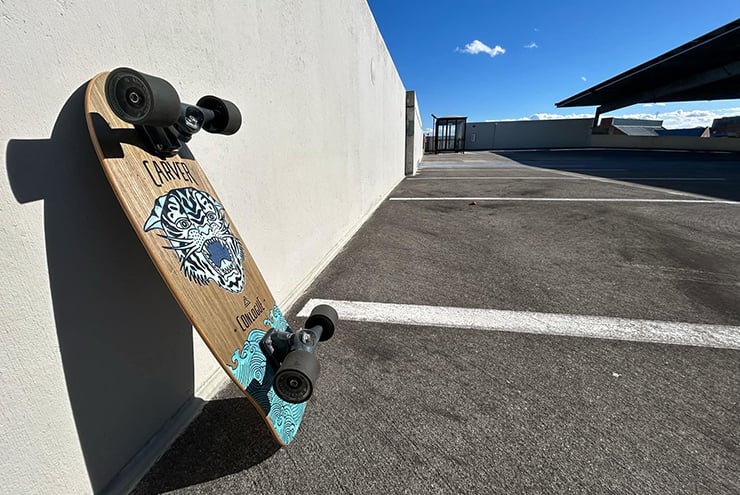
The social justice warriors are coming for skateboarding. In his new book, The Skateboard Life: Movers, Shakers, Makers & Rulebreakers: The Quintessential Story of Skateboard Culture, Neftalie Williams misguidedly tries to claim this great American sport and the culture surrounding it for the woke. Williams is a sociologist and assistant professor at San Diego State University (SDSU) and directs the new SDSU Center for Skateboarding, Action Sports, and Social Change. Think of Fidel Castro doing an ollie, and you’ve got the idea.
Professor Williams’s theories can be summed up in his academic paper (yes, there’s an academic paper on this) “Skateboarders of Color and the (Co-)Emergence of the DIY Ethos in Skateboarding,” which was published earlier this year. The argument:
Skateboarding has long been connected to a ‘Do It Yourself’ (DIY) ethos. Conventionally, this connection has been understood through skateboarding’s relationship to punk rock, hip-hop and other forms outsider art like graffiti and zines. Frequently, general discussions of DIY ignore issues of race and therefore the [sic] code DIY as unmarked whiteness. This has been the case with skateboarding as well. In this article we explore what the DIY ethos in skateboarding might mean to skaters of color. By attending particularly to an Indigenous and Black experience of skate culture, we argue that BIPOC skaters can bring their own local sense of DIY embedded in their own BIPOC communities to skateboarding. In this sense we argue that skateboarding is not just a venue for a local expression of DIY, but we should think of this BIPOC co-creating skateboarding’s DIY ethos. We argue the need to reconsider the role that racial identity plays in skateboarding DIY and DIY cultures in general encouraging scholars to consider the distinction between those that opt into a DIY ethos coming from positions of privellege [sic], and those that come to it by necessity because of societal marginalization.
Skateboarders should resist this nonsense. In his 2012 book, The Most Fun Thing: Dispatches from a Skateboard Life, skateboarder Kyle Beachy makes the point that skateboarding is one of the few things in life that doesn’t lie to you.
When you’re standing at the tip of a hill and ready to shred, you will either be able to do it or you won’t. Nobody is going to soften the landing for you. Beachy writes,
How many of us, I wonder, are lucky enough or doomed enough to have a force such as this in our lives? A practice, I mean, a pursuit or activity, an entity, in reality any kind of thing whatsoever, that we fear or respect enough that we will not lie to it, or try to trick it, or approach it with anything less than total candor? A thing that we know can see through us.
Yes, skateboarding has always tracked as something rebellious and even countercultural—but it’s also radically welcoming to outsiders. Even so, skateboarding maintains certain rules that, when taken seriously, have strong application to other parts of life. In his recent book Land On Both Feet: A Skateboarder’s 11 Lessons That Transition to Life, skateboarder Brett Sorem offers this primary lesson: Don’t “mongo.” Mongo is a term for skaters who use their dominant foot to push rather than leaving it on the board and pushing with their non-dominant foot.
Why the emphasis on what seems like a small thing? Because it’s not such a small thing after all. It’s about developing focus. “The point is, small, purposeful actions create momentum,” Sorem writes.
Without them, the whole routine can unravel. Skip making the bed once, and it’s no big deal. Skip it a few more times, and soon you’ve abandoned the habit altogether. It’s a slippery slope, but the reverse is also true: small, intentional actions can snowball into greater discipline, confidence, and purpose. So, why is pushing with your back foot so important? Because it’s about leading with your front—being balanced, grounded, and focused. When you push Mongo, you’re steering with your back foot, leaving you off-balance, unfocused, and looking down. It’s chaotic. But when you push correctly, you’re stable. You look ahead, out at the world, not down at your feet. And once it’s second nature, you don’t think about it anymore—you just go.
A recent article at the skateboarder website The Cut celebrated “the trans skaters of America’s growing queer skate scene.” One of them, New York model Efron Danzig, goes to skate parks but is “usually confronted with a bunch of guys.” “I’m put off by the skate community,” Danzig said, “but I’ll skate for as long as my body allows because I wake up and want to skate every day.”
I’ve been a skater going back to the 1970s, and while a lot of riders I know are easygoing about “queer” and “transgender” skaters in their midst, it is true that most also have serious problems with biological boys taking away awards from girls in the sport. Female skateboarder Taylor Silverman, the host of the YouTube show “Boonies HQ,” has competed against biological males three times in skateboarding contests. In two of the three competitions, she came in second, losing to a biological male who claimed to be a “trans woman.”
Silverman has criticized this practice as unfair and bemoaned the prize money that she, as a legitimate female skater in a sport dominated mostly by men, did not receive. Recently, Silverman blasted the National Organization of Women, which claimed that reluctance to let transgender women compete in sports is “white supremacy.” Silverman told Fox News:
I take the National Organization for Women claiming that fairness in women’s sports is white supremacy about as seriously as I take them claiming men can be women. They are blinded by this lie and desperate to scare people into silence. Men in women’s sports impacts all women, including minorities that the National Organization for Women seemingly want to erase to push their ridiculous narrative.
One of the great joys of going out for a ride on my skateboard is meeting so many people I wouldn’t otherwise meet. Some are neighbors cheering me on from their driveways, some are kids gawking at the old white dude on his Carver Bauhaus, and a few are security guards barking at me to move it along. But most are regular dudes of every color, shape, age, and religion—men who flag me down or approach to talk board specs or recount their own skating history, from the glorious monster hills conquered to the wipeout they survived. Many also like to comment that I ride “goofy foot,” meaning right foot forward.
Like the best American inventions, from jazz to dance to movies, skateboarding has to ability to cut across all barriers. Last year, I was interviewed by Fox News for a documentary. They wanted some footage of me riding, and when I went out to meet the crew, one of the first people I met was a young Asian cameraman. We may have been separated by age, ethnicity, and a lot of other things, but when I rode up to him, none of that mattered. “Wow,” he said before even shaking my hand, “You’re a goofy foot.” Don’t let the academics ruin this brotherhood. And don’t mongo.
Leave a Reply