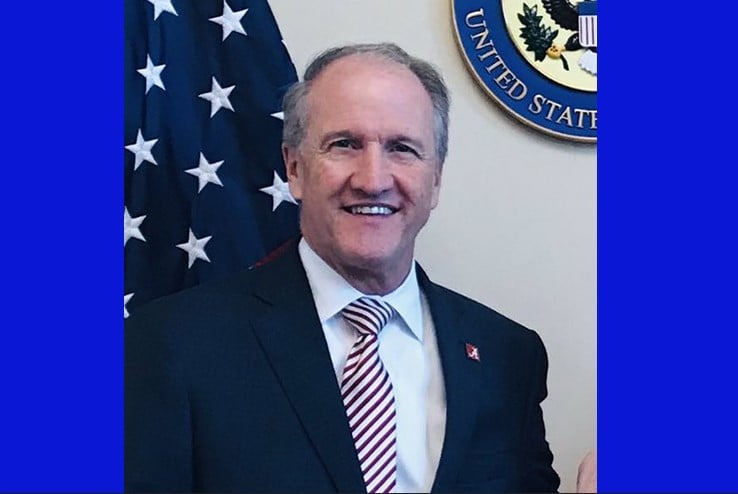
“The University of Florida should not hire Stuart Bell as president,” warned the Manhattan Institute’s director for higher education policy, John Sailer, in a recent op-ed for the Manhattan Institute’s City Journal. Sailer, who last month broke the story of Bell’s unanimous nomination by UF’s presidential search committee as its only choice for the top job, has done yeoman’s work documenting the extensive, and indeed, “award-winning” DEI regime Bell created in his previous job as president of the University of Alabama.
Alarm bells went off across the conservative commentariat, with criticism of Bell’s nomination appearing in these pages, the Wall Street Journal, the Daily Signal, the National Association of Scholars’ newsletter, and in statements from Florida Senator Rick Scott, Florida Congressman Greg Steube, Education Secretary Linda McMahon, Assistant Attorney General for Civil Rights Harmeet Dhillon, and Florida state university system Board of Governors chairman Alan Levine, among others.
In a live interview with Salem News Channel host Josh Hammer—Bell’s only interview since he received the search committee’s nomination—the would-be UF president came off as shifty, evasive, and unconvincing. Hammer quickly posted that he was “less than fully impressed” by Bell, casting doubt on Florida Governor Ron DeSantis’s quick and possibly knee-jerk endorsement of him in an X post as a “great candidate” who enjoys “my full support.”
Even the Chronicle of Higher Education, a left-leaning industry publication for college and university professionals, acknowledged Bell’s overpoweringly strong commitment to DEI by describing his policies at Alabama—many of which would now likely be illegal under federal law and both Florida and Alabama state laws—as “robust and successful.”
If there is any remaining doubt that Bell is a horrible choice to lead UF, faculty and alumni at the University of Alabama are beginning to speak out about their experiences with his leadership. In a statement to 1819, a state news source named for the year in which Alabama entered the Union, a current faculty member who asked to remain anonymous recalled participating in two search committees to hire professors during Bell’s tenure that began with “a presentation by DEI personnel” including “calls for special consideration of candidates that were racial or sexual behavior minorities.”
“We were to submit three candidates without any ranking,” the faculty member said. “If none of the three submitted candidates were among those ‘special’ folks, we were to submit a fourth named candidate that was, along with recommendations on what it would take to move the person up to the top three.”
A department chairman currently serving in Alabama’s College of Arts and Sciences told 1819 that after Bell arrived as president in 2015, DEI “efforts were redoubled” and characterized by “hypocrisy.” “One notable policy” identified by the source included a scheme to hire “diversity postdocs,” short-term professional residencies open to recent Ph.D. recipients. “The university would advertise diversity postdoc positions … that were open only to applicants from ‘underrepresented groups,’” the source alleged, claiming that “those hired for these positions would be automatically transitioned onto tenure-track positions,” full-time and potentially career-long professorships normally filled after a lengthy open application process and job search. As the source elaborated, “this was, in effect, a way to discriminate on the basis of race and sex in hiring tenure-track faculty, without ‘officially’ discriminating in hiring.”
Bell’s choices for senior administrative personnel have also raised concern. Dr. Earl Tilford, an Alabama undergraduate alumnus and retired history professor who authored a book on the university’s 1960s civil rights struggle, told 1819 that Bell “initiated the influx of DEI programs and allowed radical faculty to prosper.” Tilford further claimed that Bell “inserted three solidly woke faculty into leadership positions in the provost office before leaving office,” and thereby made it difficult “to diminish the grasp DEI already had on faculty, curriculum, and programs” after Alabama’s state legislature outlawed DEI programs in 2024.
As identified in a recent Daily Signal article by Scott Yenor, a Claremont Institute fellow and former DeSantis higher education advisor, these hires included G. Christine Taylor, whom Bell engaged in 2017 to serve as Alabama’s inaugural vice president and vice provost for diversity, equity, and inclusion. Taylor, who still holds her job under what appears to be a cosmetically altered title to conform to current law, focused her academic research prior to taking on a series of DEI posts on the intersection of race and gender in media leadership, examining what Yenor calls “the supposed barriers that black women face entering the broadcast industry.”
Alongside Taylor serves Tiffany Sippial, hired by Bell in 2023 to lead Alabama’s honors college and promoted in 2025 to associate provost for undergraduate education. Her magnum opus, a book titled Prostitution, Modernity, and the Making of the Cuban Republic, 1840-1920, claims to demonstrate what its publisher’s website calls “the central role the debate about prostitution played in defining republican ideals in independent Cuba.” Move over, José Martí.
Alabama Graduate School dean Susan Carvalho, whose undoubtedly page-turning book about Latin American fiction explores how “female protagonists challenge the spatial barriers erected by capitalist hegemony,” was appointed by Bell in 2016 and stayed in the job for 10 years, only stepping down to retire this summer. Chapman Greer, a business professor who presided over Alabama’s faculty senate in 2021, suggested in a meeting reported in the campus newspaper in that year that she was privy to “indirect” efforts that she could not publicly discuss aimed at “making sure that the integrity of what we teach does not get touched if at all possible” by anti-DEI state legislation. Two years later, she was promoted to associate provost of general education.
Such appointments will matter at UF, where the provost’s office and at least four deanships are currently held by interim appointees. Among many other powers and responsibilities, the university’s new president will presumably appoint permanent administrators in those roles. Given his track record, let us hope Stuart Bell is not the man who will do it.
Leave a Reply