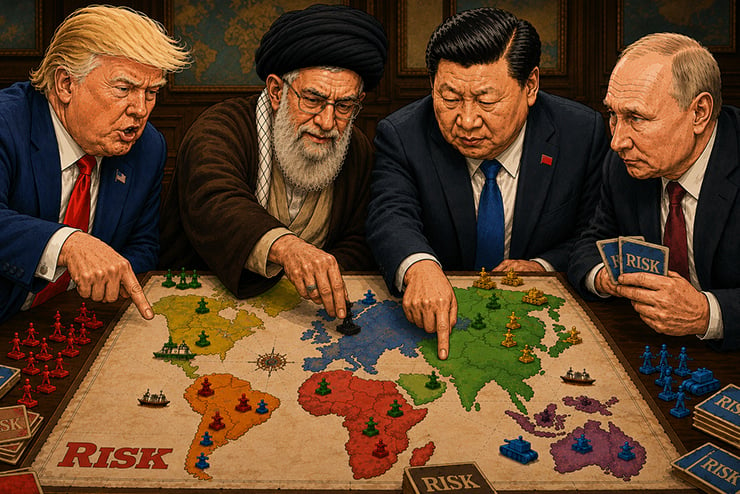
No matter how the Iran crisis ends, its course has demonstrated that global choke points remain critically important in the distribution of political, economic, and military power. Confidence in the strengthening of multilateral bodies and the stabilization of strategic balances through arms control has given way to a reality dominated by geopolitical competition and the return of power politics.
The international system has evolved toward an increasingly competitive order, in which the U.S., the Russian Federation, and China act as power poles that redefine spheres of influence and strategic priorities according to their own logic of global projection. This fact belies the notion that globalization has shrunk the world to the point where interconnectedness trumps geopolitical calculus.
The vulnerability of key choke points to attacks by even relatively marginal groups became obvious in late 2023, when the Iranian-backed Houthis in Yemen began expressing their support for the Palestinians in Gaza by attacking Israeli-connected or allied ships in the Bab-el-Mandeb (“Gate of Tears”) strait. Despite being limited to cheap drones, simple missiles, and lightly armed speedboats, they have nevertheless forced some of the world’s largest shipping and oil companies to suspend transit through the Red Sea and direct their ships around the Cape of Good Hope. This detour adds more than 3,000 miles and up to 10 days to journeys, increasing shipping costs from the Far East to Europe by at least 15 percent.
On June 15, just hours after President Trump announced the Memorandum of Understanding with Iran, the Houthis said that they would continue banning Israeli-linked ships from the Red Sea, adding to concerns about global shipping and energy flows. Over the years, Saudi Arabia has diverted more than 70 percent of its normal daily crude exports to the Red Sea port of Yanbu. That has been a boon for the global energy market, helping keep oil prices mostly at or below $100 per barrel.
Any sustained Houthi disruption of Red Sea shipping, including potential attacks on ports, would escalate the problem. Even if negotiations with Iran proceed smoothly, it will take months for maritime traffic in the Strait of Hormuz to return to normal. Ship-tracking data from MarineTraffic.com on June 17 indicated that there were more than 250 tankers and over 330 cargo ships inside the Persian Gulf. The total number of vessels trapped there may be even higher, as some ships are not broadcasting their location.
Any renewed blockade of the Bab-el-Mandeb would extend the timeline for normalizing traffic and potentially give the Iranians an additional negotiating tool. Paradoxically, Iran may not be too adversely affected. Decades of embargoes that have curtailed Tehran’s energy exports have also produced one of the most diversified and industrialized economies in the region. During this conflict, Iran continued to export oil, especially to China by land, at nearly 3 million barrels per day. Some $2 billion in monthly revenue comes from the export of metals, chemicals, and food. It is a system that, despite its glaring dysfunctions, has capitalized on the modernizing drive of the 1960s and 1970s.
Severing Iran’s links with its regional proxies—Houthis in Yemen, Hezbollah in Lebanon, and Hamas in the Gaza Strip—has been, from the beginning of the current crisis, a firm Israeli demand. It has been less emphatically echoed in Washington, and the Iranians believe they can bypass it. They are particularly loath to give up on the Houthis, who hold such a provenly strong geostrategic card in the Red Sea, and whose overall military position is far stronger than that of either Hamas or Hezbollah.
Further north, there’s the Turkish Straits, which divide the Black Sea—the site of the ongoing Russian-Ukrainian conflict—from the turbulent Eastern Mediterranean. Turkey and Israel were once regional partners but are now open rivals. Turkey sees itself as a natural regional hegemon, likely to profit both from Iran’s military weakening due to bombing and from Israel’s difficulty in maintaining decent relations with its Arab neighbors. Somewhat paradoxically, Israel’s success in fighting Hamas in Gaza and Hezbollah in Lebanon has made it a less palatable partner—an opportunity that Turkey will likely exploit.
There is also the natural gas rivalry between Turkey and Israel, centered on a clash of claims and infrastructure projects. Turkey actively opposes Israeli-Greek-Cypriot energy alliances, such as the EastMed Gas Pipeline and the Great Sea (powergrid) Interconnector. Turkey has also been challenging the maritime borders of its regional neighbors in a bid to position itself as the primary transit hub for gas to Europe. Seeking to reduce its reliance on Russian energy, Turkey wants to expand existing pipeline networks to become an indispensable energy corridor to Europe. To counter Israeli partnerships with Greece and Cyprus, Turkey signed a major maritime deal with Libya, and it is considering connecting to the Arab Gas Pipeline through Syria.
The Europeans are concerned. As Lucio Caracciolo, editor-in-chief of the respected Italian geopolitical journal Limes, wrote on June 15, for the first time since the end of World War II, America can no longer ensure free navigation in the straits connecting the Mediterranean to the World Ocean. The West no longer has guaranteed free access not only to Hormuz, but also to the Red Sea key choke points of the Suez and Bab al-Mandab:
The only certainty, for now: Gibraltar. Therefore, we can only rest easy on the Atlantic side. Storm clouds are looming over the area that connects us to the Indo-Pacific, that is, to deep Asia, led by China and Japan. For Washington, those straits are very important but not existential. We, on the other hand, are risking everything here.
This is bad news, Caracciolo notes, for the export-oriented economies of Europe that live on imported raw materials, especially energy that they don’t have at home. The Middle East lacks a hegemon, but the ancient power of Turkey is preparing for that role, and eyeing its old strategic holdings, such as the Strait of Sicily, a chokepoint of particular interest to Italy, including for the flow of migrants. On the North African shore, we find the remnants of Libya contested by various militias and interest groups. Turkey is in Tripolitania but capable of influencing the entire Maghreb region, reaching as far as Egypt and beyond.
Here, the variable Israel comes into play. Since Oct. 7, 2023, the Jewish state has been engaged in a war of attrition against itself, the price of revenge it seeks at all costs and against all logic due to the trauma inflicted on it by Hamas. Jerusalem cannot win and cannot lose the plethora of open conflicts on seven fronts. Sooner or later, it could also end up clashing with Turkey in Cyprus, the key to the Eastern Mediterranean and the Levant.
The potential for a Turkish-Israeli clash still remains limited, but it is certainly greater than it had been before Oct. 7, 2023. The most sensitive and potentially explosive choke point, however, is on the other side of the world: the Strait of Malacca, which connects the Indian and Pacific Oceans and lies between Malaysia, Singapore, and Indonesia. It carries up to one-third of global trade and the vast majority of energy imports for East Asian economic giants, China and Japan, as well as the lesser regional players (South Korea, Taiwan, Vietnam, and the Philippines). Reopening the Strait of Hormuz is a pressing issue for all of them, save China, which has enormous crude stockpiles, estimated at 1.4 million barrels, and therefore did not mind America expanding its firepower over Iran. But any threat to the Strait of Malacca, and to the South China Sea east of it, would be a clear casus belli for Beijing.
As it happens, India’s military is expanding across the Andaman Sea into Southeast Asia with the construction of a multi-billion-dollar base on remote Great Nicobar Island, New Delhi’s furthest reach toward the Strait of Malacca. “When completed, the Great Nicobar project would allow India to monitor activities near the Strait of Malacca, a key trade corridor for China,” the Hong Kong-based South China Morning Post reported on May 22.
“Amid the Hormuz blockade, supporters of the Indian project—including some of the country’s military veterans—argue it would enable New Delhi to ‘control’ or disrupt Chinese supply chains and worsen its ‘Malacca dilemma,’” the Morning Post said. Other sources have also described the project as a sign that New Delhi is trying to turn Great Nicobar into an economic and military outpost near China’s most important maritime lifeline, giving India greater ability to monitor the Strait of Malacca and project influence across the region.
The geostrategic conflict between China and India is a classic competition for regional hegemony in Asia. They have had territorial disputes on the Himalayan frontier for decades, but their rivalry is increasingly manifested in the Indian Ocean. India considers the subcontinent and surrounding waters its natural sphere of influence. China responded with the “String of Pearls” strategy—a network of commercial ports and naval bases in Southeast Asia, Pakistan, and Sri Lanka—to protect its energy routes and limit India’s maritime expansion.
If India is increasingly seen as a maritime rival that could shape China’s access to the Indian Ocean and Southeast Asian sea lanes, that would fit in with Secretary of State Marco Rubio’s view that the United States’ top priority must be countering China. Rubio was in India on May 26 for the Quad foreign ministers’ meeting, which brings together the U.S., Japan, Australia, and India. The visit focused on repairing relations between New Delhi and Washington after a year of escalating tensions.
Those tensions began in April 2025, when President Trump imposed universal tariffs, which included India. They escalated in May when additional tariffs were announced, and peaked in August of last year, when Washington imposed punitive tariffs on New Delhi for its Russian oil purchases—thus raising the U.S. general tariff rate on India to 50 percent. In addition, Trump repeatedly praised India’s perennial rival, Pakistan, and its chief of staff as Washington and Islamabad worked together to forge a way out of the war with Iran.
Cultivating good relations with India is essential if the U.S. wishes to act as an offshore balancer in the Indo-Pacific. Controlling the one choke point in America’s backyard, the Panama Canal, and protecting the Western Hemisphere remain this country’s top strategic interests. Arbitrating conflicting claims of faraway nations over the Indian Ocean and the South China Sea is not one of them. ◆
Leave a Reply